Van's Air Force

The definitive Van's Aircraft support community! Buying, building or flying an RV? Join our exclusive family of mentors and enthusiasts!

How to dimple near the bend in skins?

jonbo

Member
Patron
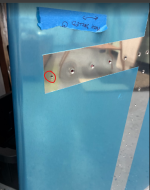
I've tried a few things and I just can't seem to get a good dimple in the forward part of skins with a bend.
- I tried the cleveland close quarters dimple dies (uisng a blind rivet puller) but those made a very shallow dimple that the rivet head sits proud of.
- I tried bending the skin back with assistance (while using a c-frame) but it's really hard to keep the skin flat and also kinda scary to hammer in that way.
- I also tried the tight fit dimpling fixture drilled onto the table but that didn't seem to make the dimple any sharper.
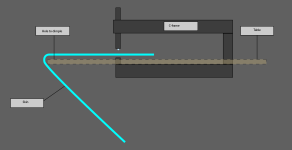
1758488998373.png
I'd be happy to hear any tips.
 
It's quite surprising how much you can flex without damage. I dimpled every skin hole with a C-frame. Find something to hold the skin open just enough to hit the ram. Get it all lined up perfect. Hold the skin down against the bottom (male) die firmly and whack it. Personally, I don't use the spring. I want the skin to sit on the male die and the ram with female die holding it. Everything together before the big whack.
 
Not sure if you turned the skin over, I know it's simple, but in the heat of the moment sometimes we don't think of that. I know I didn't a few times with both c frame and drdt, trying to hold open a skin and get access to whack or move the handle, when I should have just turned the skin over.
 
I learned fast that doing this with the C frame yielded poor results. I used a dimple die on the last one or two holes near the bend and solved the problem. Perhaps you an try again with your dimple dies.

Carl
 
Not sure if you turned the skin over, I know it's simple, but in the heat of the moment sometimes we don't think of that. I know I didn't a few times with both c frame and drdt, trying to hold open a skin and get access to whack or move the handle, when I should have just turned the skin over.
Good advice! I did try this but my table is too long for the skin to fit outside out and still reach the hole near the bend in the skin.

1758503704522.png

I have another area where I have a table setup but even with the table edge flush with the C-frame, the bottom of the skin contacts the bottom of the c-frame and I can't get the hole line up with the dies.
 
Like the drawing, should be able to open up the bottom a bit more to fit if you can move the cframe. My cframe I don’t mount, so I can move it to an edge, and I’ll admit the drdt has a nose that does a good job fitting vs the c frame, which is why I have both.
 
I learned fast that doing this with the C frame yielded poor results. I used a dimple die on the last one or two holes near the bend and solved the problem. Perhaps you an try again with your dimple dies.

Carl
Thanks for this reply.
I went back and watched a video from cleveland tools and I was using the close quarters dies wrong. I needed to use the copper mandril first and then follow up with the steel mandril. It's still really underdimpled, but they do make a point of saying this is not as good as you'll get with a c-frame.
 
What I mean is, just put your cframe on top of the table and move it to the edge.
Gotcha. The front edge of the c-frame feet pushes the skin away just enough to prevent getting to the forward bend hole. I think, like you said, this part is a better fit for the Drdt-2 with its angled stand. I've been avoiding getting one just because of the expense and not wanting to build another table but it might be worth it.
 
Thanks for this reply.
I went back and watched a video from cleveland tools and I was using the close quarters dies wrong. I needed to use the copper mandril first and then follow up with the steel mandril. It's still really underdimpled, but they do make a point of saying this is not as good as you'll get with a c-frame.
If you have a problem with under dimpled holes with a "pop rivet" dimpler, the problem is with the dimple dies. I've built a few airplanes (several award winners) and use nothing BUT pop rivet dimpler for the entire airplane. I get my dies from Bob Avery.
 
If you will use a steel "stem" from a suitability sized pull rivet, which have a "frangible" stem that is designed to break at the point of setting the rivet to its design specifications, you will get closer to a squeezer dimple set. This is a much higher level than either the copper mandrel or the steel nails that some suppliers recommend. I tried years ago to buy the stems only from Stanley Tool, parent company of the "Pop" rivet brand, and they wouldn't give me the time of day, so ... I harvest my own using "Pop's" own engineering guide to pick the best stem for the job. This is a one and done deal, you lose the stem every time, but you also get maximum and repeatable performance.

YMMV - But this works better than those other things.

HFS
 
I was able to flex the skin and use the c-frame impact dimpler on all my skins. They may not be perfect, but I think they’re still better than a pop rivet dimpler. Get a second person to help you flex the skin open.
 
You might want to consider the CAD1 machine from Clemson Aeronautics.
 
I was able to flex the skin and use the c-frame impact dimpler on all my skins. They may not be perfect, but I think they’re still better than a pop rivet dimpler. Get a second person to help you flex the skin open.
Ditto. Once you do one or two, it becomes apparent that you can, in fact, flex the skin enough to do this without damage. Just be sure to press down on the skin against the die to ensure it's perfectly flat.

It'll work...we've done it on several airplanes with excellent results.
 
Gotcha. The front edge of the c-frame feet pushes the skin away just enough to prevent getting to the forward bend hole. I think, like you said, this part is a better fit for the Drdt-2 with its angled stand. I've been avoiding getting one just because of the expense and not wanting to build another table but it might be worth it.
Jonbo - I recently completed an -8 rudder for my -7. The bent-skin trailing edge was a challenge. I WAS able to do the all the dimples with my C-frame and the skin upside down on my work bench. A helper here would have been welcome, but it worked. For me.

The next challenge will be when you (presumedly) go to back-rivet those same rivets. Here is where I would recommend a helper to hold the skin open in order to get a straight shot with the back-rivet fixture at those far rivets. The skin will want to "bow" away from the back rivet plate and make those end rivets difficult to set. I needed to climb on top of the bench and press down the skin with one hand with the gun in the other. Take your time and it'll work....
 
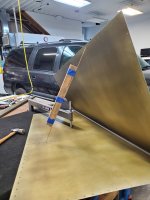
I was able to hold the skin open using a length of TIG welding rod. I bent each end to a “Z”. So the ends kind of hooked into the rivet holes. One end on the horizontal- table side, the other end on the “vertical” side, forming a sort of triangle. The welding rod wasn’t stiff enough to hold everything open, so I taped a piece of 1x2 wood to most of the length of the rod. I adjusted the opening by using different hole combinations.

Barry S.
 

Attachments

  • 20241231_133408.jpg
    20241231_133408.jpg
    3.4 MB · Views: 36
Thanks for this reply.
I went back and watched a video from cleveland tools and I was using the close quarters dies wrong. I needed to use the copper mandril first and then follow up with the steel mandril. It's still really underdimpled, but they do make a point of saying this is not as good as you'll get with a c-frame.
I went to the hardware store with the dies and found finishing nails that fit.

I use those and crank it until the nail snaps which usually gets me a decent dimple. However your mandrils are consumed quite rapidly but at least they're cheap.

Edit: I should add that sometimes you don't destroy the nail and it can be a pain to get off the part because the rivet gun puts teeth marks in the nail which removes the tolerance for the dies to slide off. I've had to sand/dremel those teeth marks off to get the dies off the part.

This might just be because I got lucky and found nails that are an extremely good fit to the dies. The nails are almost better for alignment than the mandrel that came with my die kit.
 
Last edited:
I was able to hold the skin open using a length of TIG welding rod. I bent each end to a “Z”. So the ends kind of hooked into the rivet holes. One end on the horizontal- table side, the other end on the “vertical” side, forming a sort of triangle. The welding rod wasn’t stiff enough to hold everything open, so I taped a piece of 1x2 wood to most of the length of the rod. I adjusted the opening by using different hole combinations.

Barry S.
I am sorry, Your signature says you're building a 14 A
Building RV-14A
Completed Vert.Stab, Rudder, Horizontal Stab.,
Working on the elevator
The skin that you're showing in your picture is for a RV14 A?
Thanks
 
Gotcha. The front edge of the c-frame feet pushes the skin away just enough to prevent getting to the forward bend hole.
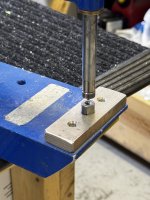
My solution to leading edge dimpling. Gives just enough clearance for that last dimple without the c-channel digging into the other side of the LE bend
Also I support the skins on either side with temporary platforms of 3/4” plywood sitting on some 2x4s, perfect height, infinitely adjustable
& no, I don’t do this on that carpeted table!
IMG_2600.jpeg
 
I am sorry, Your signature says you're building a 14 A
Building RV-14A
Completed Vert.Stab, Rudder, Horizontal Stab.,
Working on the elevator
The skin that you're showing in your picture is for a RV14 A?
Thanks
HishamH,

The picture I posted was the skin of the vertical stabilizer for a -14A. I used the same method for the horizontal stabilizer skin.
Barry S.
 
My solution to leading edge dimpling. Gives just enough clearance for that last dimple without the c-channel digging into the other side of the LE bend
Also I support the skins on either side with temporary platforms of 3/4” plywood sitting on some 2x4s, perfect height, infinitely adjustable
& no, I don’t do this on that carpeted table!
View attachment 98068
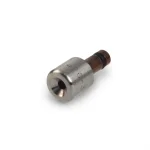
Cleaveland sells a small-diameter female die
1759880244520.webp
 
Back
Top