Van's Air Force

The definitive Van's Aircraft support community! Buying, building or flying an RV? Join our exclusive family of mentors and enthusiasts!

Hot CHT #3 cylinder

Slipaway

Member
Sponsor
I apologize in advance for the length of this post but wanted the readers to know the entire story. I bought an RV9A in August 2025, with a Superior O-320 XP engine and while it had CHT and EGT probes the EI engine monitor was inop. Recently I had installed an MGL engine monitor and now I can see what is going on. The #3 cylinder, on climb out from take off fairly quickly gets into the 430 or higher degree range. Upon leveling off the temperature goes back to a normal range consistent with the other 3 cylinders. The EGT of #3 cylinder does not climb and remains consistent with the other three cylinders. I have ruled out a faulty temperature probe as everybody I have talked to says temperature probes either work or they are wacky and they don't act consistently the same. From everything I see the baffling is in the proper position and a good installation. The cylinder compressions are all in the mid 70's/80 so i think that rules out a leaky valve or one that is not closing properly. When I cruise around for a while and then begin another climb the #3 cylinder CHT goes back up but it takes longer than initial climb out from take off. I normally climb out at 1000 to 1250 FPM and have tried 500 and 700 FPM but it doesn't matter the temperature continues to rise. I am at quite a loss as to how to remedy this situation and was hoping someone on Vans Air Force has had a similar experience or can give me some guidance. While Superior states there cylinders are tested to 500 degrees getting over 430 during an extended climb is not comforting or smart.

+
 
Swap #1 & #3 CHT probes. Fly. See if the problem stays on #3 or moves to #1. If it stays, put the probes back and swap connections. Repeat.
I had a low #1. It turned out to be a bad connection.
 
With a new-to-you plane, it sounds like we don't know if it's been doing this all along or if it's a new issue. Larry's spot on by first confirming that it's an actual temperature issue and not an instrumentation issue. That's quick and easy.

If #3 remains hotter than the others after that check, know that this is not unusual for that back right cylinder due to how the cooling fins are manufactured. You might want to do a quick search to see how this can be helped with either the "washer trick" or by adding a small bypass duct to allow air to flow down the back and underneath. The washer trick is the easiest to do, but the bypass duct is a more efficient solution. Dan Horton has at least one post on this; I used his idea as the basis to install a duct on my rear baffle--it works. This has been discussed frequently on this forum and there's a wealth of information on it. Sometimes the trick is finding the right info, though. If you can't find the right post, let us know and we'll find it for you.
 
Do a search for hot #3 cylinder and buckle down for a lot of reading. This issue and the resolution has been thoroughly documented on this site
 
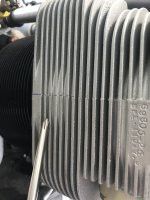
The screwdriver points to the area that is often the problem, and it's just the way the cylinders are made. We can ask why all day long, but that's just the way they are. The casting cuts off cooling air flow to the bottom of the cylinder when a baffle is laying against it, so you need to create a path for air to traverse around the casting block down the back baffle to the lower part of the fins. All of the cylinders are like this, but #3 is affected the most because of how the baffles are made. Do a quick search, as there are plenty of posts on this forum on how to address it.
 

Attachments

  • IMG_5320.jpeg
    IMG_5320.jpeg
    1.5 MB · Views: 43
#2 also but to a lesser degree.

Actually, all of them are cast this way - the fins aren't deep enough on the intake port side of the head, the intake port is larger than the exhaust port in the casting.

This becomes a problem when the baffling limits the airflow through the area of reduced (or no) fin depth.
 
Actually, all of them are cast this way - the fins aren't deep enough on the intake port side of the head, the intake port is larger than the exhaust port in the casting.

This becomes a problem when the baffling limits the airflow through the area of reduced (or no) fin depth.
I stand corrected.
I was referring to the CHT issue on #3. Some also see high CHTs on #2 and add a washer.
 
I apologize in advance for the length of this post but wanted the readers to know the entire story. I bought an RV9A in August 2025, with a Superior O-320 XP engine and while it had CHT and EGT probes the EI engine monitor was inop. Recently I had installed an MGL engine monitor and now I can see what is going on. The #3 cylinder, on climb out from take off fairly quickly gets into the 430 or higher degree range. Upon leveling off the temperature goes back to a normal range consistent with the other 3 cylinders. The EGT of #3 cylinder does not climb and remains consistent with the other three cylinders. I have ruled out a faulty temperature probe as everybody I have talked to says temperature probes either work or they are wacky and they don't act consistently the same. From everything I see the baffling is in the proper position and a good installation. The cylinder compressions are all in the mid 70's/80 so i think that rules out a leaky valve or one that is not closing properly. When I cruise around for a while and then begin another climb the #3 cylinder CHT goes back up but it takes longer than initial climb out from take off. I normally climb out at 1000 to 1250 FPM and have tried 500 and 700 FPM but it doesn't matter the temperature continues to rise. I am at quite a loss as to how to remedy this situation and was hoping someone on Vans Air Force has had a similar experience or can give me some guidance. While Superior states there cylinders are tested to 500 degrees getting over 430 during an extended climb is not comforting or smart.

+
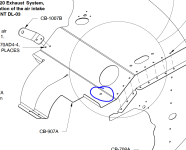
Register with Van's Aircraft, and then download the plans for the O-320 Baffling -- the drawing is OP-44 IIRC. Compare your baffle setup with what's described in OP-44.

Sometimes adding a single washer (AN960-10) between the baffle wall and cylinder head at the location circled in blue is all that's needed.

Screenshot 2026-05-22 at 9.35.55 AM.png
 
As some have mentioned, if you search for you, get ready to go down the rabbit hole.

I had similar issues with my (new to me) RV7. My baffles were bad. Gaps everywhere, and just poorly installed. Fixed them and it brought temps down, but Cyl3 was still always running away on climb. The washer trick, worked for me. Brought it down again, and now its good.
 
This is such a well-known thing and has been for a long time. I keep wondering why Van's hasn't addressed it with a simple mod to their baffle kits. Maybe someone from the company will see this post and respond, or consider making that change.
 
This is such a well-known thing and has been for a long time. I keep wondering why Van's hasn't addressed it with a simple mod to their baffle kits. Maybe someone from the company will see this post and respond, or consider making that change.
IIRC, they call out a washer as a spacer between the cylinder and baffles. Simple and effective.
 
Back
Top