



Hi Brains Trust,
I am still working on my electrical system and thought i had a system nailed, so began FMEA.
The working document can be found here.
This has the detailed wiring diagram of my system, with numbered items corresponding to the FMEA for that item. Also attached are 2 drawings, representing a mass simplification of the same system (for ease of understading hopefully).
My system will use essentially 2 busses:
- On the 'main side' - a main bus (for non-critical loads, and PWR2 inputs), a battery and a 60a Alternator.
- On the 'engine side' - an engine bus, primarily powered by a battery & the Monkworkz MZ30. Backup power from the 'main side' via a diode.
- A X-TIE, which links the 'engine side' power sources to the 'main side' in the case of alternator failure. The X-TIE will remain open (un-linked) for normal flight.
Initially, i evisioned the MZ-30 being run in 'backup mode' - 14.2 volts. The 'engine side' battery would therefore have to be charged 'backwards' via the engine bus feed. The MZ30 would only fire up, if the main alternator failed (as it would be seeing 14.4 volts from the alternator).
Then i started to look at the FMEA! - see first image below.
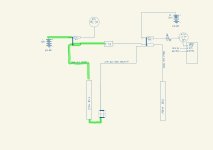
I realised, that in this architecture, if any of the wires, or the 'fat wire tie point' itself - marked in green - were to short to ground (and not burn through and self clear) - this would result in engine stoppage. (Both batteries would have access to the short, and likely shutdown. The main alternator would start to send 60 amps, but would also drop in volts. The MZ30 would see the drop and try to come online, then likely trip. The MAIN ALTN regulator would likely see the short and shutdown the alternator too (i think), and i would have a glider.)
Here is the question:
Is the risk of a short in these areas, low enough, that this is acceptable for flight? I think a short of the actual feed wires is 'very improbable' and this leaves the FMEA risk as 'low'. I would be happy to run with this. However, the 'fat wire tie point' on the firewall, is listed as 'improbable' - if there were to be a short, it would likely be here (on the firewall). This works out as a 'medium' risk. Which is unacceptable.
This is the 'fat wire tie point' i was planning to use.
A solution:
A solution is in the second image below.
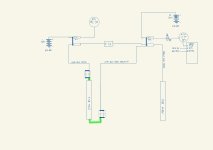
This adds a diode to the normal engine bus feed line from the 'engine side'. This would prevent the 'main side' feeding any of the previously marked shorts, and allow only a very small area where a short could stop the engine (such as a short on the bus itself). If any of the wires on the 'engine side' were to short, the engine bus would remain unaffected (so long as the diode did it's job), and would remain fed by the 'main side'.
This is the diode package i planned to use. This diode has a Vrrm (Repetative Repeat Reverse Voltage) of 45V - there is nothing in the aircraft that can produce anywhere near that, so i assume the diode would not break down and allow a short to be fed backwards?
How to charge the battery?
With this diode in place, this means that unless i opened the X-TIE, the 'engine side' battery would never be charged - there is no path from the MAIN ALTN to the 'engine side' battery, without opening the X-TIE. It also means that the Monkworkz would not see bus voltage (only battery voltage) and would be on all the time (and at 14.2 volts may not charge the battery properly).
How would i best setup the Monkworks in this configuration?
Would it make sense to run the MZ30 in prmary mode (14.6 volts) so that in essence i have 2 seperate electrical systems - with the engine bus being fed by both systems. Is there any concern with the engine bus being fed by the MAIN ALTN at 14.4 volts, and the MZ30 at 14.6 volts (minus any voltage drops along the path). I assume that the MZ30 would carry the load on the engine bus most of the time (since it's slightly higher volts), and the MAIN ALTN would not be putting much effort into the engine bus? Does this have implications of the life of the MZ30?
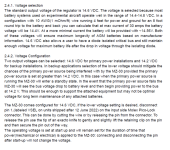
Attached is the text from the MZ30 Manual on Voltage Configuration.
The nice thing about this configuration, is that in the event of smoke in the cockpit, everything on the 'main side' can be shut off, keeping the engine and some basic instruments going.
Thanks in advance for any input! I am getting close to actually ordering bits (i think anyway!).
I am still working on my electrical system and thought i had a system nailed, so began FMEA.
The working document can be found here.
This has the detailed wiring diagram of my system, with numbered items corresponding to the FMEA for that item. Also attached are 2 drawings, representing a mass simplification of the same system (for ease of understading hopefully).
My system will use essentially 2 busses:
- On the 'main side' - a main bus (for non-critical loads, and PWR2 inputs), a battery and a 60a Alternator.
- On the 'engine side' - an engine bus, primarily powered by a battery & the Monkworkz MZ30. Backup power from the 'main side' via a diode.
- A X-TIE, which links the 'engine side' power sources to the 'main side' in the case of alternator failure. The X-TIE will remain open (un-linked) for normal flight.
Initially, i evisioned the MZ-30 being run in 'backup mode' - 14.2 volts. The 'engine side' battery would therefore have to be charged 'backwards' via the engine bus feed. The MZ30 would only fire up, if the main alternator failed (as it would be seeing 14.4 volts from the alternator).
Then i started to look at the FMEA! - see first image below.
I realised, that in this architecture, if any of the wires, or the 'fat wire tie point' itself - marked in green - were to short to ground (and not burn through and self clear) - this would result in engine stoppage. (Both batteries would have access to the short, and likely shutdown. The main alternator would start to send 60 amps, but would also drop in volts. The MZ30 would see the drop and try to come online, then likely trip. The MAIN ALTN regulator would likely see the short and shutdown the alternator too (i think), and i would have a glider.)
Here is the question:
Is the risk of a short in these areas, low enough, that this is acceptable for flight? I think a short of the actual feed wires is 'very improbable' and this leaves the FMEA risk as 'low'. I would be happy to run with this. However, the 'fat wire tie point' on the firewall, is listed as 'improbable' - if there were to be a short, it would likely be here (on the firewall). This works out as a 'medium' risk. Which is unacceptable.
This is the 'fat wire tie point' i was planning to use.
A solution:
A solution is in the second image below.
This adds a diode to the normal engine bus feed line from the 'engine side'. This would prevent the 'main side' feeding any of the previously marked shorts, and allow only a very small area where a short could stop the engine (such as a short on the bus itself). If any of the wires on the 'engine side' were to short, the engine bus would remain unaffected (so long as the diode did it's job), and would remain fed by the 'main side'.
This is the diode package i planned to use. This diode has a Vrrm (Repetative Repeat Reverse Voltage) of 45V - there is nothing in the aircraft that can produce anywhere near that, so i assume the diode would not break down and allow a short to be fed backwards?
How to charge the battery?
With this diode in place, this means that unless i opened the X-TIE, the 'engine side' battery would never be charged - there is no path from the MAIN ALTN to the 'engine side' battery, without opening the X-TIE. It also means that the Monkworkz would not see bus voltage (only battery voltage) and would be on all the time (and at 14.2 volts may not charge the battery properly).
How would i best setup the Monkworks in this configuration?
Would it make sense to run the MZ30 in prmary mode (14.6 volts) so that in essence i have 2 seperate electrical systems - with the engine bus being fed by both systems. Is there any concern with the engine bus being fed by the MAIN ALTN at 14.4 volts, and the MZ30 at 14.6 volts (minus any voltage drops along the path). I assume that the MZ30 would carry the load on the engine bus most of the time (since it's slightly higher volts), and the MAIN ALTN would not be putting much effort into the engine bus? Does this have implications of the life of the MZ30?
Attached is the text from the MZ30 Manual on Voltage Configuration.
The nice thing about this configuration, is that in the event of smoke in the cockpit, everything on the 'main side' can be shut off, keeping the engine and some basic instruments going.
Thanks in advance for any input! I am getting close to actually ordering bits (i think anyway!).
Last edited:

