Van's Air Force

The definitive Van's Aircraft support community! Buying, building or flying an RV? Join our exclusive family of mentors and enthusiasts!

Help wiring AeroLED VXi wing tip lights

bertschb

Where's my engine????
Sponsor
I started another thread recently looking for recommendations for shops that would build custom harnesses for me to accommodate my AeroLED VXi lights. Basically everybody just said do it myself so I'm going to see how far I can get trying it myself - with your help! Here's where I'm at- I'm building an RV-14 and I purchased AeroLED VXi wing tip lights without knowing they are not compatible with the factory harnesses. Yeah, I'm a new builder.

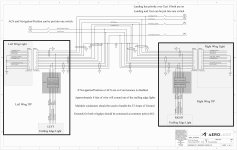
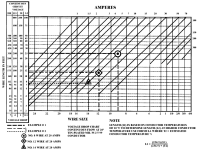
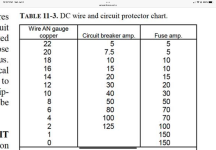
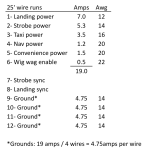
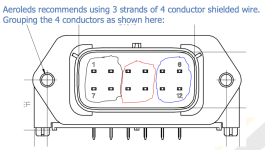
I need 12 wires in total as shown below. I estimated the size of the wires by using a 25' wire run and referencing the load on each wire against the chart in the FAA AC43.13-1B document. The wires will probably be a little shorter than 25' but I want to error on the side of safety. AeroLED recommends using three strands of four conductor shielded wire.

My questions-
1- How should I group the wires within the 3 strands of each conductor? Power wires together (12awg), then grounds (14awg) then the rest (20awg)?
2- Where can I source shielded 4 conductor 12awg and 14awg wire? I came up empty. Links would be greatly appreciated.
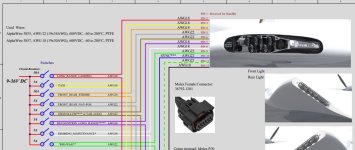
3- Any idea why AeroLED says there are 27 amps of ground (per the comment on their wiring diagram below)? I only came up with 19 amps (see below).
VXi wire specs.png VXi connector.png VXi wiring pinoutsJPG.jpg

AeroLED VXi wiring diagram
VXI wiring diagram JPG.jpg


FAA AC43.13-1B....

wire amperage chart.png
 
Don't forget to add twisted pair back to the FWF for the pitot tube heat or at least to the wing root to get past the magnetometer or better yet stray from plans and use a GMU11.
 
Don't forget to add twisted pair back to the FWF for the pitot tube heat or at least to the wing root to get past the magnetometer or better yet stray from plans and use a GMU11.
I think the Stein fuselage harness has a wire(s) for pitot heat but yes I'm planning to use 12 or 14g twisted pair in the wings to get to the fuselage harness. I haven't got to that yet. I have the GMU22. Factory harness and mount will work with that. I think.

I'm just focused on wing tip lights right now so I can keep my head above water.
 
Wow, 266 watts of lighting !
Is that a lot compared to what was on the 172's that I learned on in the 80's? Serious question because I have no idea. I thought LED's would use less power.
 
Last edited:
I’m not sure that you really need shielded cable for the landing and taxi power. These are not subject to rapid pulsing that would induce RF interference. I would ensure the sync and strobes are shielded, but that might be all. If you want to reduce RFI, then twist the power and ground wires together. You can use a power drill to do that.

I will acknowledge that I have the same VXi lights, but haven’t installed them yet, so haven’t really thought too much about this. I’m still working on my panel and wiring the fuselage now. I figure wings should be pretty straightforward by the time I get to them.

But good on you for looking into this and doing it yourself. I’m sure you will get there.
 
And your wire lengths seem a little long. Keep in mind that each wing is wired separately so you only need about 12’ of wire plus the length needed to get to the breaker for each side. This is probably closer to 18’ or so? So you might be able to get by with smaller gauge wire. Maybe 14 AWG for the landing lights. LEDs also should be able to accept more than 3% voltage drop.
 
And your wire lengths seem a little long.
I thought so too but...
The wings are around 9'. Add maybe 3' to the end to reach the front of the wing tip light. Add 2' at the wing root so there is enough to connect to the fuselage harness. Another 2' to get from the outside of the fuselage to the center tunnel. 4' from the rear tunnel to the floor of the panel under your feet. 2' to get "up" to the instruments. Another 2' for slop. That's 24'. It adds up. I'm also trying to account for needing to "zig and zag" through as yet unknown snap bushing in ribs - i.e. - the runs won't be perfectly straight. I agree that the wires will probably end up being shorter. Maybe 22' when all done? I would prefer to be safe than sorry for planning purposes.

I have no clue how these wires will be terminated at the panel because I was relying on using the Stein fuselage harness (which has wires for lights) which would have just plugged into whatever connector their panel would have had. I'll worry about that later. I just want to get wires from the lights to the panel for now.
 
Your post caused me to go back and look at my own wiring calculations because I ran 14ga on an RV-10, so even longer run than you have. Turns out I didn't calculate it, but used the manufacture's recommendation. Just a data point - Not AeroLED's, but FlyLEDs running the same ~7A recommends 14awg. They even suggest 16awg would be acceptable. No reference to length though. It might have just a slightly higher voltage drop than the 0.5 the table is based on. They'll still be plenty bright!

The suggestion of AeroLEDs to bundle the wires the way they show in the instruction doesn't make any sense to me. It means you'd be running 14ga (or 12ga) for everything just the way their grouping shows.
 
I have no idea what a 172 uses but equivalent LED's have reduced power use by about 50%.

Example, I run two 45w landing lights, wing tip nav strobes @ 20w each (peak) and a pos/strobe taillight @ 14w.
So my total (which is pretty typical) is 144w (but average is less as that's peak strobe current)
75w and 100w landing lights are available, but don't know anyone who uses them.
 
I started another thread recently looking for recommendations for shops that would build custom harnesses for me to accommodate my AeroLED VXi lights. Basically everybody just said do it myself so I'm going to see how far I can get trying it myself - with your help! Here's where I'm at- I'm building an RV-14 and I purchased AeroLED VXi wing tip lights without knowing they are not compatible with the factory harnesses. Yeah, I'm a new builder.

I need 12 wires in total as shown below. I estimated the size of the wires by using a 25' wire run and referencing the load on each wire against the chart in the FAA AC43.13-1B document. The wires will probably be a little shorter than 25' but I want to error on the side of safety. AeroLED recommends using three strands of four conductor shielded wire.

My questions-
1- How should I group the wires within the 3 strands of each conductor? Power wires together (12awg), then grounds (14awg) then the rest (20awg)?
2- Where can I source shielded 4 conductor 12awg and 14awg wire? I came up empty. Links would be greatly appreciated.
3- Any idea why AeroLED says there are 27 amps of ground (per the comment on their wiring diagram below)? I only came up with 19 amps (see below).
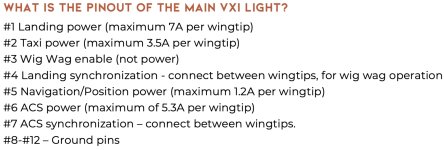
View attachment 76315 View attachment 76316 View attachment 76321

AeroLED VXi wiring diagram
View attachment 76319


FAA AC43.13-1B....

View attachment 76310
Re. Aeroleds calling for shielded 4 core cable that would be 14 AWG, I'm not sure where you would get this, it may be unobtanium outside of NASA. This installation info looks like it comes from the FAQ sheet and there isn't apparently an installation manual on their website. For comparison, the installation manual for the VX lights does not require shielded wires. I suggest calling Aeroleds and asking about possible other practical options for wire and also access to the full installation manual.
 
Re. Aeroleds calling for shielded 4 core cable that would be 14 AWG, I'm not sure where you would get this, it may be unobtanium outside of NASA. This installation info looks like it comes from the FAQ sheet and there isn't apparently an installation manual on their website.
Yeah, I spent a couple hours looking for 4 conductor shielded wire in 12awg or 14awg. No Bueno. AeroLED has a video showing how to assemble the VXi lights. I'll contact them and ask about the wiring.
 
Yeah, I spent a couple hours looking for 4 conductor shielded wire in 12awg or 14awg. No Bueno. AeroLED has a video showing how to assemble the VXi lights. I'll contact them and ask about the wiring.
Could always run two lengths of 14ga shielded, that is readily available.
 
Could always run two lengths of 14ga shielded, that is readily available.
I'm not sure which of the wires needs to be shielded. I couldn't even find 2 core shielded in 12awg or 14awg so I would need to just run individual shielded wires. I find it really strange that AeroLED recommends 4 core shielded wire when it apparently doesn't exist in the size that builders would need. I mean, this is what they do - lights and wiring.
 
From my neighbor -

I think you are somewhat overthinking and over-complicating this installation. My RV-10 (the one shown in the installation video intro) was VXi production number 1. We used 3 runs of 16/3 shielded wire to each wingtip (bought from SteinAir). Our wire runs are slightly longer than yours. If you are concerned about the actual current draw, do a test for yourself. Wire up one light using non-shielded wire and power it from a bench power supply. Use a clamp on meter and determine the actual current draw. I think you may find the current draw to be less than published. I also think the wire lengths you are using to determine the conductor size are much too long.

We retrofitted the VXi wingtips after the plane was already flying and removed the previous wiring that was installed for the Aerosun VX lights in the stock wingtips. Modifying the Van’s harnesses to accommodate the differences (or just making your own) isn’t terribly difficult.

You should reach out to AeroLED’s and I think you will find that their engineer (Ken Robinson) is very competent, extremely helpful but also extremely conservative.

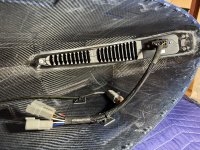
1734357085331.jpeg
 
I think you are somewhat overthinking and over-complicating this installation.
It may appear that way but if you knew NOTHING about wiring and were tasked with installing these lights, would you just randomly grab some wire off your shelf and throw them in? All I'm trying to do is install the lights by following the information provided by the company that makes the lights and also FAA guidelines to determine the proper wire size. Since I'm building an airplane rather than a dune buggy, I'm trying to do it correctly so the airplane is safe to operate.

As for the wire length - Stein (the company that builds the wire harnesses for Vans) actually told me this:
"The RV-14 has 23 feet of wire to each wingtip, plus 2-3 feet from the breaker to the fuselage harness connection point - Lets call it 25 feet. "

I spoke with Ken at AeroLED last week. Nice guy. He said he designed the VXi lights. He recommended running all new wires rather than just trying to use the factory harness and then only running new wires that are missing from the harness (taxi/convenience/grounds). Since I don't think any of the wires in the factory harness are shielded, I've decided to try to run all new wires. I sent Ken an email yesterday asking him about the requirement for 4 conductor shielded wire that I can't seem to source anywhere. Haven't heard back from him but I didn't expect him to reply on a Sunday.

Yes, I am spending WAAAY too much time on this but it's only because I'm clueless and there are contradictions between the wires I'm supposed to use and those that actually exist. I did ask Stein if they sell a 12awg or 14awg four conductor shielded wire. The biggest I found on their website was 18awg. Waiting for a reply.

Thank you Dean for posting that photo! It's extremely helpful!!! I plan to use the Deutsch connectors myself. I really like them.
 
Normally you only shield things that pulse, like the strobes. It makes no sense to shield a position or landing light.
The other puzzling thing is the wire size. The LED’s are current driven devices that aren’t sensitive to small voltage drops.
Those of us using the popular FlyLed units are instructed to use 18-22 gauge with the 18 gauge for the landing lights only.
 
Those of us using the popular FlyLed units are instructed to use 18-22 gauge with the 18 gauge for the landing lights only.
FAA AC43.13-1B says you can run 3 amps through an 18awg wire for a 25' run. Those FLYLed light's must draw less power than the VXi lights (7 amps for the landing light).
 
Goodness
Mine draw 2-3A per side. And in wig wag your landing lights are pulsing and the magnetic field generated by the pulse is proportional to the current so I suppose shielding is best practice
 
Last edited:
Let us know what Ken says. Another contact at AeroLEDs told me that (3) strands of 4 conductor 18AWG was sufficient (and readily available) to wire the modules.

I agree however that AC43.13 gives us a different math problem when calculating the required wire size to the electrical load, which leads to heavier/harder to source (and $$) wire if trying to keep with multiple conductors in one strand. I'm currently very skeptical of using all 18AWG to these modules. But then again I didn't design them. I've yet to wire mine up.
 
Let us know what Ken says. Another contact at AeroLEDs told me that (3) strands of 4 conductor 18AWG was sufficient (and readily available) to wire the modules.

I agree however that AC43.13 gives us a different math problem when calculating the required wire size to the electrical load, which leads to heavier/harder to source (and $$) wire if trying to keep with multiple conductors in one strand. I'm currently very skeptical of using all 18AWG to these modules. But then again I didn't design them. I've yet to wire mine up.
Ken said he can't legally recommend anything other than what the FAA recommends. But, he said others have successfully used 18awg. If the FAA AC43.13-1B says 12awg, there is no way I'm using 18awg even if others have used it. 14awg? Yeah. 16awg? I dunno. 18awg? No way. Josh at SteinAir said he will reach out to his wire vendors to see if they can get 12-14awg 4 conductor shielded.

I have to say both Ken at AeroLED and Josh at SteinAir really are working hard to find a solution. If Josh finds a vendor with the AeroLED recommended wire, I'll pass that information along to Ken. Maybe AeroLED could then update their VXi FAQ's to include a reference to the vendor that has the wire they recommend. Fingers crossed there actually is a source for this wire.
 
Ken said he can't legally recommend anything other than what the FAA recommends. But, he said others have successfully used 18awg. If the FAA AC43.13-1B says 12awg, there is no way I'm using 18awg even if others have used it. 14awg? Yeah. 16awg? I dunno. 18awg? No way. Josh at SteinAir said he will reach out to his wire vendors to see if they can get 12-14awg 4 conductor shielded.

I have to say both Ken at AeroLED and Josh at SteinAir really are working hard to find a solution. If Josh finds a vendor with the AeroLED recommended wire, I'll pass that information along to Ken. Maybe AeroLED could then update their VXi FAQ's to include a reference to the vendor that has the wire they recommend. Fingers crossed there actually is a source for this wire.

Thanks. I checked with a WireMasters contact re: 4 conductor 14AWG (at least 1 strand of it for the heavier demand circuits), but they went dark on me. Haven't picked the task back up yet. I should be making contact with Stein guys this week also, so I'll add a +1 on somebody needing to source something more sufficient.

Additional note: It would be nice to know which ground pins (of #8-12) handled which incoming load circuits, so if 3 conductor 14AWG (example) could be sourced for pins #1,2,6 (the heavier load circuits), then the ground pins for the return 14AWG could be paired appropriately.
 
Last edited:
The twisted shielded pair requirement seems dubious. Just twisting the ground and power wires together will cancel the magnetic field. The shielding requirement is typically for low level signals susceptible to electric fields. You can make your own by clamping the wires on one end and putting the other end in your drill motor and wind them up.
 
Again from my neighbor with the RV-10 and the VXi wingtips -

All the ground pins are connected according to Ken at AeroLED’s - so no need to determine which one is carrying the “heavier” load.

I still say 16 gauge wire is sufficient, but build as you deem best for you.

When I have a chance, I will go fly the plane, turn on all the lights and provide the amperage draw I am seeing on my plane. It’s not 100% accurate of course, but may provide a data point that might make you less uncomfortable with using smaller gauge wires.

 
Last edited:
I don't recall seeing any requirement for twisted pair wires. Just shielded.
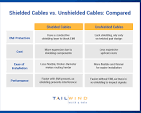
This is the google AI explanation:
Cat6 Shielded vs. Unshielded Cable for Businesses
While both twisting wires and shielding are used to reduce electromagnetic interference (EMI) in cables, "twisting wires" primarily works by canceling out noise from within the cable itself by twisting pairs of wires together, while "shielding" involves wrapping a conductive material around the wires to block external noise from entering the cable;essentially, twisting is more effective against internal interference, while shielding protects against external noise sources
 
Last edited:
Does the VXi wiring diagram in my first post help?

Not quite, but the next response from 280FX does (noting that they're connected and share the ground load, not individual circuits). The AeroElectric Connection Wire Data Table graph is also helpful. I have a big bundle of 3 conductor 16AWG, and that looks like it will be sufficient for the power runs, according to that table.

I'm considering a harness that includes (2) strands of 3 conductor 16AWG for Landing/Strobe/Taxi power and 3 pins of the grounds. Then (2) strands of 3 conductor 18 or 20AWG for the rest.
 
Last edited:
I'm considering a harness that includes (2) strands of 3 conductor 16AWG for Landing/Strobe/Taxi power and 3 pins of the grounds. Then (2) strands of 3 conductor 18 or 20AWG for the rest.
That sounds like a great plan. I may end up doing the same if I can't find heavier shielded wires. Thanks for sharing this.
 
Last edited:
FAA AC43.13-1B says you can run 3 amps through an 18awg wire for a 25' run. Those FLYLed light's must draw less power than the VXi lights (7 amps for the landing light).
Maybe I’m missing something but isn’t AC.43 13-1B a voltage drop chart?
 

Attachments

  • IMG_0208.png
    IMG_0208.png
    1.3 MB · Views: 23
Maybe I’m missing something but isn’t AC.43 13-1B a voltage drop chart?
It's actually a 646 page document titled "Acceptable Methods, Techniques, and Practices - Aircraft Inspection and Repair". You can find it here. The chart I shared in my first post is on page 520.
 
Last edited:
It’s true that the wire size vs wire length in the AC 43.13 calculations is based on a fixed maximum voltage drop that is somewhat arbitrary and conservative. 0.5 volts in this case. But Paragraph 11-66-c states that “If the voltage drop does not exceed the limit established by the aircraft or product manufacturer, the resistance value for the circuit may be considered satisfactory.”
Basically if the manufacturer is OK with a 1V drop you are good to go with 18 gauge.

AC 43.13 is not a design requirement. It’s a guideline for repairs and modifications where manufacturer data is not available. The very first paragraph of the whole AC says it only applies if it’s not contrary to manufacturers data.
 
Last edited:
Again from my neighbor -

Interesting that the data sheet provided by AeroLED’s shows power consumption as 100 watts per wingtip. That would seem to imply a maximum total current draw of 8.3 amps at 12 volts for all the lights. This is much closer to what I have seen on my plane versus the 17 amps per wingtip per the FAQ publication.

 
Again from my neighbor -

Interesting that the data sheet provided by AeroLED’s shows power consumption as 100 watts per wingtip. That would seem to imply a maximum total current draw of 8.3 amps at 12 volts for all the lights. This is much closer to what I have seen on my plane versus the 17 amps per wingtip per the FAQ publication.

I suspect they added everything together to arrive at 17A per wingtip. However, taxi and landing lights cannot be on at the same time (I suspect landing = taxi + a few more lights). And with strobes on, you won't see 5A per strobe, but rather the average draw, probably ~1-1.5A max. So, with nav/strobes/landing all on, this would be around 8-9A total per wingtip.
 
Something isn’t right. Wired like post #1 you would have something like 8 pounds of wire just for the wingtip lights.
That a vendor would recommend an implementation that you can’t wire with readily available Tefzel insulated aircraft wire is unbelievable.
 
Last edited:
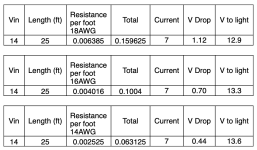
I don't know if this interests anybody but Ken from AeroLED sent me this chart showing voltage drop with different wire sizes:
Screenshot 2024-12-17 at 11.51.20 AM.png
 
The question is that 12.9 vs 13.6 volt supply acceptable. Usually an LED’s light output is current driven and not as sensitive to a voltage change. To first order that 0.7 volt drop will dim your lights by a maximum of 5 percent.

If he can’t tell you, which seems bizarre, test it yourself. Buy $50 power variable supply on Amazon. If you were closer you could use mine. People using those lights need to know this.
 
Last edited:
The question is that 12.9 vs 13.6 volt supply acceptable. Usually an LED’s light output is current driven and not as sensitive to a voltage change. To first order a 0.7 volt drop in a 14 V supply will dim your lights by a maximum of 5 percent.

If he can’t tell you, which seems bizarre, test it yourself. Buy $50 power variable supply on Amazon. If you were closer you could use mine. People using those lights need to know this.
I don’t think light brightness is the driving concern here. It’s the 300 mW per foot heat load in the wire. Without checking, I think that’s okay for a single 18 gauge wire in open air. But in the center of a tightly packed bundle? Or in a plastic conduit? That might be a bit marginal.
 
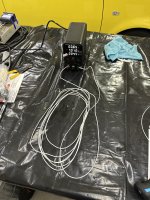
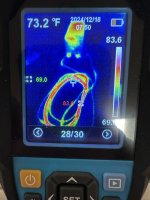
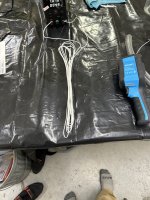
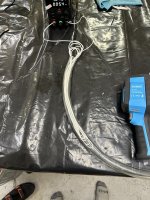
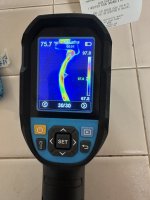
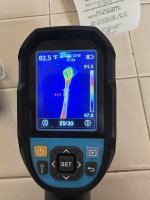
Test of temperature rise of 18 gauge wire roughly 20 feet long 7 amps.
70F ambient.
Open air 84F
Bundled 92F
Bundled in conduit 98F dissipating 4 watts per foot ( 3/4 tygon tubing)
Maximum allowable wire temp 302F
Maximum conduit temp (Vans type Nylon) 350F
Temperature of my Hoover vacuum cleaner cord after 5 minutes 102F
To be fair this doesn’t include the air pressure at altitude and the temperature rise above ambient could double but it’s not very hot.
 

Attachments

  • IMG_1261.jpeg
    IMG_1261.jpeg
    2.1 MB · Views: 28
  • IMG_1264.jpeg
    IMG_1264.jpeg
    1.4 MB · Views: 28
  • IMG_1262.jpeg
    IMG_1262.jpeg
    1.8 MB · Views: 25
  • IMG_1263.jpeg
    IMG_1263.jpeg
    2.1 MB · Views: 22
  • IMG_1266.jpeg
    IMG_1266.jpeg
    1.2 MB · Views: 23
  • IMG_1265.jpeg
    IMG_1265.jpeg
    1 MB · Views: 20
  • IMG_1267.jpeg
    IMG_1267.jpeg
    1.2 MB · Views: 23
Last edited:
I used WH-00125 for landing lights. Uses 14 awg I believe. Aveo calls for 18 awg so I thought no problem. Actual measured amp draw 6.2 amps per side.

Screenshot 2024-12-17 185806.jpg
 
Normally you only shield things that pulse, like the strobes. It makes no sense to shield a position or landing light.
The other puzzling thing is the wire size. The LED’s are current driven devices that aren’t sensitive to small voltage drops.
Those of us using the popular FlyLed units are instructed to use 18-22 gauge with the 18 gauge for the landing lights only.
I am running these FlyLEDs for landing lights:

Their information on that page states:
8 amps max current draw, and for 12 volt systems only.
If you have a 50w halogen in your wings now, you're already pulling that much current and you'd be lucky to have 5-700 lumens of (eww, yellow) light...
And of course, with our conventional linear power supply design, there will not be any intercom or radio noise. Guaranteed.
I used the same wires I used for my HID 50 watt landing lights they replaced. Those were non-shielded 18 gauge red wires for power and a short section of non-shielded 18 gauge black wire to a local screw in the closest wing rib for ground. No 12 or 14 gauge wires needed. Incandescent bulbs may have needed that heavier wiring but not LEDs.
 
Again from my neighbor with the RV-10 and the VXi wingtips -

All the ground pins are connected according to Ken at AeroLED’s - so no need to determine which one is carrying the “heavier” load.

I still say 16 gauge wire is sufficient, but build as you deem best for you.

When I have a chance, I will go fly the plane, turn on all the lights and provide the amperage draw I am seeing on my plane. It’s not 100% accurate of course, but may provide a data point that might make you less uncomfortable with using smaller gauge wires.

From my neighbor-

Flew the plane today and here were the amp readings shown on my GDU460 (ammeter shunt) -

  • Strobes 1-2 amps
  • Nav lights 2 amps
  • Taxi lights 6 amps
  • Landing lights 7 amps (additional from taxi lights)
Of course this isn’t completely accurate but it is probably close. I’m perfectly comfortable with the 16 gauge wire I ran to the wingtips.
 
Hello everyone my name is Ken Robinson. I happen to be the guy who designed the electronics within the VXI lights. I want every customer of the VXI lights to have a great experience with the light installation. I see lots of people making comments here. If you want definitive information about the wiring or the operation I invite any of you to contact me directly (email and cell# below), I will say all of my current numbers were based on alternators putting out 14V. So yes there will be voltage drop getting out the the wingtip, but I am ok with that. I designed the light to be very happy with about a 1V drop. If there is less than 12.9V getting to the light the performance and the current will be lower than designed. But as this table below show 18AWG should be adequate for the job. If a customer would like to use a thicker gauge wire they certainly can, but keep in mind there is a limit to what the connecter crimp pins will work with. There is a version of the female connector that I chat about in the FAQ that is designed for bigger wire gauges.

VinLength (ft)Resistance per foot 18AWGTotalCurrentV DropV to light
14250.0063850.15962571.1212.9

[email protected]
cell: 208-361-6676

Also realize the current in the strobe lights is 4.3A per wingtip but it is only on for .25 seconds every 1.46 seconds so it averages to a much lower number.
 
Hello everyone my name is Ken Robinson. I happen to be the guy who designed the electronics within the VXI lights. I want every customer of the VXI lights to have a great experience with the light installation. I see lots of people making comments here. If you want definitive information about the wiring or the operation I invite any of you to contact me directly (email and cell# below), I will say all of my current numbers were based on alternators putting out 14V. So yes there will be voltage drop getting out the the wingtip, but I am ok with that. I designed the light to be very happy with about a 1V drop. If there is less than 12.9V getting to the light the performance and the current will be lower than designed. But as this table below show 18AWG should be adequate for the job. If a customer would like to use a thicker gauge wire they certainly can, but keep in mind there is a limit to what the connecter crimp pins will work with. There is a version of the female connector that I chat about in the FAQ that is designed for bigger wire gauges.

VinLength (ft)Resistance per foot 18AWGTotalCurrentV DropV to light
14250.0063850.15962571.1212.9

[email protected]
cell: 208-361-6676

Also realize the current in the strobe lights is 4.3A per wingtip but it is only on for .25 seconds every 1.46 seconds so it averages to a much lower number.
That cell number is a voice only number no text messages.
 
Question: the FAQ document on the aeroLED site specifies shielding on both ends of the wire runs. Does that mean that the wiring run in the wingtip must have the shield grounded to the wing body and the panel side shield grounded to the common ground forest of tabs?
 
Back
Top