
My RV-12 has a heavy left wing. We adjusted the left flaperon pushrod to lower the flaperon slightly. This adjustment made the left turning tendence even worse. We then reversed that adjustment to raise the left flaperon slightly higher that were it was and the left turning tendancy improved slightly, but not completely. But, when I lower the flaps (below 83 knots), the left turning tendance goes away completely. Any thoughts on what is wrong and what I should do to correct this problem?

Van's Air Force
You are using an out of date browser. It may not display this or other websites correctly.
You should upgrade or use an alternative browser.
You should upgrade or use an alternative browser.
Heavy wing...sometimes
- Thread starter glenadavis
- Start date


Yes it is.Is your ball perfectly centered?

try lowering one flap 1-2 degrees.. use your phone to measure.

Glad to share my experience with this on my RV-12.My airplane had a very slightly heavy left wing. I double checked all of the things on the Van's 'heavy wing' suggestions like the aft portion of the top skin and pinching the trailing edge. Having seen where other builders were able to fix theirs with the rod adjustment I eventually decided to turn to that. What I didn't like was that it was kind of hearsay and process of elimination, even though it seemed to work. This made me more curious about the initial assembly process as well as a little more precise approach to the adjustment.
What I focused on was that the dimensioning for the height of the rod bearing is not a real precise operation. You have a measurement to take, from the surface of the skin to a point in space at the center of the rod bearing. There is no real index, so there is room for parallax and centering errors. Some people will have more luck with this than others, and I believe that a small bit being off can go a long way. You have 4 chances to get this off by a little bit.
I drew up and printed a little gauge or jig. Super simple and tiny little thing that you just rest against the skin and can slide through the rod bearing. Eliminates any center-finding or eyeball measuring issues. I had a few that were off by a slight amount. Once I adjusted each so that my jig would slide neatly into the rod bearing. This fixed the heavy wing.
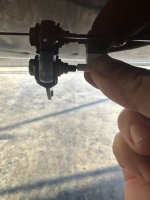
Photo is the only one I have, but I'm just holding it up to the attached bearing to view. To use the jig you'll remove the bolt and the round end is your gauge to get consistent and accurate rod height dimensions.
You can find the file on Thingiverse if you have a printer or a friend with one. Let me know if you want to try this and can't print the jig.
What I focused on was that the dimensioning for the height of the rod bearing is not a real precise operation. You have a measurement to take, from the surface of the skin to a point in space at the center of the rod bearing. There is no real index, so there is room for parallax and centering errors. Some people will have more luck with this than others, and I believe that a small bit being off can go a long way. You have 4 chances to get this off by a little bit.
I drew up and printed a little gauge or jig. Super simple and tiny little thing that you just rest against the skin and can slide through the rod bearing. Eliminates any center-finding or eyeball measuring issues. I had a few that were off by a slight amount. Once I adjusted each so that my jig would slide neatly into the rod bearing. This fixed the heavy wing.
Photo is the only one I have, but I'm just holding it up to the attached bearing to view. To use the jig you'll remove the bolt and the round end is your gauge to get consistent and accurate rod height dimensions.
You can find the file on Thingiverse if you have a printer or a friend with one. Let me know if you want to try this and can't print the jig.
Last edited:

Piper J3
Well Known Member
Particularly this post, making the same point with a different method.
flaperon hinge (rod end) adjustment
What is the effect on roll trim, of making a half turn OUT on the LEFT aileron hinge rod ends? The reason I ask is that I have found the hinge rod ends are not equally set, and I have a slight roll. After reading a bunch of posts about roll trim, I've checked all the components and trailing...
vansairforce.net
I meant to add that it's possible you have some other problem and that setting the rod bearings correctly doesn't solve things. It still makes sense to start by getting all the bearings heights even and accurate. You mention having made a few changes already, so it's good to start from the ground up.
If you still have a heavy wing issue after verifying the rod bearing heights, the next thing I would recommend is reviewing the rigging check for the flaperons in the PAP. This will tell you whether the torque tubes were drilled properly.
Thanks Nate. We are 80yr old builders and do not have access or know of anyone with a printer. Is there some way of acquiring one.Glad to share my experience with this on my RV-12.My airplane had a very slightly heavy left wing. I double checked all of the things on the Van's 'heavy wing' suggestions like the aft portion of the top skin and pinching the trailing edge. Having seen where other builders were able to fix theirs with the rod adjustment I eventually decided to turn to that. What I didn't like was that it was kind of hearsay and process of elimination, even though it seemed to work. This made me more curious about the initial assembly process as well as a little more precise approach to the adjustment.
What I focused on was that the dimensioning for the height of the rod bearing is not a real precise operation. You have a measurement to take, from the surface of the skin to a point in space at the center of the rod bearing. There is no real index, so there is room for parallax and centering errors. Some people will have more luck with this than others, and I believe that a small bit being off can go a long way. You have 4 chances to get this off by a little bit.
I drew up and printed a little gauge or jig. Super simple and tiny little thing that you just rest against the skin and can slide through the rod bearing. Eliminates any center-finding or eyeball measuring issues. I had a few that were off by a slight amount. Once I adjusted each so that my jig would slide neatly into the rod bearing. This fixed the heavy wing.
Photo is the only one I have, but I'm just holding it up to the attached bearing to view. To use the jig you'll remove the bolt and the round end is your gauge to get consistent and accurate rod height dimensions.
You can find the file on Thingiverse if you have a printer or a friend with one. Let me know if you want to try this and can't print the jig.
View attachment 87512
Thank you, Martha
The title of the file or a link would be helpful. There are too many things on thingaverseGlad to share my experience with this on my RV-12.My airplane had a very slightly heavy left wing. I double checked all of the things on the Van's 'heavy wing' suggestions like the aft portion of the top skin and pinching the trailing edge. Having seen where other builders were able to fix theirs with the rod adjustment I eventually decided to turn to that. What I didn't like was that it was kind of hearsay and process of elimination, even though it seemed to work. This made me more curious about the initial assembly process as well as a little more precise approach to the adjustment.
What I focused on was that the dimensioning for the height of the rod bearing is not a real precise operation. You have a measurement to take, from the surface of the skin to a point in space at the center of the rod bearing. There is no real index, so there is room for parallax and centering errors. Some people will have more luck with this than others, and I believe that a small bit being off can go a long way. You have 4 chances to get this off by a little bit.
I drew up and printed a little gauge or jig. Super simple and tiny little thing that you just rest against the skin and can slide through the rod bearing. Eliminates any center-finding or eyeball measuring issues. I had a few that were off by a slight amount. Once I adjusted each so that my jig would slide neatly into the rod bearing. This fixed the heavy wing.
Photo is the only one I have, but I'm just holding it up to the attached bearing to view. To use the jig you'll remove the bolt and the round end is your gauge to get consistent and accurate rod height dimensions.
You can find the file on Thingiverse if you have a printer or a friend with one. Let me know if you want to try this and

You have the link to the part on Thingiverse? I can't find it on there.Glad to share my experience with this on my RV-12.My airplane had a very slightly heavy left wing. I double checked all of the things on the Van's 'heavy wing' suggestions like the aft portion of the top skin and pinching the trailing edge. Having seen where other builders were able to fix theirs with the rod adjustment I eventually decided to turn to that. What I didn't like was that it was kind of hearsay and process of elimination, even though it seemed to work. This made me more curious about the initial assembly process as well as a little more precise approach to the adjustment.
What I focused on was that the dimensioning for the height of the rod bearing is not a real precise operation. You have a measurement to take, from the surface of the skin to a point in space at the center of the rod bearing. There is no real index, so there is room for parallax and centering errors. Some people will have more luck with this than others, and I believe that a small bit being off can go a long way. You have 4 chances to get this off by a little bit.
I drew up and printed a little gauge or jig. Super simple and tiny little thing that you just rest against the skin and can slide through the rod bearing. Eliminates any center-finding or eyeball measuring issues. I had a few that were off by a slight amount. Once I adjusted each so that my jig would slide neatly into the rod bearing. This fixed the heavy wing.
Photo is the only one I have, but I'm just holding it up to the attached bearing to view. To use the jig you'll remove the bolt and the round end is your gauge to get consistent and accurate rod height dimensions.
You can find the file on Thingiverse if you have a printer or a friend with one. Let me know if you want to try this and can't print the jig.
View attachment 87512
Thanks for asking, I meant to include this in my post.You have the link to the part on Thingiverse? I can't find it on there.

RV-12is Flaperon Bearing Gauge by nholderbein
A gauge for setting the 11/32 offset for installing the flaperon rod bearings. Slightly undersized to allow for being 'between threads', but should easily establish a fairly consistent and precise offset for all 4 bearings. Small and prints in just a few minutes.
 www.thingiverse.com
Thanks! That site's search engine stinks!Thanks for asking, I meant to include this in my post.
RV-12is Flaperon Bearing Gauge by nholderbein
A gauge for setting the 11/32 offset for installing the flaperon rod bearings. Slightly undersized to allow for being 'between threads', but should easily establish a fairly consistent and precise offset for all 4 bearings. Small and prints in just a few minutes.
