Van's Air Force

The definitive Van's Aircraft support community! Buying, building or flying an RV? Join our exclusive family of mentors and enthusiasts!

Hartzell Raptor

DanH

Legacy Member
Benefactor
Advertiser
Mentor
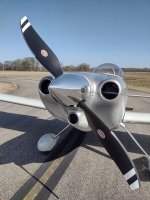
Recently flew a two-blade Raptor about 10 hours on the front of my RV-8. This is the late model carbon prop specifically designed as a much lighter alternative to the 7497 aluminum BA. That's not to say the 7497 was copied in carbon. It's a clean sheet design to optimize properties, with a lot of subtle differences, including the hub structure.

I'd say Hartzell engineering nailed it. A very nice prop all around. Seems to pull harder at low speed, like during runway acceleration or when pulled into an upline. No notable change in top speed or cruise. The Big Deal, at least with me, is the low mass moment of inertia, as it drives a pleasant change to handling properties, in particular given an RV-8 with an angle valve 360 or 390.

A typical F7497 aluminum blended airfoil is roughly 59 lbs, while the equivalent Raptor is about 38 lbs. That's 21 lbs lighter overall, or ~35%. However, the weight loss is in the blades, not the hub. The MMoI is approx. 0.57 slug*ft2 for the composite vs ~1.93 slug*ft2 for the aluminum....70% less. That's huge in terms of effect, and it shows up in multiple ways. For example, start right at the beginning, just seconds into the takeoff roll...push the stick to raise the tail to longeron level. With the aluminum prop, you'll need a rudder input to keep it straight while the airframe rotates in pitch; gyroscopic precession drives the nose 90 degrees to the pitch change, in the direction of rotation. With the carbon prop, the same pitch rate results in very little rudder requirement, a reduction proportional to the reduced MMoI. The effect (or more more precisely, the lack of effect) extends to all maneuvers with high pitch or yaw rates.

Another design driver; unlike the previous paddle carbon prop, the blade chord does not require a shaft extension or extended hub to clear the cowl intakes at full coarse pitch. It's a bolt-on with standard RV cowls.

Given the short term test, I did not do a dynamic balance. Still, perceived vibration was less than with the 7497, in particular within the classic range from 2100 to 2350.

I liked it a lot.
IMG_20250201_125304640_HDR 600w.jpg
 
Last edited:
The reduced rudder need on rotation means that you can accept a higher crosswind component from the left on take-off, since you have more rudder authority to handle it. Nice improvement there, too.

Dave
 
I recently took possession of a 3 Blade Raptor...looking quite lonely waiting for the 390 it will mate to. Glad to hear of your positive reception and review. Hoping the extra blade gives me similar good vibes.
 
I enjoyed flying the 3-blade Raptor a couple of years ago when I swapped it back and forth for the WW-300, tested it, and wrote it up. The two props performed almost identically, and both wee superior in every way to the two-blade metal BA prop. Climb and speed were better (and identical between the two three-blade props)…but as you said Dan, the lightness on teh nose and lower moment of inertia are really noticeable, and quite pleasant.
 
Thanks Dan!
I’m looking at the same setup as you nearly with an Angle Valve engine and the usual Hartzell aluminium prop.
So if putting the composite prop on can make a noticeable difference to CG I would be very interested!
 
Did they supply counterweights and their mounting brackets to make the prop feasible on an A-model nose-dragger? :rolleyes:
 
Thanks Dan!
I’m looking at the same setup as you nearly with an Angle Valve engine and the usual Hartzell aluminium prop.
So if putting the composite prop on can make a noticeable difference to CG I would be very interested!

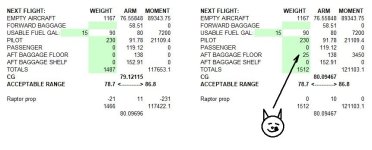
It does make a difference in CG (roughly an inch), but again, the real benefit is reduction of mass moment of inertia. You're installing a smaller gyroscope.

If CG is your only criteria, you can do the same thing with a 25 lb bag of cat food on the rear baggage floor. It's cheaper and the cat will appreciate it.

(I'm guessing at the prop arm, as I'm not at the airport right now.)

ScreenHunter_2749 Mar. 28 13.40.jpg
 
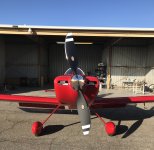
Depending on what your “mission” is there is another 2 blade Hartzell composite. The HC-G2YR. The Raptor is a composite version of the BA aluminum prop. The HC-G2YR is advertised to have 100 pounds more static thrust than the BA and was targeted to the sport flying/formation flyer who wanted more thrust and engine braking. You supposedly give up several knots and add 5 pounds over the Raptor.
Quantitative comparisons are rare and I don’t have enough experience to know the difference but it is whacky fun. 42 seconds from throttle up to 1000ft AGL at 300 MSL with a 180 HP -8 at 1450#.


Attachments

  • IMG_4181.jpeg
    IMG_4181.jpeg
    1.9 MB · Views: 110
Recently flew a two-blade Raptor about 10 hours on the front of my RV-8. This is the late model carbon prop specifically designed as a much lighter alternative to the 7497 aluminum BA. That's not to say the 7497 was copied in carbon. It's a clean sheet design to optimize properties, with a lot of subtle differences, including the hub structure.

I'd say Hartzell engineering nailed it. A very nice prop all around. Seems to pull harder at low speed, like during runway acceleration or when pulled into an upline. No notable change in top speed or cruise. The Big Deal, at least with me, is the low mass moment of inertia, as it drives a pleasant change to handling properties, in particular given an RV-8 with an angle valve 360 or 390.

A typical F7497 aluminum blended airfoil is roughly 59 lbs, while the equivalent Raptor is about 38 lbs. That's 21 lbs lighter overall, or ~35%. However, the weight loss is in the blades, not the hub. The MMoI is approx. 0.57 slug*ft2 for the composite vs ~1.93 slug*ft2 for the aluminum....70% less. That's huge in terms of effect, and it shows up in multiple ways. For example, start right at the beginning, just seconds into the takeoff roll...push the stick to raise the tail to longeron level. With the aluminum prop, you'll need a rudder input to keep it straight while the airframe rotates in pitch; gyroscopic precession drives the nose 90 degrees to the pitch change, in the direction of rotation. With the carbon prop, the same pitch rate results in very little rudder requirement, a reduction proportional to the reduced MMoI. The effect (or more more precisely, the lack of effect) extends to all maneuvers with high pitch or yaw rates.

Another design driver; unlike the previous paddle carbon prop, the blade chord does not require a shaft extension or extended hub to clear the cowl intakes at full coarse pitch. It's a bolt-on with standard RV cowls.

Given the short term test, I did not do a dynamic balance. Still, perceived vibration was less than with the 7497, in particular within the classic range from 2100 to 2350.

I liked it a lot.
Dan,
Thanks. Now adding to my long wish list of upgrades.
Undoubtedly it is a considerable improvement. Reducing the rotating mass is important for inertia (I=mr squared). Yet, the reducing the weight by 21 pounds will help CG too.
Daddyman58
 
The problems with crankshaft failures on Lycoming used for aerobatics dates back to the late 80's. I flew a Pitts S2B that had two broken crank flanges in the first 1000 hours since new The first, at around 100 hour since new involved the prop departing the engine. Those problems did not go away until the German props with the wood core blades. Those props had their own problems.
The maneuvers that caused the failures were torque rolls, multi turn snap rolls, flat spins and lomcevaks. The first failure on the S2B above occurred during a flat spin.
 
The problems with crankshaft failures on Lycoming used for aerobatics dates back to the late 80's. I flew a Pitts S2B that had two broken crank flanges in the first 1000 hours since new The first, at around 100 hour since new involved the prop departing the engine. Those problems did not go away until the German props with the wood core blades. Those props had their own problems.
The maneuvers that caused the failures were torque rolls, multi turn snap rolls, flat spins and lomcevaks. The first failure on the S2B above occurred during a flat spin.

Had one of those in my Pitts S-2B. It was replaced with an MTV-9 and never had another issue.

Well, that's not entirely true. The MT hub had to be replaced more than once because of internal galling. To be fair, that airplane flew a LOT and almost all of it was gyroscopic in nature. It was a living, breathing torture test for a propeller.

--Ron
 
Back
Top