Van's Air Force

The definitive Van's Aircraft support community! Buying, building or flying an RV? Join our exclusive family of mentors and enthusiasts!

Hardwired USB power suggestions?

mburch

Well Known Member
Patron
My panel currently has a 12V "cigar lighter" socket, in which I've been using a plug-in USB adapter to charge my phone. Since the old-school socket is pretty much obsolete these days, I'd like to change this out for a dedicated, hardwired USB receptacle. I'd ideally like to find one that fits in the existing round hole without any other fasteners, so I don't have to mess up my panel labeling. And of course I want one that's not going to melt, burn up, or generate a bunch of RF interference. USB-C would be great, since that's the way everything is headed in the future, but USB-A (rectangular plug) is acceptable too.

A google search yields hundreds of options, but it's hard to tell if any particular one is suitable for aircraft use. Anybody have a suggestion based on positive experience?

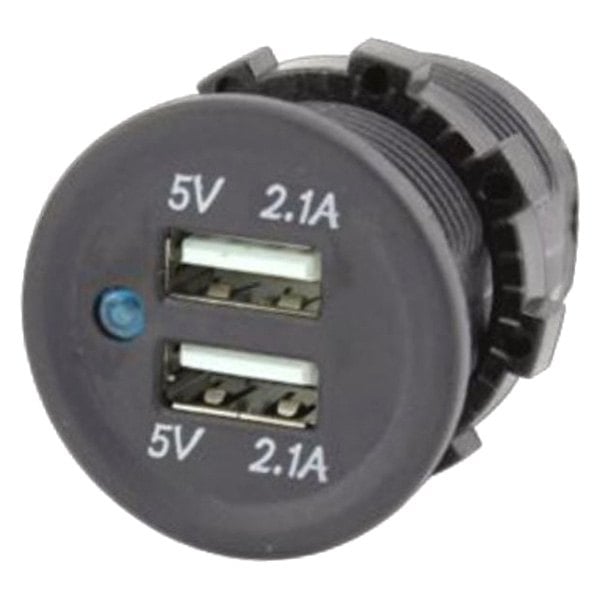
round-dual-usb-power-socket-k426515-1.jpg
usbr12v2_0.jpg
Hot-Product-Ds-Series-Dual-USB-Outlet-3-1A-Port-Socket-12-Volt-Outlet-LED-Car-Charger-USB-for-Car-Boat-Motorcycle.webp


Current "cigar lighter" socket in my panel:

1755974907331.png
 
Matt

I found this comparison of USB charging ports helpful while researching my options. I'm going with the crazy overpriced Garmin GSB-15 ports on the panel. Not sure for the cigar lighter hole between the seats.
 
Last edited:
Don't spend crazy amounts on Garmin/certified USB ports. Why not a powerwerx or similar with up to 65w output? $40. https://powerwerx.com/panel-mount-usb-65w-qc40-typec-pd Steinair sells them too.

Here is AI answer also highlighting powerwerx. I use them.

If you're looking for panel-mount USB charging ports with the highest power output, here's what I found:

Top Performers & Leading Options​

1. Power Delivery panel-mount units (~60 W output)

  • Powerwerx PanelUSBQC4.0: USB-C QC4.0 port delivers up to 60 W with 20 V input; compatible with multiple fast-charging protocols including PD 3.0/PPS, QC4.0+, QC3.0, etc.
  • Coolgear USB Power Delivery 60 W Industrial Panel Charger: Flush-mount, dual-port USB-C charger rated at 60 W.
These seem to offer the highest USB-C output in standard panel-mount form—up to 60 W.

Other Notable Panel-Mount Chargers​

  • PM-2USB-2PD (Batteries America): Four-port charger (2× QC3.0, 2× USB-C PD) with a max combined output of 78 W. Each Type-C PD port supports up to ~20 V/3 A (~60 W combined across ports).
  • Impulse Electronics Panel Mount USB-C + QC3.0 PD: USB-C PD port up to 18 W only.
  • Steinair Dual A/C USB Panel-Mount Charger: USB-C QC4.0 up to 36 W (12–14.9 V input), up to 27 W (9–11.9 V input).
  • Cliff-Top Dual USB Charger: 5 V/4.2 A on USB-A only (~21 W), not USB-C PD.
  • Powerwerx PanelUSB-Plus: Dual-USB (A), 4.8 A total (~24 W).

Summary: Highest Panel-Mount USB-C Power Delivery​

ModelUSB-C Power Delivery Maximum
Powerwerx PanelUSBQC4.0Up to 60 W
Coolgear 60 W Panel Charger60 W
Others (Impulse, Steinair)18–36 W
Multiport Combined Unit78 W combined (multiple ports)
Best standalone choice: Powerwerx PanelUSBQC4.0 or Coolgear 60 W panel for single-port high power delivery (~60 W).
Best combined multi-port option: PM-2USB-2PD for up to 78 W across multiple ports.

Product Recommendations​


  • If you need the highest USB-C power delivery available in a standard panel-mounted form (up to 60 W), this is the top pick.

  • Best fit if you prefer multiple USB ports and want up to 78 W total output shared across those ports.

Final Recommendations​

  • For maximum single-port output, go with Powerwerx PanelUSBQC4.0 or Coolgear’s 60 W unit.
  • For multi-port flexibility, PM-2USB-2PD offers the most aggregate power.
  • If you need even more (e.g., 100 W or higher), your best bet may be to consider off-board chargers rather than panel-mount units, as few panel-mount models exceed ~60 W.
Need help selecting based on your input power (12 V or 24 V), device compatibility, or ruggedness? Feel free to ask—I’ve got your back!
 
Last edited:
OP I have a pair of the Amazon ones, one on each side. They've worked fine so far, but all I've powered has been my phone and a cheap Bluetooth music pickup. Perhaps I shouldn't have mounted them right next to the headset jacks but it hasn't caused problems.
 
Not sure the output on the Amazon ones but buy the fastest charging = highest wattage output. The USB c PD are currently the way to go with up to 60-100 watts. Standard USB A is about 15w. (2.5-3 amps). Night and day in charge time. You can either get a combo USB c pd/USB a if you need the USB a, or get two USBC , one with PD and use an adapter for usbc-a when you need an USB a (rectangle plug). The future is going to be all USB c. Hope that helps.
 
Not sure the output on the Amazon ones but buy the fastest charging = highest wattage output. The USB c PD are currently the way to go with up to 60-100 watts. Standard USB A is about 15w. (2.5-3 amps). Night and day in charge time.
I'll second this. I like Blue Sea Systems stuff but I don't think they made a comparable product to their USB A (which are great) for USB C. C is much faster charging.
 
I'll second this. I like Blue Sea Systems stuff but I don't think they made a comparable product to their USB A (which are great) for USB C. C is much faster charging.
Just be careful with high charge rates if you are going to used the port with you iPad. The higher the charge rate, the higher the temp, and the iPad is sensitive to heat. I find my USB-A ports (2.8 amp) can cause my iPad Pro (M4) to overheat on a warm day, so I leave it unplugged and fly on its battery.
 
My panel currently has a 12V "cigar lighter" socket, in which I've been using a plug-in USB adapter to charge my phone. Since the old-school socket is pretty much obsolete these days, I'd like to change this out for a dedicated, hardwired USB receptacle. I'd ideally like to find one that fits in the existing round hole without any other fasteners, so I don't have to mess up my panel labeling. And of course I want one that's not going to melt, burn up, or generate a bunch of RF interference. USB-C would be great, since that's the way everything is headed in the future, but USB-A (rectangular plug) is acceptable too.

A google search yields hundreds of options, but it's hard to tell if any particular one is suitable for aircraft use. Anybody have a suggestion based on positive experience?

round-dual-usb-power-socket-k426515-1.jpg
usbr12v2_0.jpg
Hot-Product-Ds-Series-Dual-USB-Outlet-3-1A-Port-Socket-12-Volt-Outlet-LED-Car-Charger-USB-for-Car-Boat-Motorcycle.webp


Current "cigar lighter" socket in my panel:
View attachment 95789
Those are all cheap ones pictured. Go with the blue sea version. Well made, reliable and noise free.
 
I purposely selected a low output USB device for my aircraft based on my need to only maintain or slightly increase the battery level in my iPad or like device. I’m a bit leery of high charging rates and the potential dangers that come with increased battery temps as I don’t have a way to toss the offender overboard. It may be over cautious but a battery fire is scary.
 
Never had a battery issue on a high charge rate Exclusively use 100w chargers at home for iPads, iPhones and Samsung. A 2.8a USB will barely keep up and many times fall behind. Futureproof yourself.
 
Matt,

When I Garminized my panel this year, I specifically and very intentionally kept my "old school" cigar socket because of the constant design changes of USB and the myriad devices I use to connect to them. Let's see: We now have USB-A, USB-B, USB-C, Mini-USB, and Micro-USB. There are cigar lighter sockets for virtually all of these designs, and they are all dirt cheap if I need to get a new one when the USB brain trust designs something else in the future. That's why I kept mine, wired to my battery bus with #18 on a 10A circuit. It cranks whatever needs juice just fine.

I love your panel, by the way! (y) I especially love that "old school" cigar lighter! ;) My new GMA 345 already has a USB port, but my cigar socket gives me all the options possible without any worry about obsolescence. It can even light cigars!
 
Last edited:
Just be careful with high charge rates if you are going to used the port with you iPad. The higher the charge rate, the higher the temp, and the iPad is sensitive to heat. I find my USB-A ports (2.8 amp) can cause my iPad Pro (M4) to overheat on a warm day, so I leave it unplugged and fly on its battery.
Agree with that. It is concerning when the iPad can use electrons faster than the socket can supply though.

A lot of the heat comes from high brightness - if not the backlight, the battery power required to keep it that bright. I can usually limp it along while charging once at cruise altitudes with cooler air.
 
Never had a battery issue on a high charge rate Exclusively use 100w chargers at home for iPads, iPhones and Samsung. A 2.8a USB will barely keep up and many times fall behind. Futureproof yourself.
The problem comes when the heat from charging is in addition to heating from the sun hitting the Ipad with high ambient temps. Had the Ipad get really warm to the point of shutting down once or twice.
 
The problem comes when the heat from charging is in addition to heating from the sun hitting the Ipad with high ambient temps. Had the Ipad get really warm to the point of shutting down once or twice.
Me too. It's a constant problem. iPads really aren't great in high temps.
 
I installed a couple of the Blue Sea PN: 1045 years ago, fits in the standard round hole, no issues.
 
Last edited:
The problem comes when the heat from charging is in addition to heating from the sun hitting the Ipad with high ambient temps. Had the Ipad get really warm to the point of shutting down once or twice.
Definitely need to keep the iPads out of the sun, whether charging or not, or they'll get too hot and shut down. Ever leave a phone on your car seat in direct light for 20 min? I drape a towel or cardboard nearby to block sun.
 
I purposely selected a low output USB device for my aircraft based on my need to only maintain or slightly increase the battery level in my iPad or like device. I’m a bit leery of high charging rates and the potential dangers that come with increased battery temps as I don’t have a way to toss the offender overboard. It may be over cautious but a battery fire is scary.

This is exactly my plan and I'm glad you mentioned it. I don't need to charge from 1% to 100%, I just want my phone to still be topped off when I land. And I'm not a big fan of iPads generally, so powering one of those things isn't high on my todo list.

SteinAir.
+1^
Why not support those that support us, VAF.

Yes, we all love Steinair... but they are just reselling Powerwerx chargers with a substantial markup - I don't think they need my money that badly! ;)
 
+1^
Why not support those that support us, VAF.
Powerwerx are excellent. However this model outputs only 2.4a per port so 12w max which is very marginal, particularly for an IPAD pro etc. Stein also sells this model which is 65w and 45w and you just use a a to c adapter if u need A (which lowers the output). https://www.steinair.com/product/dual-usb-panel-charger-type-c/?v=0b3b97fa6688 . iPads, phones and devices will only take as much as they are designed for without overheating. It's not a risk to put a higher output device on it and it further proofs your $ and time. Here is a good summary from AI.

A high-output USB charger (like 30W, 60W, or even 100W Power Delivery chargers) will not force extra power into your device.

Here’s how it works:

The charger only offers power.
Think of it like an electrical "buffet" — the charger puts different "voltage/current options" on the table.

The device decides how much to take.
Your iPad, iPhone, laptop, etc. has internal charging circuitry that negotiates with the charger (using protocols like USB Power Delivery or Apple’s charging standard). It only draws what it’s designed for — usually around 10–30W for an iPad, depending on the model.

Overheating risk:

Using a genuine or reputable charger: safe. The iPad won’t overdraw and won’t overheat just because the charger can supply more.
 
iPads really aren't great in high temps.
I didn't want to contribute further to thread drift so I started a new thread on iPad overheating potential solution:
 
Stein also sells this model which is 65w and 45w and you just use a a to c adapter if u need A (which lowers the output).
Thank you raabs. I’m gonna order that one in stead of the A-C. It appears all the devices I would have in the plane are C anyway. If you haven’t read enough on this topic, here’s another bit of information on USB charging (for those of us who can remember when beer can tabs were removable).
 
Last edited:
The device decides how much to take.

Overheating risk:

Using a genuine or reputable charger: safe. The iPad won’t overdraw and won’t overheat just because the charger can supply more.
Exactly!
When I designed the charge controller for the CQ Headset with Bluetooth, I made the choice to be very conservative, for all the obvious reasons. It doesn't matter how much current you provide, it is just going to sip on it with a very controlled and accurate charge profile. This includes secondary temperature monitoring as another charge control input. I don't know (ok, maybe I do) what other manufacturers that source their controls from unnamed offshore entities are doing, but I sleep well at night with my control in the cockpit.
 
Has anyone installed a MagSafe charger? This could be a cool thing to put in the centre tunnel - would hold your phone magnetically.

 
Has anyone installed a MagSafe charger?
That looks pretty slick, but I think that 60mm (2 11/32”) hole would need some modifications to the F-14123, for the 14. Standard oem cigarette lighter hole size is 1 1/8”.
 
Has anyone installed a MagSafe charger? This could be a cool thing to put in the centre tunnel - would hold your phone magnetically.
Would need to fit into a 2 3/8 hole which is smaller than a normal cup holder. Does look pretty nice.
 
That looks pretty slick, but I think that 60mm (2 11/32”) hole would need some modifications to the F-14123, for the 14. Standard oem cigarette lighter hole size is 1 1/8”.
It wouldn’t be too hard to replace that part with one wide enough to fit a 60mm hole.

I was initially thinking just aft of the fuel selector, or between the spars but it won’t fit in either of those places.
 

Attachments

  • IMG_7901.jpeg
    IMG_7901.jpeg
    1.6 MB · Views: 20
  • IMG_7902.jpeg
    IMG_7902.jpeg
    1.5 MB · Views: 19
I like the concept but you’d be sticking 25+W of pure inductive EMF into close proximity to com radios or your antenna coax’s.

Auto OEMs had lots of issues early on integrating inductive chargers with no RFI. I’m sure a lot of aftermarket inductive chargers arent even truly Qi/Qi2/Magsafe standard let alone FCC compliant so so I’d definitely double and triple check for interference on all frequencies before i made any holes.

Even apple released a whole stack of USB to MagSafe chargers that were unusable in cars.
 
I like the concept but you’d be sticking 25+W of pure inductive EMF into close proximity to com radios or your antenna coax’s.

Auto OEMs had lots of issues early on integrating inductive chargers with no RFI. I’m sure a lot of aftermarket inductive chargers arent even truly Qi/Qi2/Magsafe standard let alone FCC compliant so so I’d definitely double and triple check for interference on all frequencies before i made any holes.

Even apple released a whole stack of USB to MagSafe chargers that were unusable in cars.
Good point.

I’ll probably just go with something like this.
 
Good point.

I’ll probably just go with something like this.
Specs on the above below. I'm assuming that with the proper type C user the voltage gets stepped up (Ex using a Starlink antenna that needs ~40 watts) from 12 volts input even though the spec says, "Normal voltage: 24VDC"?

  • Normal voltage: 24VDC
  • Operating Voltage: 9V-30V DC
  • Peak Voltage: 34V DC(max)(3-4seconds)
  • USB TypeC -1 output:
  • QC4.0 (5V/3A/15W, 9V/3A/27W, 15V/3A/45W, 20V/3A/60W)
 
Would need to fit into a 2 3/8 hole which is smaller than a normal cup holder. Does look pretty nice.
That size is definitely on the smaller side, but if it fits a 2 3/8 hole securely, it should still work fine. The design does look nice, and pairing it with a custom coaster could help stabilize it if the fit is a bit loose.
 
Back
Top