Van's Air Force

The definitive Van's Aircraft support community! Buying, building or flying an RV? Join our exclusive family of mentors and enthusiasts!

GPS antenna ground plane, Criticality?

Freemasm

Well Known Member
Patron
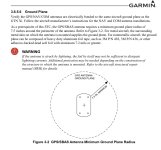
Various sources mention the need for and area recommendations regarding ground plane requirements when installing a GPS antenna. There are plenty of references here that utilize a polymer base when installing the aforementioned on curves surfaces.

Is the requirement ultra conservative?
Is the contact through the mounting screws enough?

Can you VAFers get me smarter regarding such? “xxx hours, no problems!” statements won’t be particularly helpful getting to a better understanding.

Much thx.

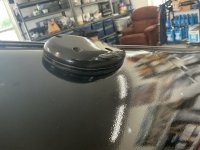
Picture below stolen from this forum.
 

Attachments

  • https___vansairforce.net_attachments_img_0668-jpeg.119770_.jpeg
    https___vansairforce.net_attachments_img_0668-jpeg.119770_.jpeg
    3 MB · Views: 25
Well as the source for your picture, I can tell you that I consulted a few antenna engineering experts before using a composite base for the GPS antenna, and they all told me that the screws proved the electrical connection to the actual aluminum ground plane. It convinced me, and you already said that you didn’t want to hear anecdotal experiences, so I don’t need to give them to you…😉
 
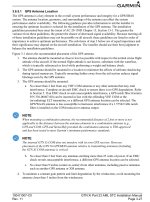
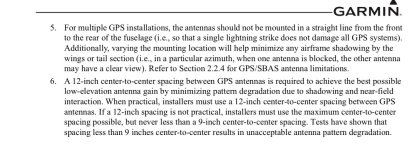
Attached are the pages out of the install manual that cover the Garmin gps antenna. The last photo is my RV-8 install.

The most critical guidance is how to prevent the inherent GTN comm RFI from blocking out the GPS signal. It can happen. Do not mount the GPS antenna on the glare shield and make sure you add at least the minumum amount of coax (per the install manual) to attenuate the GTN comm harmonic RFI picked up by the antenna pre-amp.

Side note. Builders get bent around the axle on ground planes. Think RF, not DC.

Carl
 

Attachments

  • IMG_2898.jpeg
    IMG_2898.jpeg
    452.7 KB · Views: 21
  • IMG_2899.jpeg
    IMG_2899.jpeg
    146.5 KB · Views: 17
  • IMG_2900.jpeg
    IMG_2900.jpeg
    177.7 KB · Views: 23
  • 20210210_145716.jpeg
    20210210_145716.jpeg
    1.1 MB · Views: 21
The only critical mounting requirement is that the GPS antenna has a clear view of the sky. No metal or carbon fiber should obstruct the antenna view of the sky.

GPS antennas do not need a ground plane to work well. However, you would be well advised to follow the antenna manufacturer's installation instructions.

A ground plane is required for most VHF COM antennas because the ground plane forms half of the antenna system. Without that ground plane the antenna would not be resonant and would be a very poor impedance match to the transmitter. That constraint does not apply to GPS receiving antennas.
 
Attached are the pages out of the install manual that cover the Garmin gps antenna. The last photo is my RV-8 install.

The most critical guidance is how to prevent the inherent GTN comm RFI from blocking out the GPS signal. It can happen. Do not mount the GPS antenna on the glare shield and make sure you add at least the minumum amount of coax (per the install manual) to attenuate the GTN comm harmonic RFI picked up by the antenna pre-amp.

Side note. Builders get bent around the axle on ground planes. Think RF, not DC.

Carl

Specifically...think Dipole vs Monopole.
 
The only critical mounting requirement is that the GPS antenna has a clear view of the sky. No metal or carbon fiber should obstruct the antenna view of the sky.

GPS antennas do not need a ground plane to work well. However, you would be well advised to follow the antenna manufacturer's installation instructions.

A ground plane is required for most VHF COM antennas because the ground plane forms half of the antenna system. Without that ground plane the antenna would not be resonant and would be a very poor impedance match to the transmitter. That constraint does not apply to GPS receiving antennas.
Sorry, but that constraint is required at any frequency.
 
Sorry, but that constraint is required at any frequency.

The constraint was transmitter impedance matching. That constraint does not apply to GPS receiving antennas.

It is well documented that GPS receiver antenna gain can be increased by using an optimized ground plane. That does not mean that the same antenna will not work well without a ground plane.

In my over 30 years of using fixed and portable GPS receivers most have used an antenna with no external ground plane.
 
A million years ago, there was a young idiot ME student. After taking the required, not-so-hard AC/DC circuits course, he thought, hey wouldn't it be cool/interesting to double major and get a double E degree as well.

Then came Signals class. He could do the math, get the right answers, even get good grades. That said, said idiot realized he had zero intuition into the related art ** and that was the last EE course he took.

Thanks for the feedback and DMs. Question started with reading the related Garmin manual(s), seeing the commercial and glareshield GPS antenna totally encapsulated in polymer (and much smalled .cable), seeing Ironflight's pic,, etc. Then came the opinions/arguments, etc. from previous VAF posts.

The conclusions (mine alone):
- There will never be consensus regarding the need for a GPS antenna ground plane for our applications (certification not considered).
- The GP's real value would be demonstrated in the "fringe' conditions related to satellite line of sight variables.
- The lack of a per print GP will probably never matter.
- The aforementioned idiot still does not have an intuitive insight into anything signals related, even while parroting the examples and theory above,

Thx.

** After working with EEs for decades, I'm convinced the lack of true intuition into the discipline wouldn't have made him any different from the majority of other EEs. This includes those that could dress themselves in clothes that match.

and he hasn't done a single %^&#! Laplace transform since that class.

Thx and have a good weekend. Cheers boys.
 
Back
Top