Van's Air Force

The definitive Van's Aircraft support community! Buying, building or flying an RV? Join our exclusive family of mentors and enthusiasts!

glazing putty or faring compound before or after primer?

We have gotten all but the bottom rudder faring on. (That one is a real pain). We want to fill in the pulled rivets and minor defects on the Horizontal and Elevators. Do we prep just the areas we want to work and apply an sandable epoxy primer now followed by 'body work'. Or do we do a primer wash and body work then apply the primer? Mark and Cindy
 
If you are planning to have your aircraft professionally painted, you can ask your painter to smooth and to finish the bottom forward rudder fairing for you. Most paint shops do a good job at this type of finishing work. If you are painting it yourself, do your best to surface fill using epoxy/micro and sand it into the final shape. Only apply primer when you ready to paint your airplane. It is just extra work to prime it now.
 
If you are planning to have your aircraft professionally painted, you can ask your painter to smooth and to finish the bottom forward rudder fairing for you. Most paint shops do a good job at this type of finishing work. If you are painting it yourself, do your best to surface fill using epoxy/micro and sand it into the final shape. Only apply primer when you ready to paint your airplane. It is just extra work to prime it now.
What Phat ^ said.
Who is painting it? Check with them on primers.
If you plan to paint, primer is before paint for max adhesion.
Repairs are ok. Use epoxy and micro for small stuff.
Pop rivets can be plugged with a smidge of JB Weld. Before it hardens, cut the excess with a razor.
 
It is generally considered acceptable and good practice to apply filler/putty after epoxy primer coat on bare metal. Not so much over 2K primer on bare metal. A side benefit is that filler will create a chemical bond with the epoxy primer if applied in the primers curing window.
 
Probably going to have a friend help with the painting at a bump shop with a big paint both and professional 'gun man'. But the expectation is more that I will have it close to ready for paint. I need to make sure that I work out the primer that will cover both fiberglass and bond to aluminum. I understand it is 'paint systems' one chooses. This will be for all six of the farings for the rudder vertical and horizontal. I am thinking what we would do is tape off the areas to get work, lay down primer, then putty or faring compound, fill and sand, then when the entire thing gets painted these areas will get another light primer coat before top coat.

What is "2K primer".

Alternatively. The previous builder had been using the Sherwin Williams primer-wash recommended by Van's. I could lightly apply that (I have a gallon) and do the 'bondo' work adhering to the vinyl primer wash. But not sure the Sherwin Williams is meant for the fiberglass.

This is a tough row to hoe.

Mark and Cindy
 
.

What is "2K primer".
two kinds of primer in modern materials. A dtm or direct to metal primer like epoxy primer. This seals and protects as well as creates a base for all of the other layers. Then there is build primer, that is often referred to as 2k primer. It is sprayed on relatively thick with the intention of sanding it down flat. Getting a flat surface is its primary purpose and its biggest benefit is easy sanding. It is porous and therefore a poor base coat on metal. It also doesn’t adhere to metal as well as dtm.
 
Alternatively. The previous builder had been using the Sherwin Williams primer-wash recommended by Van's. I could lightly apply that (I have a gallon) and do the 'bondo' work adhering to the vinyl primer wash. But not sure the Sherwin Williams is meant for the fiberglass.

This is a tough row to hoe.

Mark and Cindy
I would not apply bondo over the SW without asking them if the polyester filler will adhere to it. I know it is an adhesion promoter for paint, but don’t know if that would apply to fillers.

You can apply bondo directly to metal, it is just not the very best way.
 
Probably going to have a friend help with the painting at a bump shop with a big paint both and professional 'gun man'. But the expectation is more that I will have it close to ready for paint. I need to make sure that I work out the primer that will cover both fiberglass and bond to aluminum. I understand it is 'paint systems' one chooses. This will be for all six of the farings for the rudder vertical and horizontal. I am thinking what we would do is tape off the areas to get work, lay down primer, then putty or faring compound, fill and sand, then when the entire thing gets painted these areas will get another light primer coat before top coat.

What is "2K primer".

Alternatively. The previous builder had been using the Sherwin Williams primer-wash recommended by Van's. I could lightly apply that (I have a gallon) and do the 'bondo' work adhering to the vinyl primer wash. But not sure the Sherwin Williams is meant for the fiberglass.

This is a tough row to hoe.

Mark and Cindy
Normally, I would fill and sand fiberglass parts before priming. An epoxy primer will bond to both fiberglass and aluminum, if the surface is properly prepared (degreased and scuffed).

"2K primer" means 2-pack primer, i.e. there is a part A component and a part B component, to be mixed before spraying. Part A is the paint base and part B is the activator (catalyst). Other types of primer are 1K i.e. 1-pack which is sprayed without needing an activator.

The wash primer is probably not suitable for filling over, it would be better to spray an epoxy primer first and then apply a filler, either epoxy-based or polyester-based. After the filler has been sanded then those areas can be spot-primed.

An epoxy filler can also be used on bare aluminum if the surface has been sanded/scuffed to give the filler something to key into so it will adhere properly.

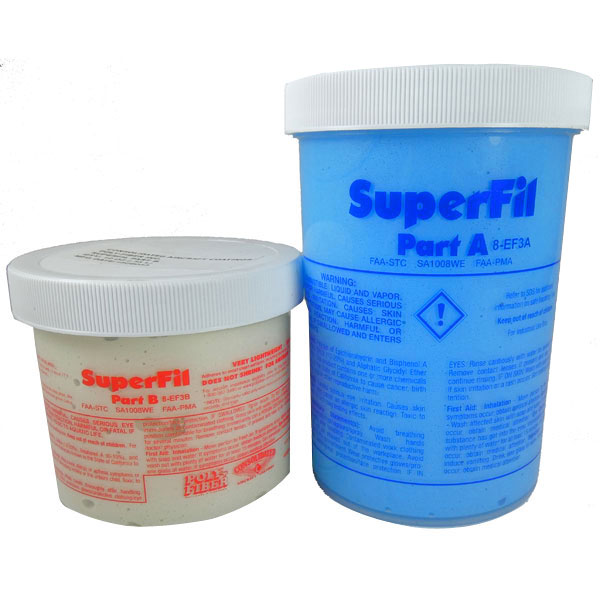
An easy-to-use epoxy filler is Super Fil:
 
+1 on the Poly-Fiber SuperFil, easy to sand, great filler and/or glazing compound just before epoxy primer, light weight & durable - no cracking. I would suggest the smaller1 Qt container.... goes a long way.
 
Polyester body fillers absorb moisture so unless what you are filling is sealed off on the back side don't be putting polyester body filler over seams or rivets.
 
Polyester body fillers absorb moisture so unless what you are filling is sealed off on the back side don't be putting polyester body filler over seams or rivets.
To eliminate any confusion - Poly-Fiber SuperFil is an EPOXY filler product, Poly-Fiber is the Company Name:
SUPERFIL EPOXY FILLER - An ultra lightweight corrosion-inhibiting filler for aircraft, marine, and automotive use. Adheres to composites, bare aluminum, steel, and bare or varnished wood. Epoxy resin with non-MDA hardener. Ships non-hazardous. Apply EP-420 Epoxy Primer directly over SuperFil.
 
To eliminate any confusion - Poly-Fiber SuperFil is an EPOXY filler product, Poly-Fiber is the Company Name:
SUPERFIL EPOXY FILLER - An ultra lightweight corrosion-inhibiting filler for aircraft, marine, and automotive use. Adheres to composites, bare aluminum, steel, and bare or varnished wood. Epoxy resin with non-MDA hardener. Ships non-hazardous. Apply EP-420 Epoxy Primer directly over SuperFil.
Yes I would agreed that the PolyFiber epoxy filler would be a good choice. I'll have to try that one for sure. For more clarity when I say polyesters filler Im referring to any plastic automotive body fillers. IMHO they have no place anywhere on a aircraft.
 
While waiting to arrange spraying the 2K and for the mail man to bring me a NOS Rudder faring (to see if it fits any better) I decided to re-attack the panel and engine fire wall. And seems like I saw a passing comment by someone that had to cut his subpanel open because the radio stack didn't fit.

Yep. To my horror it's not even close. I don’t know what radios Van was looking at when they set the panel to subpanel spacing. It is not even close. A GNC 355 (already purchased) needs about 13 inches of space length wise. I think there is about 8 inches.

This means that channel F-697 and the center subpanel portion will need to be cut. Planning on the opening beginning 1 inch up from the bottom lip of the subpanel and extending up 4 inches with a width of 6 & 5/8th. The stack needs about 3 ½ inches of height this will give me a little extra. I may lean that back a bit as I recheck my numbers. Don't need big gaps but no skin tight openings either.

Is there anything I should learn now before I cut? I am a little worried about weakening the panel and having to build gussets. Also chewing my lip about why the F-697 channel is the length it is. Usually there is a reason. Looks like it does a lot to stiffen that center section.

Thanks to all above. I will go with the super fil and make sure the seams/rivets are sealed well before applying.

Vr
Mark & Cindy
 
Back
Top