


Van's Air Force

The definitive Van's Aircraft support community! Buying, building or flying an RV? Join our exclusive family of mentors and enthusiasts!

Gauge Settings - Need Input....

Reflex

Well Known Member
Friend
As I finish up my -14, I've begun to set up the gauges on my G3X. Much to my surprise, much of the data isn't readily available. I've documented the initial settings to the best of my ability and have done a search on this site for the missing data. I'm hoping some of you might give me your input as to how to fill in the blanks.

While I've found some good data on this site, I couldn't find anything like the chart I placed below.

What I'm looking for is good data that can be justified either by documentation or sound logic. Please take a look at the chart below and give me your thoughts.

I'm hoping to find answers to the undocumented numbers that were a guess and to the cells with question marks in them. If you disagree with what's been documented or something jumps out at you, I'd like to hear what you did and why.

Note the parameters at the bottom of the chart.
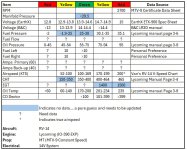
Gauge Settings.jpg
Thanks,

Fred
 
I have my alarms set to indicate anytime I vary much out of "my normal" operating ranges rather than the manufacturers min/max numbers. I want to get an indication of a problem earlier versus later. For example my alternator voltage I have my minimum set at 14 Volts not <13V per the manual. My normal voltage is 14.4 volts. I have my oil pressure caution range starts at <70 PSI.
I realize you have not flown yet so you need determined your own baseline numbers of what is "normal". I'm sure your post will generate a lot of good feedback.
Garmin G3X has the ability to apply logic to the alarm setups.
 
You will need to set a min and max for egt. The actual numbers are personal preference but realize that a minimum of say, 900 degrees and a maximum of 1550-1600 will give you a much better visual representation on the gauge than if you were to set the min at zero and the max at 1600. Play with it in the config page and see the difference.
 
In general, don't get too carried away with yellow and red ranges that have minimal meaning. In other words, you don't want alarms going off on take off because your CHTs are below 350. Those alarms can be a nuisance at best, and possibly distracting at critical phases of flight. Later on, when you have passengers, you don't want them freaking out because alarms are popping up every two minutes. It doesn't promote confidence in you or your plane. And the following is likely to spark controversy, but here is my two cents.

Fuel Flow - It is what it is. Like manifold pressure, I've never seen alarm ranges.
Fuel Levels - That may be overly conservative, but you state that's your personal preference. Just under half full is not really a cautionary level, but do as you like. I start getting a little twitchy when either tank is below 5 gallons.
Amps - That's another "is what it is". Sheldon Cooper would admonish me for that statement. If the alternator was putting out more than a few amps over its rated capacity, that may be something for concern.
CHT - I agree with the yellow range starting at 400 degrees, but I think 464 is too high for the top end of that range. Yes, I know what the book says. But a more conservative approach would be something like 420 or 425. Mike Busch has an excellent webinar on this subject that's worth watching. It's on YouTube with a title something like "How Hot is Too Hot". Yes, I know many will say that 425 for the start of the red range is too conservative. But I can only answer for me and not an average of what the Think Tank says.
EGT - Again, quoting from Mike Busch, there really is no alarm range for EGT. It's just a reading. CHT is the key parameter to watch for engine health.
Airspeed - Follow what Van's says for white, green, & yellow arcs and all the V speeds. You can adjust those later after or during Phase 1 testing.
 
As I finish up my -14, I've begun to set up the gauges on my G3X. Much to my surprise, much of the data isn't readily available. I've documented the initial settings to the best of my ability and have done a search on this site for the missing data. I'm hoping some of you might give me your input as to how to fill in the blanks.

While I've found some good data on this site, I couldn't find anything like the chart I placed below.

What I'm looking for is good data that can be justified either by documentation or sound logic. Please take a look at the chart below and give me your thoughts.

I'm hoping to find answers to the undocumented numbers that were a guess and to the cells with question marks in them. If you disagree with what's been documented or something jumps out at you, I'd like to hear what you did and why.

Note the parameters at the bottom of the chart.

View attachment 72151
Thanks,

Fred
FUEL PRESSURE, Inlet to fuel injector min 14, max 45 psi. (green).
OIL PRESSURE, min 55, max 95 psi, (green) 25-55 psi (yellow) min 25 psi idling. Below 25 psi RED. Rear mount sensor.
Start, Warm-up, Taxi, and Take-off max 115 psi (yellow). Above 115 psi RED.

Good luck
 
You are creating distractions if you set alarms based on personal restrictions. Oil pressure red line for idle should be 25#. Max oil pressure for start and warm up is 115#
CHT max is 500. Recommended max 435 continuous.
Oil temp 150-245 above 30 degrees F.
CHT should be kept below 400 until rings are seated.
 
You are creating distractions if you set alarms based on personal restrictions. Oil pressure red line for idle should be 25#. Max oil pressure for start and warm up is 115#
CHT max is 500. Recommended max 435 continuous.
Oil temp 150-245 above 30 degrees F.
CHT should be kept below 400 until rings are seated.
Never exceed the maximum red line cylinder head temperature limit of 465°F (260°C), measured at the bayonet location.

Good luck
 
Lycoming operators manual, all 0 360 mo0dels. bayonet probe, maximum cylinder head temperature 500 degrees F. There may be odd ball engines that are lower but very rare. Does not include helicopter engines.
Yes, you are correct about the 360 engines.
However this is NOT a 360 engine.
The 390 engine has 465 F max limit.

Good luck
 
Yes, you are correct about the 360 engines.
However this is NOT a 360 engine.
The 390 engine has 465 F max limit.

Good luck
Correct. And if memory serves, 435 is the limit for max cruise.

Why people think 380 is a magic number for Lycomings has always puzzled me. I understand not wanting to run it in high speed cruise right at 435 (or 450 for most other Lycomings) but, say, 400 seems perfectly fine to me.
 
Back
Top
