Van's Air Force

The definitive Van's Aircraft support community! Buying, building or flying an RV? Join our exclusive family of mentors and enthusiasts!

GASCOLATOR????

Cindy and I are completely baffled by Van's lack of guidance on this one. The gascolator is a fuel filter. That they call it a gascolator should have been a warning. I can't, for my life, find where the instructions are that outline where this doubler "VA-161" for the 'gascolator' goes and why it's the size and shape it is. Some of the posting and notes seem to treat it as optional. Every A/C I have flown has at least one fuel filter. Even more confusing some of the pictures I find online of completed projects don't show it.
Our engine will be fuel injected and whether it's a tail dragger or tri-cycle seems to matter but exactly how is a mystery. Any guidance is greatly appreciated in advance.
We are making baby steps....:)

Mark/Cindy
 
I purchased a -7 project that has 61 hours on it. The builder opted for the gascolator on the engine side of the firewall, and gave no provision to sump it short of removing the lower cowling.

As part of the work I did to it, I installed a cowl flap conveniently located to allow me to sneak a couple fingers up there to spill gas all over my hand and onto the ramp.

I see the gascolator as a last chance to let any water to drop out of the system before it hits the motor. We all know that water is NOT combustable.

I had a number of people point out that I could have just used a hole saw and cut an opening just big enough for the typical thin aviation fuel tester.
 
Is this for a RV6, 7 or 9? If so, the doubler would be located behind the firewall, lower passenger side. Generally below & to the right of the battery box.
A gascolator by its self isn’t a great filter as its screen isn’t fine enough to protect your injectors. Most builders install inline filters either between the tank & valve, or between the valve & aux fuel pump. If they also install a gascolator, it would be primarily for water collection.
Because each builder would have individual desires for routing their fuel systems, Vans offers fairly generic guidance here.

Wait till you get into wiring your plane… you will be the designer!
 
"...The gascolator is a fuel filter. That they call it a gascolator should have been a warning..."
I'm not sure what you mean by this?

A gascolator is essentially a can that attaches to the firewall. Fuel goes into the can through a filter cartridge, then is picked up via a standpipe that is a small distance above the bottom of the can so that and water/sediment can collect on the bottom below the level of the fuel pickup.

When you sump the fuel on a Cessna, the fwd most fuel sump on the belly is a drain for the gascolator bowl. Some systems don't have a gascolator drain. You just take it apart and clean it out annually.

A gascolator isn't the only place you can install a fuel filter. If you have a fuel injected engine there is typically a fuel filter integral to the electric boost pump assembly. TS flight lines also makes a kit to put fuel filters in line in the wing roots. These and probably other filter solutions make a gascolator redundant so they are omitted from some systems by design, except in countries where they're required for certification (Canada for example)
 
See drawing 19 zone A/B-5/6, 36A zone A-3, and op-28. LOTS of discussion about "gascolators" in this forum, it is worth a good search. RAA Canada has "gascolator" written into their regulations, but after a long battle by one of the members here, it was finally decided that on a fuel injected engine, a fuel filter was legal. When I designed my fuel system I read the manufacturer's specs for filtration on the fuel boost pump and the injector servo. So I have Andair "gascolators" serving as filters upstream of the fuel boost pump, and a Falls Filtration fuel filter mounted on the firewall. Due to the mounting bracket and size of the filter, I ended up making my own version of the VA-161. Note the injector servo has a "last chance" finger filter, but this should not be confused with a main filter.
 
Fuel injection - No Gascolator! I know we are using tractor engines on airplanes but it is 2026. . .Not 1926!
How are you removing water from the system without a Gascolator?

Sh*t happens and water will stop that big twirly thing out front from making power.
 
Cindy and I are completely baffled by Van's lack of guidance on this one. The gascolator is a fuel filter. That they call it a gascolator should have been a warning. I can't, for my life, find where the instructions are that outline where this doubler "VA-161" for the 'gascolator' goes and why it's the size and shape it is. Some of the posting and notes seem to treat it as optional. Every A/C I have flown has at least one fuel filter. Even more confusing some of the pictures I find online of completed projects don't show it.
Our engine will be fuel injected and whether it's a tail dragger or tri-cycle seems to matter but exactly how is a mystery. Any guidance is greatly appreciated in advance.
We are making baby steps....:)

Mark/Cindy
Op-28 Dwg shows gascolator install & reinforcement bracket, it never hurts to install the bracket now even if you do not install a gascolator later. A fair amount of people DO install gascolators even with injected engines, it DOES provide a low water trap & a fine screen internal. It does also create a heat soaking device on the engine side of the firewall which can exacerbate fuel heating & vapor issues. I installed one and have not found it to be an issue. Mine is an IO-360-M1B tail dragger with a Sam James extended cowl
 

Attachments

How are you removing water from the system without a Gascolator?

Sh*t happens and water will stop that big twirly thing out front from making power.
Sump drains, protections from getting water in fuel (many different ways, hangared always, store my own fuel, etc.). Sure, stuff happens. It for sure would cause the engine to stumble for a moment while that plug was swallowed and spit out the exhaust as super heated steam, but in reality, it would take a very large “plug” of water to stop the engine. Truthfully, in 30 years of flying time, I have never seen a solitary drop of water in any fuel I have ever burned.
 
The Gascolator is more than just a fuel filter. In the Canada we must have a gascolator or equivalent. Transport Canada defines equivalent as:

"4.6 Gascolator alternatives
  1. (1) In some aircraft designs, installation of a ‘gascolator’ as a unit may not be possible or practical.
  2. (2) Other means of achieving the necessary capabilities of the Fuel Strainer or Filter Assembly may be employed if, for reasons of practicality, the builder chooses to develop an alternate design that performs the same functions and meets the intent of this guidance.
  3. (3) The builder of the aircraft should be prepared to demonstrate that whatever means are employed, an adequate supply of filtered fuel, free of water and sediment, to the engine is assured, and that there are sumps and drains that will allow the capture, detection, and removal of contaminated fuel prior to flight, with reasonable ease.
  4. (4) Readily accessible and serviceable in-line filters of sufficient capacity, together with separate water drains at low points, may be employed.
  5. (5) Paper filter elements are not acceptable, unless they are rated by their manufacturer for airborne aviation fuel use."
This is from the Transport Canada fuel system Advisory Circular 549-001 which is what the MDRA uses as their amateur built fuel system inspection criteria.
 
Last edited:
Sump drains, protections from getting water in fuel (many different ways, hangared always, store my own fuel, etc.). Sure, stuff happens. It for sure would cause the engine to stumble for a moment while that plug was swallowed and spit out the exhaust as super heated steam, but in reality, it would take a very large “plug” of water to stop the engine. Truthfully, in 30 years of flying time, I have never seen a solitary drop of water in any fuel I have ever burned.
My daily driver sits in its own hangar and has 5 sumps. I have never sumpted anything looking like water. That being said, I will ALWAYS check all 5 before engine start.

It only takes once…
 
Last edited:
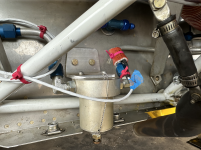
Mine is on the engine side of the firewall on my RV6 - carbed O-360 (see pic). The “downspout” is from home depot. If it looks crooked it’s because it is. The threads on the brass tube are cut that way. I’ve tried two of them and they are both the same. A standard fuel tank drain is on the bottom using a coupler. Nothing leaks - works fine - drain sample through a hole in the cowl below it. I have to turn on my electric fuel pump to get more than a few drops out of it. Easily opened up for checking/cleaning during my CI. Ive never found anything in it.
 

Attachments

  • IMG_2238.jpeg
    IMG_2238.jpeg
    2.7 MB · Views: 158
  • IMG_2177.jpeg
    IMG_2177.jpeg
    1.8 MB · Views: 158
Found water at OSH once. Condensation. was the last time I parked there without having the tanks topped off.
Once I found brass debris in the bowl (lots!) from a failing aux fuel pump.
Both those days could have ended badly…
 
Truthfully, in 30 years of flying time, I have never seen a solitary drop of water in any fuel I have ever burned.
I could have said the same thing (albeit only 20 years) until the day I found a HUGE slug of water in my fuel. Interior o-ring had failed in my fuel cap and the thing had acted as a funnel during a rainstorm when it was parked outside at my travel destination. I have no opinion on gascolators but everyone should stay frosty about water in fuel (I’m sure you do). It killed an instructor here at W96, a good person and good pilot.
 
I could have said the same thing (albeit only 20 years) until the day I found a HUGE slug of water in my fuel. Interior o-ring had failed in my fuel cap and the thing had acted as a funnel during a rainstorm when it was parked outside at my travel destination. I have no opinion on gascolators but everyone should stay frosty about water in fuel (I’m sure you do). It killed an instructor here at W96, a good person and good pilot.
I've also found water in fuel before. Regardless of how a guy feels about a gascolator, it's just dumb to not sump fuel
 
Whenever I'm tempted to skip sumping the tanks - I always do it on at least the first flight of the day, or after taking on fuel - I always think: how dumb will I look when the accident report comes out... 😳
I agree! I keep my aircraft inside a hangar and always check the sumps after I refuel and never found any fuel.

Many years ago I worked in law enforcement. One of the things they drilled into us was: Bad habits can kill you.

I always do my preflight before I climb into the cockpit. After getting in I always read the checklist out loud.

More than once I have climbed out to check something simple like a fuel sump because bad habits can kill you.

I spent 25+ years working as an A&P mechanic. Every safety meeting always stressed risk mitigation because every day we did things that were potentially deadly.

I guess some folks like to put the experimental back into experimental aircraft when they make the decision not to install such a simple device.

Play stupid games, win stupid prizes!
 
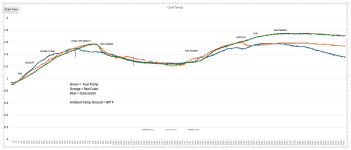
My RV-9A with a fuel-injected IO-320 has a gascolator on the firewall with a sump drain. There are also sump drains on each of the two fuel tanks. No fuel filters that I can find. I always drain all three and look for water before each flight of the day as well as sticking the tanks for fuel level. Just a habit. I realize that gascolators are generally non-standard on a fuel injected engine. I'm told it's because water is less of an issue for fuel injected engines and is a potential source of heat soaking that can contribute to difficult hot starts. I occasionally have hot starting issues in the summer but it's more of an annoyance than a deal-breaker and I've never been unable to ultimately get the engine going. I've monitored the fuel system temps at several under-cowl locations during flight, and although it does get hot, it's not outrageously hot. That said, I've been considering pulling the gascolator and associated fuel lines out and replacing with insulated fuel line, it's just not enough causing enough of an issue to put it on the urgent list.

ETA: this gascolator is well below the inboard aspect of my fuel tanks (where the sumps are) and is the lowest point in my fuel system.

1771110813196.png
 
Last edited:
My RV-9A with a fuel-injected IO-320 has a gascolator on the firewall with a sump drain. There are also sump drains on each of the two fuel tanks. No fuel filters that I can find.
Your servo has a filter that needs to be checked and cleaned annually. Many folks don’t seem to realize it is there. It can bite you if it loads up and starts to bypass.
 
The low point of an RV-8 fuel system is at the tank drain. Seems to me that the fuel tank and its drain performs the same function as a gascolater.
That’s true. But the fuel supply line for the engine is also located in that same place, built per plans, and any water dislodged in flight from various “traps” in your tank end up there too eventually. A gascolator should trap that before it’s a problem.
 
That’s true. But the fuel supply line for the engine is also located in that same place, built per plans, and any water dislodged in flight from various “traps” in your tank end up there too eventually. A gascolator should trap that before it’s a problem.
Also, when you move the plane at all, any water at the bottom of the tank gets moved around and may not drain easily. So you can only really get a good sump if the plane has been stationary for a few hours.

My gascolator is mounted in the left wing root - it’s a bit of a pain to access and clean the filter but at least it stays nice and cold there.
 
Your servo has a filter that needs to be checked and cleaned annually. Many folks don’t seem to realize it is there. It can bite you if it loads up and starts to bypass.
Good tip. I'll have to ask my mechanic about that.
 
I guess some folks like to put the experimental back into experimental aircraft when they make the decision not to install such a simple device.

Play stupid games, win stupid prizes!
On a high wing airplane where gravity will move water when parked or a carbureted airplane where fuel pressure is less than 10 psi, then yeah, sure.

But I didn't install a gascolator on my fuel injected RV7. I don't miss it and don't think my fuel system is inherently dangerous because of it.

On my low wing tail dragger, water isn't going to settle naturally in a firewall mounted gascolator when parked because it would have to run uphill to get there. When the engine is running, it would have to be the size of a milk jug to give enough sump space at the bottom for the engine to not just go ahead and shove it through there at 27 psi.

My opinion only, and probably worth what you paid for it
 
Carbed engines are more susceptible to water than fuel injected engines. Water will sink in the float bowl and since fuel is drawn through the main jet at the bottom of the bowl it causes rough running or potentially an engine outage especially at low power settings like on short final. Bear in mind water exists in several forms in AvGas. Including invisible to the naked eye. Water can also freeze in fuel lines. Here are a couple of places to start your research:

AC 20-125
More info

Water in AvGas


Larry is absolutely correct about the screen at the carb and fuel servo's. At least the ones I'm familiar with. Screen size in the gascolator is selected for a reason. There is a finer mesh screen downstream of the gascolator and one in the fuel divider in fuel injected engines.
 
Carbed engines are more susceptible to water than fuel injected engines. Water will sink in the float bowl and since fuel is drawn through the main jet at the bottom of the bowl it causes rough running or potentially an engine outage especially at low power settings like on short final. Bear in mind water exists in several forms in AvGas. Including invisible to the naked eye. Water can also freeze in fuel lines. Here are a couple of places to start your research:

AC 20-125
More info

Water in AvGas


Larry is absolutely correct about the screen at the carb and fuel servo's. At least the ones I'm familiar with. Screen size in the gascolator is selected for a reason. There is a finer mesh screen downstream of the gascolator and one in the fuel divider in fuel injected engines.
In short summary, water can and does emulsify in gasoline and demulsify in local areas of a fuel system to become droplets -> slugs of water. It has happened and at least some of the related ADs, ACs, SBs, articles, etc are written in blood.

This isn’t about proving someone’s preference is superior or validating their choices here. It’s about educating and sharing knowledge.

If we only had to design around nominal conditions, this whole airplane mess would get way simpler.

My worthless $0.02 for the day.
 
On my low wing tail dragger, water isn't going to settle naturally in a firewall mounted gascolator when parked because it would have to run uphill to get there. When the engine is running, it would have to be the size of a milk jug to give enough sump space at the bottom for the engine to not just go ahead and shove it through there at 27 psi.
Unlike a sump drain, the gascolator is not there to collect water by being a low point. A gascolator is an active seperator. Its job is to catch any water in the fuel passing throuh it, seperate it out and push it to the bottom of the jar and held for later removal. It is there to catch any water that is making its way to the engine, regardless of how it got there. This is important for carbed engines which have bowls that act like gascolators. Littl drops of water in fuel going to a carb will slowly collect in the bowl and coalecse to from larger slugs of water. Because the carb feeds from the bottom of the bowl, you now get large slugs of water that disrupt the engine. No need to deal with this in FI, as the smal drops keep passing through with the fuel and create only minor performance issues.
 
Last edited:
I was going to put 2 fuel filters in my wing roots for my fuel injected engine.
Wasn’t going to bother with a gascolator. Don’t think they are required for FI are they?
 
I was going to put 2 fuel filters in my wing roots for my fuel injected engine.
Wasn’t going to bother with a gascolator. Don’t think they are required for FI are they?
No, read post #27, and others, just above your post.
 
Unlike a sump drain, the gascolator is not there to collect water by being a low point. A gascolator is an active seperator. Its job is to catch any water in the fuel passing throuh it, seperate it out and push it to the bottom of the jar and held for later removal. It is there to catch any water that is making its way to the engine, regardless of how it got there. This is important for carbed engines which have bowls that act like gascolators. Littl drops of water in fuel going to a carb will slowly collect in the bowl and coalecse to from larger slugs of water. Because the carb feeds from the bottom of the bowl, you now get large slugs of water that disrupt the engine. No need to deal with this in FI, as the smal drops keep passing through with the fuel and create only minor performance issues.
I agree 100%. That sentiment was what I was trying to capture further down in my post, but evidently I didn't do a very good job :)
 
How are you removing water from the system without a Gascolator?

Sh*t happens and water will stop that big twirly thing out front from making power.
For my -7, I sump the fuel tanks as they are the lowest point for the fuel. I opted not to instal the gascolator because where ever I mounted it (firewall) it would be higher than the bottom of my fuel tank. My engine is fuel injected with a filter at the pump, pluse the trottle servo has a fuel line filter as well.... No point to have a gascolator.
 
For my -7, I sump the fuel tanks as they are the lowest point for the fuel. I opted not to instal the gascolator because where ever I mounted it (firewall) it would be higher than the bottom of my fuel tank. My engine is fuel injected with a filter at the pump, pluse the trottle servo has a fuel line filter as well.... No point to have a gascolator.
Not saying you should have a gascolator, but it does NOT have to be at a low point of the system to remove water from fuel. It is an active seperator that removes water from actively flowing fuel and doesn't rely upon simple settling as with your sump drains.
 
Sump drains remove the water so there is no need to "seperate" it at a gascolator. There are 6 feet of tubing after fuel leaves the tank which has no entry point for water.
 
Bulk water is only part of the story. Ref post 26.

"xxx hours and no issues" as many are apt to state here is not validation. This is one of those instances where it isn't an issue, until one day it is. This is my last post regarding such/this thread.
 
Sump drains remove the water so there is no need to "seperate" it at a gascolator. There are 6 feet of tubing after fuel leaves the tank which has no entry point for water.
Very true. But our airplanes don't have a lot of dihedral, so those water drops you acquire on a fuel stop may not work their way to the wing tank drains in time to drain out when you sump the tanks. So the gascolator allows them to be trapped before they go through your fuel delivery system.

For what it is worth, I have a gascolator in my -6. In 25 years, I've never found a drop of water in the gascolator. But I see it as a backstop for both sumping the tanks and for filtering out debris.
 
Having been on Florida's West coast (PIE) for my first 20 years of flying from a C152 (my first plane to Saratoga SP) all had gascolators due to inherent moisture occurring naturally. Failure to sump tanks and gascolator would get your attention sometime after engine start, not a good thing.
 
Sump drains remove the water so there is no need to "seperate" it at a gascolator. There are 6 feet of tubing after fuel leaves the tank which has no entry point for water.
except if theres water in the fuel from the tank truck/pump that delivered it in the first place.
 
What is this active separator and how does it work?

Carl
Fuel enters parallel to edge of jar at a downward angle, causing a rotational movement of the fuel in the bowl. this creates time for the heavier water to separate and sink. Fuel exits from the very top where water is less likely to rise to. Newly entering fuel rotates, taking time, while the fuel near the center has already been through the dwell phase. The screen at the top, in addition to being a filter, makes it harder for the water to exit due to its higher surface tension. air oil separators work on similar principles, but the oil sticks to the sides while the air doesn't.
 
What is this active separator and how does it work?

Carl
@ Carl. Was probably a poor choice of words on his part. In (the majority?) of such devices, there will some type of media such as a screen that takes advantage of the high surface tension of water as compared to fuel. The intent is for the low local velocities inside the device to allow emulsified water to coalesce on the media. As it collects, it will eventually amass to droplet size of drop to the bottom of the vessel where it can be sumped.

As you know, there's a reason they state 15-30 minutes after fueling before sumping -> flying.
 
Fuel enters parallel to edge of jar at a downward angle, causing a rotational movement of the fuel in the bowl. this creates time for the heavier water to separate and sink. Fuel exits from the very top where water is less likely to rise to. Newly entering fuel rotates, taking time, while the fuel near the center has already been through the dwell phase. The screen at the top, in addition to being a filter, makes it harder for the water to exit due to its higher surface tension. air oil separators work on similar principles, but the oil sticks to the sides while the air doesn't.
Now you are comparing an air/oil separator where the density of the two fluids is a factor of almost a thousand to gas/water separator who have a density difference of 1.4?

An example of an active filter would be the powered centrifugal fuel filters they use on ships.
 
Now you are comparing an air/oil separator where the density of the two fluids is a factor of almost a thousand to gas/water separator who have a density difference of 1.4?

An example of an active filter would be the powered centrifugal fuel filters they use on ships.
I didn’t compare the two, nor did i say water sticks to the walls on a fuel water separator. I said it was all about creating dwell time to let the water settle out. Send new fuel to the sides and bottom and pull old fuel from the center and top. I didn’t design these things and not trying to promote them. Only saying that they actually work at separating a moving volume of fluid. Far mmore active than what happens at the sump drains in the tanks.
 
Let’s say we accept the assertion that a gascolator is unnecessary in a fuel injected airplane engine. What’s the downside to having one in a fuel injected airplane engine?
 
Man….to me this is the same old thing…there’s a group who like to argue and be first adopters of un-proven ideas. have at it.
I’ve owned a helluva lot of airplanes and ALL of them have had a gascolater…my turbine helicopter doesn’t but it’s totally different in operation.

If you don’t want one and don’t see the value….go do you.

I’ll stick with the old wives tale…and keep on sumping and be all happy…and not have to argue on silliness where no one is ever gonna win.

Thank God it’s experimental aviation. Experiment away…
 
Let’s say we accept the assertion that a gascolator is unnecessary in a fuel injected airplane engine. What’s the downside to having one in a fuel injected airplane engine?
The standard response would be heat soak or vapor lock or whatever, but honestly, I don't see a down side per se. I just didn't feel like there was enough real world benefit to warrant the additional plumbing complexity plus taking up space on an already crowded firewall.

I have zero problem with somebody installing a gascolator if that's what they want to do, but I've been around airplanes for a long time and think that I have a pretty solid knowledge base on which to formulate my opinion. I simply don't believe that a standard size gascolator is going be able to separate out water at the pressure it's being shoved through there for a fuel injected engine.

I'm happy to change my opinion if somebody wants to set up a bench test rig, shove a mix of water and fuel through a gascolator at 25 psi and see what happens.
 
The standard response would be heat soak or vapor lock or whatever, but honestly, I don't see a down side per se. I just didn't feel like there was enough real world benefit to warrant the additional plumbing complexity plus taking up space on an already crowded firewall.

I have zero problem with somebody installing a gascolator if that's what they want to do, but I've been around airplanes for a long time and think that I have a pretty solid knowledge base on which to formulate my opinion. I simply don't believe that a standard size gascolator is going be able to separate out water at the pressure it's being shoved through there for a fuel injected engine.

I'm happy to change my opinion if somebody wants to set up a bench test rig, shove a mix of water and fuel through a gascolator at 25 psi and see what happens.
I tend to think you may be correct…not sure why they installed them on my 185’s, or Aerostars, or R-44 or any others…you’d think if it was worthless…the big dawgs would have deleted them long ago…but who knows.
 
The standard response would be heat soak or vapor lock or whatever, but honestly, I don't see a down side per se. I just didn't feel like there was enough real world benefit to warrant the additional plumbing complexity plus taking up space on an already crowded firewall.

I have zero problem with somebody installing a gascolator if that's what they want to do, but I've been around airplanes for a long time and think that I have a pretty solid knowledge base on which to formulate my opinion. I simply don't believe that a standard size gascolator is going be able to separate out water at the pressure it's being shoved through there for a fuel injected engine.

I'm happy to change my opinion if somebody wants to set up a bench test rig, shove a mix of water and fuel through a gascolator at 25 psi and see what happens.
I bought my fuel injected airplane with a gascolator already installed by the OB...don't know why he did that, but IIUC he farmed the firewall-forward out. Frankly I'm pretty indifferent. I understand about the potential for leaks and the heat-soaking, but it's not leaking ATM and at most, heat-soak is a minor hot-start issue that has never left me unable to get the engine started. I've gone so far as to actually real-time-measure the temps at various points in the fuel system. I've contemplated removing the gascolator and replacing the fuel line with insulated teflon as a matter of supposed "best-practice" and I still might have my A&P do that at the next CI, but it's not a priority. I do sump my tanks, and the gascolator, before first flight of every flying day. I've never found water in my fuel, but I do it every single time, just as I was taught 50+ years ago. My experience with boats has taught me that water in the fuel is a bad thing, and my experience with airplanes makes me confident that water in the fuel is a really bad thing.

1771344851364.png
 
Back
Top