Van's Air Force

The definitive Van's Aircraft support community! Buying, building or flying an RV? Join our exclusive family of mentors and enthusiasts!

Fuel tank sealant from 2002-2004

lucas2696

Well Known Member
Friend
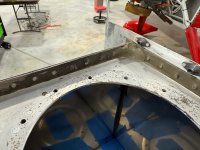
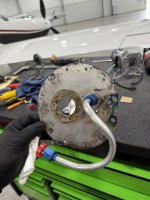
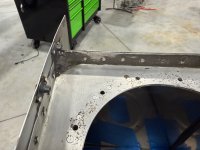
Does anyone know what sealant Van’s was recommending for fuel tank sealant around 2002-2004? I assume pro-seal. I have my tanks off, one of which the access panel on the root rib showed evidence of leakage (blue staining from around the screws). So I pulled the panel off and started to clean up the old sealant on the outside of the tank around the panel opening, and it seems like any of the sealant that was exposed to fuel has completely broken down. Feels like B 1/2 that never set up. I’m just wondering how screwed I am and how I should proceed.
This is a 2002 delivery QB RV-6, the rest of the tank nor the opposite tank show any signs of leakage.
 

Attachments

  • IMG_0919.jpeg
    IMG_0919.jpeg
    2.2 MB · Views: 49
  • IMG_0920.jpeg
    IMG_0920.jpeg
    2.3 MB · Views: 48
I repaired a tank were the builder used the rubber gaskets on the fuel senders instead of proseal. The proseal where the fuel dripped down along the outside of the rib (over several years) also turned to goo. I suspect there is a process where air, gas and proseal, over a prolonged period, promotes this breakdown. There was no evidence of proseal breakdown other than where this leak pooled.

The point. Clean the goo up, reseal and you should be fine.

Side note - the rubber gaskets on the float senders lasted 20 years before they started to leak.

Carl
 
I repaired a tank were the builder used the rubber gaskets on the fuel senders instead of proseal. The proseal where the fuel dripped down (over several years) also turned to goo. I suspect there is a process where air, gas and proseal, over a prolonged period, promote this breakdown. There was no evidence of proseal breakdown other than where this leak pooled.

The point. Clean the goo up, reseal and you should be fine.

Carl
That’s encouraging, thank you Carl. It is bizarre to me that pro-seal would break down this way on the outside of the tank but not inside. There’s plenty of time that the sealant inside the tank is exposed to gas and air as well. I had been using MEK to clean up the affected area, will that negatively impact the “good sealant” that remains? Or should I use something less aggressive?
 
I’ve seen this on my own tank. If you search proseal goo or something similar many others will report the same kind of break down. I did the vans repair kit holes and that lasted a year. I finally just drilled out the baffle and installed a new baffle with new sealant and it has been good ever since.
 
I’ve seen this on my own tank. If you search proseal goo or something similar many others will report the same kind of break down. I did the vans repair kit holes and that lasted a year. I finally just drilled out the baffle and installed a new baffle with new sealant and it has been good ever since.
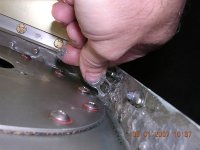
Luckily, I don’t think my baffle is leaking, just the access panel, but I do worry how much the leak may have compromised the sealant on the bottom edge of the baffle. 90% of the oversealing on the rivets on the bottom edge of the baffle was compromised, wet to the touch and wiped off with MEK.
 

Attachments

  • IMG_0921.jpeg
    IMG_0921.jpeg
    2.4 MB · Views: 39
Luckily, I don’t think my baffle is leaking, just the access panel, but I do worry how much the leak may have compromised the sealant on the bottom edge of the baffle. 90% of the oversealing on the rivets on the bottom edge of the baffle was compromised, wet to the touch and wiped off with MEK.
My tanks needed to be re-sealed completely and it was a major job to clean out the degenerated sealant goo. I tried many solvents and the most effective contained toluene. One of the products was spray painting gun wash and the other was the reducer for an acrylic enamel paint. These solvents did not harm the sound sealant.
If you need to soften or dissolve sealant that is still solid then polygone or methylene chloride will do the job. Methylene chloride was commonly available in paint stripper but it has become less readily available in US. Apparently Ace Hardware have epoxy remover that can dissolve sealant.
 
Get some PolyGone sealant remover from Aircraft Spruce. It is a gel that you brush on and it will break down the sealant. You can clean it off with acetone.
 
Sealant reversion is a known phenomenon, although no one here has ever been able to explain the chemistry.
 

Attachments

  • DSCN1016.JPG
    DSCN1016.JPG
    234.7 KB · Views: 33
I repaired a tank were the builder used the rubber gaskets on the fuel senders instead of proseal. The proseal where the fuel dripped down along the outside of the rib (over several years) also turned to goo. I suspect there is a process where air, gas and proseal, over a prolonged period, promotes this breakdown. There was no evidence of proseal breakdown other than where this leak pooled.

The point. Clean the goo up, reseal and you should be fine.

Side note - the rubber gaskets on the float senders lasted 20 years before they started to leak.

Carl
inside the fuel tanks, the proseal is constantly exposed to either air or fuel. Don’t understand why this is different outside the tank. More likely pour weight matching of components. I repaired a badly leaking tank. Once I got inside, I could literally scrap the proseal off with my fingernails. It was far too light of a gray to have been mixed correctly. I am sure there are other things that cause it to fail.
 
Back
Top