Van's Air Force

The definitive Van's Aircraft support community! Buying, building or flying an RV? Join our exclusive family of mentors and enthusiasts!

Fuel Tank…Again

Jav8or

Member
Successfully repaired my LH tank. Thanks to everyone for the guidance. Especially the EAA member who guided me locally.

But now since I have had the tanks full for over a week, the RH tank has started to leak.
This one is undoubtedly easier (KNOCK ON WOOD), since it’s coming from one of the screws on the sender.

My first inclination would be to try and tighten it, but the sender itself doesn’t have a nut plate , unlike the access cover it is attached to.

Any suggestions prior to me pulling this thing off for thanksgiving, lol!?!
 
Successfully repaired my LH tank. Thanks to everyone for the guidance. Especially the EAA member who guided me locally.

But now since I have had the tanks full for over a week, the RH tank has started to leak.
This one is undoubtedly easier (KNOCK ON WOOD), since it’s coming from one of the screws on the sender.

My first inclination would be to try and tighten it, but the sender itself doesn’t have a nut plate , unlike the access cover it is attached to.

Any suggestions prior to me pulling this thing off for thanksgiving, lol!?!
? No nutplate? Unfortunately only one path. Remove sender & access cover, clean it all up, reseal, reassemble with a dab of proseal in each screw hole.
If I were doing the repair, I'd definitely install nutplates for those sender screws while I was at it.
Sorry about Thanksgiving...
 
? No nutplate? Unfortunately only one path. Remove sender & access cover, clean it all up, reseal, reassemble with a dab of proseal in each screw hole.
If I were doing the repair, I'd definitely install nutplates for those sender screws while I was at it.
Sorry about Thanksgiving...
Yeah,

That’s what I was thinking.

Again, it isn’t hard, but if there was some magic bullet, would definitely want to try it first
 
There should be nutplates holding the sender screws to the access plate. How else would they be able to be tightened?

I would recommend replacing the phillips head screws with socket head screws. Much easier to access and tighten with the tank on the wing.
Use some PolyGone sealant remover on the access panel, scrub and prep the surfaces, make sure they are cleaned off completely before resealing with new sealant. Soak the new screws in some acetone to make sure they are squeaky clean (don't try to reuse the old screws).
 
Just because you can’t see a plate nut doesn’t mean it isn’t there. You wouldn’t be able to see them because they are riveted on the access cover plate, not the sender, and inside the tank where they wouldn’t be visible. I’m guessing you didn’t build the tanks. The pic below is typical way plate nuts are installed for attaching a fuel sender.

You’ll get multiple opinions, so here’s mine.

Don’t tighten the screw to try and fix. Until you reseal the screw, tightening won’t fix it and adds the potential for damaging the plate nut or stripping or breaking the screw. If the leak is coming from under one screw and not the flange of the sender, do the repair on just that screw. Don’t mess with the others as in, if it ain’t broke don’t fix it. Anytime you break a sealed surface, there is a potential to create a leak. Remove, clean, and install a new screw with Proseal. I would seek out that EAA person that helped you on the other tank for guidance.

If the leak is from under the flange of the fuel sender, that’s a much bigger job.

Good luck.
 

Attachments

  • IMG_2674.png
    IMG_2674.png
    700 KB · Views: 20
Just because you can’t see a plate nut doesn’t mean it isn’t there. You wouldn’t be able to see them because they are riveted on the access cover plate, not the sender, and inside the tank where they wouldn’t be visible. I’m guessing you didn’t build the tanks. The pic below is typical way plate nuts are installed for attaching a fuel sender.

You’ll get multiple opinions, so here’s mine.

Don’t tighten the screw to try and fix. Until you reseal the screw, tightening won’t fix it and adds the potential for damaging the plate nut or stripping or breaking the screw. If the leak is coming from under one screw and not the flange of the sender, do the repair on just that screw. Don’t mess with the others as in, if it ain’t broke don’t fix it. Anytime you break a sealed surface, there is a potential to create a leak. Remove, clean, and install a new screw with Proseal. I would seek out that EAA person that helped you on the other tank for guidance.

If the leak is from under the flange of the fuel sender, that’s a much bigger job.

Good luck.
Thanks.

You’re right. I didn’t do the tanks, but I did the majority of the resealing for the other tank. If all I have to do is reseal some screws…easy day.

The hardest part of the job is literally pulling the tanks off!

Additionally, I would repair all screws. Not doing so, bit me on the repair of the other tank. Once I resealed it, I did the ballon test, and one of the I screws didn’t touch, made ever so small bubbles. Then I had to pull the plate and sender to reseal that portion.
 
Update:

Since I had some time last week before i pulled the tank. I tightened the fuel sender bolts to se what would happen. Waited a few days, no leaks!

I took the plane up for a few laps in the pattern. Leak, lol!

Pulled the tank yesterday and did a pre mx leak check. Zero bubbles.

However, I know there is a leak becuase of the blue staining directly under the sender bolts.

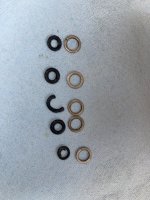
Pulled everything apart and voila, damaged o rings. Didn’t even think to look for these because the other tank did not have them. They sit pressed into the washers but i pulled them out to inspect.

Now I need new washers becuase without the orings, the inner diameter of the washer is too large.

Uuuugghhhh!
 
Pulled everything apart and voila, damaged o rings. Didn’t even think to look for these because the other tank did not have them. They sit pressed into the washers but i pulled them out to inspect.
nobody would think to look for orings there, as it is non standard, not to mention the fact that orings generally dont work on threads as the inner sealing surface. I'll never understand how builders think they can get clever and changes things that have been so well proven.
 
While we're on the subject:

RV-7 w/ 360 hours, Quick build tanks (Philippines) circa 2016. SAF-AIR CAV-110SS QD valve -- Viton o-rings.

Where's the leak -- Is it the CAV NPT fitting sealant, the CAV o-rings, the bung flange-to-tank, others?

View attachment IMG_0247.jpeg
 
Back
Top