Van's Air Force

The definitive Van's Aircraft support community! Buying, building or flying an RV? Join our exclusive family of mentors and enthusiasts!

Fuel System Pressure Testing

Brantel

Well Known Member
Benefactor
Bob's conundrum has got me nervous about the fact that I have not pressure tested my -IS fuel system. I think it would be a good idea to do that before my Avionics kit shows up and I start filling this thing full of wires and modules. That being said, the engine is mounted and hooked up as much as I can at this time and that includes the fuel lines.

The question:

Is there any reason I should not pressurize the entire fuel system with the exception of the fuel tank? Would doing so, with the engine connected, put the fuel rail regulator or injectors in any risk of damage?

I plan to plug the lines where they connect to the fuel tank, use the fuel pressure transducer port for a pressure gauge and the fuel drain manifold for the Schrader valve.
 
Maybe not a complete answer - but the normal pressure for the fuel system is 40-45 psi. Unless there is some difference between air and fuel I would think you are good to at least 45 psi. But to be ultra safe, can't you easily disconnect the engine fuel hoses at the engine and plug them or connect them together? I know the supply hose is easy to get to, I don't remember the return hose routing.

I definitely absolutely think you should get the pressure test done, if only for peace mind if you do get a leak.

I tested mine, but it was hard to look for bubbles on the firewall penetrations - so when I smelled gas in the foot wells I spent a lot of time worrying about getting the rudder pedals off etc.
I decided to look first in the unlikely but easier to access fuel pump assembly & found it there. (the airflow was carrying the smell forward under the seats)

It would have saved a lot of worry and anguish if I had gotten the mirror out & gotten a good look a the firewall fittings when I was doing the test.
 
I capped the tank fittings and made a loop for the top firewall fittings so basically pressured tested all the lines in the fuselage section except the fuel tank. I found out the suction side fuel filter into the fuel pumps will only hold around 12 psi before leaking air. I bypassed the filter and all was good for over a month or two.

I should test mine again now that I’ve installed the engine.

Dave
 
I capped the tank fittings and made a loop for the top firewall fittings so basically pressured tested all the lines in the fuselage section except the fuel tank. I found out the suction side fuel filter into the fuel pumps will only hold around 12 psi before leaking air. I bypassed the filter and all was good for over a month or two.

I should test mine again now that I’ve installed the engine.

Dave
My personal thought is to test the system while things are still accessible. The 12 is not a big plane inside, with alot of stuff crammed in there. So verifying the integrity of the fuel system ahead of time seems obvious to me. Even before the lower skin is on, and maybe some other panels. Lots of rigid tubes on a 12IS fuselage system, and at 40-45psi, that could pump alot of fuel in a big hurry.
 
My personal thought is to test the system while things are still accessible. The 12 is not a big plane inside, with alot of stuff crammed in there. So verifying the integrity of the fuel system ahead of time seems obvious to me. Even before the lower skin is on, and maybe some other panels. Lots of rigid tubes on a 12IS fuselage system, and at 40-45psi, that could pump alot of fuel in a big hurry.
I was discussing this privately with another 12iS owner - Tom, isn't this a business opportunity for you? :)

As was pointed out prior, Van's has a fuel tank leak checker for sale. A simple kit that allowed builders to pressure test their setup with instructions might be something to consider.
 
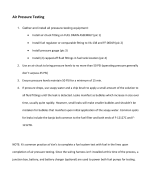
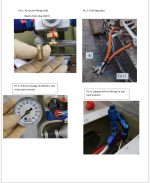
Here are the steps VAN'S uses on their factory built SLSA
 

Attachments

  • Screenshot_20250701-080921.png
    Screenshot_20250701-080921.png
    167.9 KB · Views: 159
  • Screenshot_20250701-081023.png
    Screenshot_20250701-081023.png
    1.4 MB · Views: 149
I don't think it is for most folks.
After reading bob's tales of woe, I can't really understand how that would even be a decision.
For all the builders who haven't read this thread, the whole issue could be avoided if the KAI were revised to include a simple step instructing the builder to "Pressure Test the Fuel Lines." This should be "Step 5" on KAI Page 26iS/U-08).

Given the possible consequences of failing to pressure test the fuel lines, Van's could also include a simple Fuel Line Pressure Testing kit similar to the Fuel Tank Pressure Testing Kit that is included as part of the fuel tank sub kit.

I emailed Van's support with these suggestions and was told Engineering would likely say testing the fuel lines should be considered common sense and wouldn't warrant the additional step or testing kit. I respectively disagreed considering the RV-12 must be built exactly to ASTM standards and that the KAI is full of steps that could be considered "common sense." I was told the suggestions would be mentioned at a support meeting with engineering.
 
I emailed Van's support with these suggestions and was told Engineering would likely say testing the fuel lines should be considered common sense and wouldn't warrant the additional step or testing kit. I respectively disagreed considering the RV-12 must be built exactly to ASTM standards and that the KAI is full of steps that could be considered "common sense." I was told the suggestions would be mentioned at a support meeting with engineering.
Common sense is gained through experience. The question should be what kind of experience do you want customers to have?

I should add that replies like that scare me. I wonder what other "common sense" items are omitted that I as a newbie haven't yet learned?
 
I was thinking about doing this on my -14A, but a couple of things have concerned me, so I'd appreciate some advice: (1) the AFP fuel pump is filled with preservative oil, and capped, so it's not hooked up yet, and (2) the Andair FS20 fuel selector shaft is not supposed to be rotated until fuel is in the system. So how do you test the paths to both tanks? I'd like to do the pressure test from the firewall to the fittings on the sides of the fuse before hooking the fuel line up to the engine-driven pump and (obviously) the tanks. But maybe I have to wait until I'm ready to introduce fuel into the lines. Perhaps I could test from the output side of the fuel selector back to the tank connections on the sides of the fuse, taking a chance on exercising the fuel selector once?
 
The challenge here is to realize that most builders do not have their powerplant kit on hand with the FWF parts when they are assembling KAI chapter 27 where the troublesome firewall fittings are installed in the tunnel. So in reality 2 test points are appropriate, first at end of Chapter 27 which requires a bunch of extra fittings and caps, and then again after powerplant arrives and fuel pump, filter, etc are mounted on aft cabin bulkhead before mounting engine, thus delaying installation of fuel tank. In any case the fuel system needs to be tested before any of the electrical work with the avionics kit is installed and preferable before rudder pedals are installed.
 
Looks very similar to what I plan on doing. Thanks! How did you handle the firewall mounted fittings?

Seems Van's had issues with those copper washers. They now specify and provide some washers with seal around the inside ID.
I tightened the firewall mounted fittings as reasonably tight as possible during installation.

The pressure test would determine if the entire system (less the fuel tank) would hold pressure. If it did not hold pressure, the next step was to use specialty leak detector to track down the leak.

You're correct, Vans has upgraded the washers from copper to ones with an inner seal.
 
The challenge here is to realize that most builders do not have their powerplant kit on hand with the FWF parts when they are assembling KAI chapter 27 where the troublesome firewall fittings are installed in the tunnel. So in reality 2 test points are appropriate, first at end of Chapter 27 which requires a bunch of extra fittings and caps, and then again after powerplant arrives and fuel pump, filter, etc are mounted on aft cabin bulkhead before mounting engine, thus delaying installation of fuel tank. In any case the fuel system needs to be tested before any of the electrical work with the avionics kit is installed and preferable before rudder pedals are installed.

This is the approach that I took. Ordering some extra fittings did not seem like a big deal in light of the risks involved. It was intuitive to pressure test (air) what seemed like would-be-troublesome lines as soon as they were installed.

Once I had the pumps and power plant in place, I temporarily installed the tank and tested with fuel. Round tripping the tank before avionics and harness meant a little extra work but, but at this point in a RV-12 build things are progressing fast so an extra day of work was easy to swallow. This may have been easier to tolerate due to the fact I was facing delays for avionics to even show up.
 
I tightened the firewall mounted fittings as reasonably tight as possible during installation.

The pressure test would determine if the entire system (less the fuel tank) would hold pressure. If it did not hold pressure, the next step was to use specialty leak detector to track down the leak.

You're correct, Vans has upgraded the washers from copper to ones with an inner seal.
Specifically, I was wondering if you left the engine connected to them or did you just tie them together?
 
Specifically, I was wondering if you left the engine connected to them or did you just tie them together?
From the perspective of the engine fuel lines: i capped off the forward end of the right side red fuel line (where it connects to engine).

Then I attached the pressure test manifold to the forward end of the left red fuel line to pressurize the system.

The aft side of each of these lines remained connected to the forward firewall fittings.

Then the tank lines were capped to close the fuel system for testing.
 
We're you able to maintain 45 psi on the system with the pre-pump fuel filter?
I could only get that filter to hold at around 12 psi. If I went much higher, it would start to blow bubbles past the o-ring end. I removed the filter and tested the rest of the system for a couple months with no problems.
 
We're you able to maintain 45 psi on the system with the pre-pump fuel filter?
I could only get that filter to hold at around 12 psi. If I went much higher, it would start to blow bubbles past the o-ring end. I removed the filter and tested the rest of the system for a couple months with no problems.
Dave - Sounds like you identified and isolated the problem.

No issues with my pre-pump filter or other components except for the earlier mentioned washer.
 
We're you able to maintain 45 psi on the system with the pre-pump fuel filter?
I could only get that filter to hold at around 12 psi. If I went much higher, it would start to blow bubbles past the o-ring end. I removed the filter and tested the rest of the system for a couple months with no problems.
Just for reference, mine leaked as well. Gonna try opening it up and lubing the O ring.
 
Here are the steps VAN'S uses on their factory built SLSA
For anyone that follows this procedure, be aware that the pressure gauge in this location will not show a leak that is on the suction side of the fuel pumps and check valves.
 
Just for reference, mine leaked as well. Gonna try opening it up and lubing the O ring.
Yes, I did that also. Same result. I took that filter out of the system and test both side of the system separately and was happy with the test.
I have not tested since the motor has been installed but any leak should be firewall forward or the tank. I only had 1 psi on the tank.
 
Yes, I did that also. Same result. I took that filter out of the system and test both side of the system separately and was happy with the test.
I have not tested since the motor has been installed but any leak should be firewall forward or the tank. I only had 1 psi on the tank.
I pulled it apart and it already had plenty of lube. Put it back together and made sure it was screwed in tight before putting the snap ring back in and it no longer leaked.
 
Bob's conundrum has got me nervous about the fact that I have not pressure tested my -IS fuel system. I think it would be a good idea to do that before my Avionics kit shows up and I start filling this thing full of wires and modules. That being said, the engine is mounted and hooked up as much as I can at this time and that includes the fuel lines.

The question:

Is there any reason I should not pressurize the entire fuel system with the exception of the fuel tank? Would doing so, with the engine connected, put the fuel rail regulator or injectors in any risk of damage?

I plan to plug the lines where they connect to the fuel tank, use the fuel pressure transducer port for a pressure gauge and the fuel drain manifold for the Schrader valve.
How do you know that the pressure won’t damage the filter or the input sides of the fuel pumps?
 
I pulled it apart and it already had plenty of lube. Put it back together and made sure it was screwed in tight before putting the snap ring back in and it no longer leaked.
Brantel, how much pressure did you apply to the filter and for how long? I am still at a good place to re-test the filter again before installing the tail cone.

Thanks, Dave
 
Brantel, how much pressure did you apply to the filter and for how long? I am still at a good place to re-test the filter again before installing the tail cone.

Thanks, Dave
The max pressure that filter ever sees in use is only a few psi
 
How do you know that the pressure won’t damage the filter or the input sides of the fuel pumps?
Because Vans and the people that build Vans factory planes recommend this test and have been doing them for years now with no issues.
 
Brantel, how much pressure did you apply to the filter and for how long? I am still at a good place to re-test the filter again before installing the tail cone.

Thanks, Dave
45 psi and so far about 20 hours and counting.
 
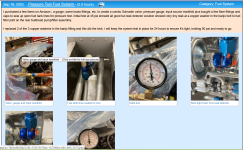
I realized that I should test the system as things became inaccessible at the forward connections through the firewall. I already had the rudder pedals in. I had leaks, had to remove the pedals. A pain but easier than now with the aircraft almost complete. I still had some issues but these helped on one fitting that just would not seal completely:


I checked with Vans and they said using them was acceptable. I was able to hold 55 PSI for DAYS!

Henry
 
I emailed Van's support with these suggestions and was told Engineering would likely say testing the fuel lines should be considered common sense and wouldn't warrant the additional step or testing kit. I respectively disagreed considering the RV-12 must be built exactly to ASTM standards and that the KAI is full of steps that could be considered "common sense." I was told the suggestions would be mentioned at a support meeting with engineering.

They're right, technically and that's pretty much all engineers care about.

But I think there's something else here and it has to do with the changing nature of instructions over the years.

Back when I built my 7A, there were separate sources for instructions. There was the big handbook which had a narrative of what you should be doing (thanks, Ken Scott) and there were the drawings. Over time, the narrative got shorter and shorter as you transitioned to just looking at the drawings and began to see a bigger picture and figure it out. Of course you had to also, because Van's left you on your own for engine and avionics.

We don't do it that way anymore. Now we have this "next step" method and we also have just numbers for things instead of names of parts and over time in a build, you sort of encounter this "Stockholm Syndrome" of addiction to the "now do this exact next step" which you blindly follow without needing to ask "but why?". You don't see the big picture and part of the reason for that is with the numbered parts instead of the name of the part, you may not even know what it is that part is supposed to be doing. "Oh, I'm installing 'F-somethingorother'? Cool."

I mean, geez, you can build that space shuttle-like spaghetti of the fuel pump assembly without ever once needing to know what 14 or 15 different fittings and lines are doing.

Consequently, we may not even fully understand how the fuel system works, let alone see the big picture that leads us to the land of common sense. Builders aren't conditioned to see the big picture. They're only conditioned to follow the next step and pressure testing isn't a next step.

I would think it even more "common sensical" to leak test the fuel tank during the build, and yet, there it is as a "next step" in that section.
 
Last edited:
Builders aren't conditioned to see the big picture. They're only conditioned to follow the next step and pressure testing isn't a next step.

I would think it even more "common sensical" to leak test the fuel tank during the build, and yet, there it is as a "next step" in that section.

I agree, and I'd argue that Van's encourages this "next step" mentality when one of the major RV-12 marketing messages on the website is (my underlines added):

"FAST BUILD AND COMPLETE PLANS You can build an RV-12 more quickly than any of our other models, and our plans are detailed, step-by-step and fully-illustrated."

Even without going into specific steps for pressure testing, a simple entry to pressure test the fuel lines at the conclusion of Section 27iS could make all the difference.
 
Even without going into specific steps for pressure testing, a simple entry to pressure test the fuel lines at the conclusion of Section 27iS could make all the difference.
I agree, there are steps that say "now is a good time to paint", why should there be any resistance to saying "now is a good time to test"? There are many teen builds out there with varying degrees of experience that would certainly benefit from the added guidance. But given some of the long standing irregularities in the plans, I figure it must be a major process to make any kind of change even if it's an obvious and simple correction.
 
Back
Top