Van's Air Force

The definitive Van's Aircraft support community! Buying, building or flying an RV? Join our exclusive family of mentors and enthusiasts!

Fuel system leak testing

Brantel

Well Known Member
Benefactor
I have been researching fuel system leak testing and see that it is common to use mineral spirits instead of gasoline for this test since it is less likely to ignite and burn the airplane and everything around it.

Any reason not to do this?

I completed a pressure test with air but I don’t want to find a puddle of gas in the floor of my airplane waiting to burst into flames.
 
I have been researching fuel system leak testing and see that it is common to use mineral spirits instead of gasoline for this test since it is less likely to ignite and burn the airplane and everything around it.

Any reason not to do this?

I completed a pressure test with air but I don’t want to find a puddle of gas in the floor of my airplane waiting to burst into flames.
Did you go over every rivet and seam with HVAC leak detector or soap/water solution? If you did and there weren't any bubbles, you are likely good to go using only air in the tanks. If you used the mythical "balloon test", it's anybody's guess...
 
Did you go over every rivet and seam with HVAC leak detector or soap/water solution? If you did and there weren't any bubbles, you are likely good to go using only air in the tanks. If you used the mythical "balloon test", it's anybody's guess...
Yeah, did all that for the tank with soap and water and low air pressure.

More concerned with the distribution system. I also high pressure tested it all as well but some fittings were blinded off like where it attaches to the tank.

No way to fully test it for sure without putting fuel in it and running the pumps.
 
Some of us pressure test them with air blanking off one end and pressuring the other.

 
I pressuriz the tank to 1-1.5 psi and spray the entire structure with soapy water. In my experience, if it will hold 1 psi of air, it will not leak unpressurized fuel. Not sure you are going to “see” mineral spirits weeping without some kind of dye.

Never used a balloon, but doubt it creates 1 psi in the tank. Takes a large volume of air to do that.
 
I capped the tank lines and high presure tested the distribution lines to 50 PSI and it held for 10 days. For the tank, I capped the fittings. and poured about 2 gallons of 100LL in left it sitting several days in each side and looked for leaks and dye stains. So only real fear is the 2 connections on tank when installed which will get checked on permanent tank install with mark 1 eyeball and borescope using the same 100LL.
 
Never used a balloon, but doubt it creates 1 psi in the tank. Takes a large volume of air to do that.

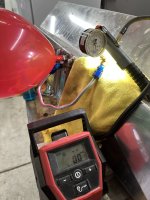
Not what Brian needs at this stage, but the balloon is making the rounds lately...or I'm just coming across it because I'm working on a leaking tank for a friend. Anyway, a balloon can be helpful, it works to limit pressure on one end with the volume and pressure coming from an inflator or similar on the other. Pump up the balloon, shut off the inflator, now you have a lightly pressurized system to test against. The balloon is not secured as another layer of protection against over pressure, repeat the fill step as necessary to cover for the small leak wherever it is attached.

That fuel line going from the tank to the gauge/schrader setup was originally shaped to join the two fittings at the firewall. I tested my system piecewise. Along with some good luck, this approach worked. I capped the lines at the tank fittings, and/or connected them at the firewall up front, and tested sections with what I recall being about 40psi. After I had validated it in 2 or 3 sections I was comfortable putting it all together and running the system with fuel in the driveway.


IMG_5247.jpeg
 
Back
Top