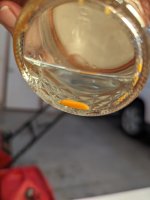
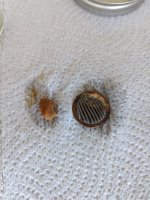
Went to do my pre-flight, and a glob of orange-ish viscous material appeared in my fuel checker. It adheres like an oily substance. I had just fueled, let it sit for an hour, cleaned the tube, and I'm not seeing this anymore. Thoughts?
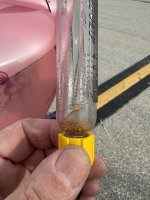




Can you catch a few gallons and filter through a very fine media to look for contamination?Unscrew the sump drains and drain while vigorously rocking the wing around.
RV-12 with a central tank. The goo on the side is the same as the crap that first came out.Can you catch a few gallons and filter through a very fine media to look for contamination?
Your photo in the first post shows a lot of something clinging to the barrel above the orange goo that just doesnt look right.
Both wings or only one side?
Cheap insurance if you do so.Do I need to drain the entire tank? Replace the fuel filter?
Yes and yes. This looks like it might be autofuel that has sat around for a while and stagnated, washed out by 100LL. It can turn to a lumpy mess and clog things up. Pull your quick drain and drain out ALL the fuel, either filtering it as it comes out or running it through a filter (even a paint filter) as you put it back in. In the old days they used a chamois. If this is in the tank, it might also be in your fuel filter. You probably don't want to find this out flying........... You might pull the fuel lines firewall forward and make sure they are clean, especially if there are low points in a fuel line bend. Not familiar enough with -12 to know where fuel lines go but flushing/draining from the most distal part of the fuel system would also make sense..........Do I need to drain the entire tank? Replace the fuel filter?


I have to add to Keith's response:A few years ago, I had a similar thing occur (see attached pics). It would look exactly like your pic with the "goo" on the side just like what you have. The fuel came out of a communal 100LL fuel tank that somehow got contaminated. We finally figured out that it was some sort of microbe that grew in the fuel. There may have been some water or rust contamination that also contributed. This is known to happen in jet fuel but seldom in avgas but it can happen. Bottom line is that this stuff was able to pass through a fuel filter (that was also supposed to stop water) and my fine screen fuel filter and make its way into my carburetor. It would corrode metal (especially any steel) and finally caused my carb accelerator pump to stiffen and almost seize. It would pass through and then grow or somehow accumulate to a jelly like consistency. After we identified the source of the bad fuel we had a really hard time eliminating it from our aircraft tank. After doing a lot of sumping and draining and not seeing any more, we would still occasionally see the same thing. It was very persistent.
Finally my friend determined that the best way to fully eliminate it was to completely drain the tank and system again and then set up a small blower to continually blow air into and out of the tank to COMPLETELY dry out every nook and cranny. It seems like the drying finally killed the microbe where fine filtering didn't do it. After that (plus never using that supply tank again) I have not had any problems. If it were me, I would do what Roadjunkie1 said and drain everything and put that gas in your lawn mower.
Good luck
Keith
To add to what my friend and flying buddy Rick (rag) said above and what Ralph says on his post, this problem can exist even if you are flying on a regular basis so if you see any of that stuff then take the actions above. Fortunately it didn't cause me an off field landing but it did cost me a very expensive carb overhaul after I notice that my throttle control was really stiff. I blamed it on the cable until I figured out it was actually the accelerator pump causing the throttle arm to get so stiff I could barely move it with my hand. We found LOTS of that crud and corrosion inside the carb. It had made it through the inline fuel filter after the tank and also made it through the small carb filter (which showed no evidence on the little screen).Had a Super Stol in the shop a few years ago, same contamination. As it sat for half a year, fuel samples came out with globs of it.
I pulled the tanks, thankfully removable, & sent them out to be steam flushed. I also found deposits all the way through the whole fuel system. All lines, valve, filters, electric & mechanical fuel pumps were replaced as well extensive carb overhauls. So check everything!
I also had a similar condition with a F-1. The owner actually had an emergency return to the field, engine lost power. I found globs all through his fuel system too. Ever re-plumb a Rocket? Not fun! He also had to replace pumps, gascolator, fuel servo, & spider.