Van's Air Force

The definitive Van's Aircraft support community! Buying, building or flying an RV? Join our exclusive family of mentors and enthusiasts!

Flipping the wing

TShort

Well Known Member
Friend
Anyone come up with a simple / safe way to flip the wing with 2 people?

When clecoing the skins on with the LE not in place, there is no way to set it safely on either the leading or trailing edge. Aft, there are skins to bend. Fwd, there are unsupported LE ribs, wiring, etc. With 2 people, it is just heavy and awkward enough to make it tricky to flip without setting things down part way through.

Curious what others are doing.
 
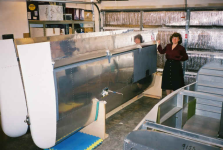
Found building this wing jig very useful -- used a wing nose rib as a template.

View attachment 114935
It will be easy once the whole wing is skinned, but during the skinning process it needs flipped with only the bottom skins on. This leaves the LE ribs dangling off the front and thin skin off the back, it is pretty bulky / heavy and probably can't just be rotated around by 2 people without stopping to swap hands partway through...
 
You can also have the nose skinned and fuel tank bolted-in place with the top skins completed too, and then install your bottom skins in the wing-jig. Worked very nicely for me, and my 9'er flew in perfect rig on it's first flight. Per-punched skin and ribs make things work very nice!(y):cool:(y) BTW -- photo taken in 2002 (24-years ago), where my first test fight was October 31st, 2004.

View attachment 114954
This is the RV-15 forum, and the wing is quite a bit different (and the assembly order is very different) from a low-wing RV….
 
This is the RV-15 forum, and the wing is quite a bit different (and the assembly order is very different) from a low-wing RV….
I appreciate your keen observation Paul -- many times while viewing topics in the forum feed, the RV model doesn't always standout. And yes, there are several new models of RV's that take very different construction techniques. And yes -- the RV-15 wing likely needs to be built on a flat table top. However, building a wing jig would still be of great value for safe wing storage after construction -- right? (y):cool:(y)
 
Making the flip of the wing from bottom up to top up with zillions of Cleo’s in took some planning. We picked about 5 places at intersections of both the fore and aft spar with ribs. Then removed interfering Clecoes. After staging 4” x 4” x ~4” blocks, I recruited three folks visiting the project and Paul to flip it. One person on each corner and one to ensure the blocks are appropriately placed. Seemed work fine.

I would definitely wait until you can recruit at least two, and better three, more folks. They don’t have to be aviation folks, just careful and relatively strong (except the block placer, people.
 
Making the flip of the wing from bottom up to top up with zillions of Cleo’s in took some planning. We picked about 5 places at intersections of both the fore and aft spar with ribs. Then removed interfering Clecoes. After staging 4” x 4” x ~4” blocks, I recruited three folks visiting the project and Paul to flip it. One person on each corner and one to ensure the blocks are appropriately placed. Seemed work fine.

I would definitely wait until you can recruit at least two, and better three, more folks. They don’t have to be aviation folks, just careful and relatively strong (except the block placer, people.
Louise, did you happen to take any photos of this? Thanks much.
 
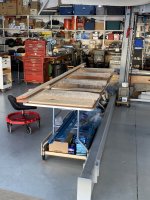
I've been pondering this dilemma since I ordered the kit at Oshkosh. I have in mind a way to weld up some rotating flipping stands but until the skins are on I think this will be overly floppy. I made some carpeted rails to rest it on with bottom clecos in place, see image. The plans make it clear they want all skins in place prior to riveting. I also suspect having several hundred clecos installed will add a lot to the weight and clumsiness. I'm guessing each wing comes in at 100 pounds give or take, plus clecos. I've also pondered making some wing end removable handles to make it easier to hang on to. If these handles were to extend beyond the leading and trailing edges of the wing then it could be set on them as one repositions for the second half of the flip.
 

Attachments

  • IMG_1214.JPG
    IMG_1214.JPG
    1.8 MB · Views: 65
Making the flip of the wing from bottom up to top up with zillions of Cleo’s in took some planning. We picked about 5 places at intersections of both the fore and aft spar with ribs. Then removed interfering Clecoes. After staging 4” x 4” x ~4” blocks, I recruited three folks visiting the project and Paul to flip it. One person on each corner and one to ensure the blocks are appropriately placed. Seemed work fine.

I would definitely wait until you can recruit at least two, and better three, more folks. They don’t have to be aviation folks, just careful and relatively strong (except the block placer, people.
Thanks, Louise.

I have made padded rails similar to those in the post from alphalpha. It is resting on these right now with bottom skins in place.

I will probably wait until I have more helpers to do it safely.
 
With two people, we grabbed at each end by the spars and/or mounting structures. We moved off the table towards the TE side, lower the TE as we went such that we end up holding it mostly by the main spar as it shifted. It's a little bit awkward but at that point we could shift hands and lift it back up, swinging the TE past the end of the table to the opposite side that it came from.

Try to describe the same thing another way. I think the important part is that we lowered the wing close to the ground to change hands, thus the orientation of the wing while lifting it up. This as opposed to trying to flip the wing while lifting it above the table.
 
With two people, we grabbed at each end by the spars and/or mounting structures. We moved off the table towards the TE side, lower the TE as we went such that we end up holding it mostly by the main spar as it shifted. It's a little bit awkward but at that point we could shift hands and lift it back up, swinging the TE past the end of the table to the opposite side that it came from.

Try to describe the same thing another way. I think the important part is that we lowered the wing close to the ground to change hands, thus the orientation of the wing while lifting it up. This as opposed to trying to flip the wing while lifting it above the table.
How much do you think it weighed?
 
I work odd shifts and live out in the country, getting a bunch of people here is tough to coordinate (and I am impatient!) - so here is what I did, worked well with 2 people.

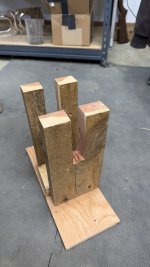
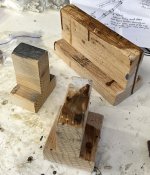
I cobbled together this small stand, it has a cutout to accommodate the wiring harness in the LE and is just deep enough to clear the nose ribs.

IMG_7534.jpeg

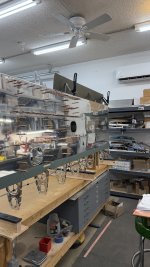
We picked up the wing, rotated it 90 degrees and set it into the stand temporarily. This allowed me to go to the other end and hold things while John swapped hands around, then I went back to my end and picked it back up and we turned the wing over onto padded blocks to clear the clecos:


IMG_7531.jpeg

I did screw the stand down to the bench.

Went well, no issues. Two of us were able to lift and flip it without any trouble.
 
I work odd shifts and live out in the country, getting a bunch of people here is tough to coordinate (and I am impatient!) - so here is what I did, worked well with 2 people.

I cobbled together this small stand, it has a cutout to accommodate the wiring harness in the LE and is just deep enough to clear the nose ribs.

View attachment 115291

We picked up the wing, rotated it 90 degrees and set it into the stand temporarily. This allowed me to go to the other end and hold things while John swapped hands around, then I went back to my end and picked it back up and we turned the wing over onto padded blocks to clear the clecos:


View attachment 115292

I did screw the stand down to the bench.

Went well, no issues. Two of us were able to lift and flip it without any trouble.

Could it be riveted in this position? I am not far enough along yet but is the wing the only surface that needs both skins on before riveting or do the flaps and ailerons require this?
 
Could it be riveted in this position? I am not far enough along yet but is the wing the only surface that needs both skins on before riveting or do the flaps and ailerons require this?
Do you mean standing vertically / on the LE? In my case above there is no way I would leave it like that, the simple little stand I built was just to hold it for 10 seconds while I moved my hands to enable flipping it another 90 degrees.

I suppose you could rivet it in that position, but leaving it laying on the bench is quite easy and standing it up would require fixtures of some sort.

Both ailerons and flaps require all skins to be fully assembled / cleco’d before riveting.
 
Do you mean standing vertically / on the LE? In my case above there is no way I would leave it like that, the simple little stand I built was just to hold it for 10 seconds while I moved my hands to enable flipping it another 90 degrees.

I suppose you could rivet it in that position, but leaving it laying on the bench is quite easy and standing it up would require fixtures of some sort.

Both ailerons and flaps require all skins to be fully assembled / cleco’d before riveting.
We had a 5.7 earthquake only ~30 mile (50 km) away so I would never leave my precious and expensive work in this position. First thing we did after the shake was check the shop! (Fortunately, no damage.)
 
Here are a couple jigs I used on my RV-3B that definitely came in handy.

This one shows three sizes of Tees that I made. They are merely two pieces of 2x4 glued together. I used Titebond 3 because I had it on hand and it's good stuff. The glue doesn't matter too much.

These hold whatever they are supporting at a height high enough that clecoes don't touch the work surface. The Tees are easily stored or moved around and can be made any length that you can get straight 2x4s in.

Tees.JPG

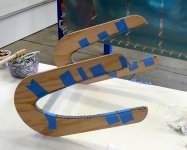
This next one might or might not be useful. I used it mostly on my leading edge fuel tanks, which are a lot different than the RV-15s have. I used C-clamps as supports to prevent the Rocker from rocking. The C-clamps added a third contact point for stability while being easily adjustable. I recommend two C-clamps for assurance that one won't flip out of the way.

As with the Tees, the Rocker was deep enough to prevent interference with the clecoes. Unfortunately the photo didn't pick up on it but the two sides are held together with pipe and pipe ends. You can see its shadow.

Cradle Rocks.jpg

Dave
 
Back
Top