Van's Air Force

The definitive Van's Aircraft support community! Buying, building or flying an RV? Join our exclusive family of mentors and enthusiasts!

Flat spot on tire

We had a little incident on landing (will post in another thread) that resulted in our right main skidding for maybe 50ft. As a result we have a flat spot and I’m not sure whether it is safe to fly on. What do you all think and how do you determine whether a tire with a flat spot is safe to fly on?
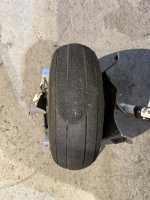
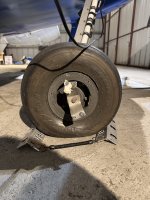
IMG_8413.jpeg
IMG_8404.jpeg
 
We had a little incident on landing (will post in another thread) that resulted in our right main skidding for maybe 50ft. As a result we have a flat spot and I’m not sure whether it is safe to fly on. What do you all think and how do you determine whether a tire with a flat spot is safe to fly on?

View attachment 76581
View attachment 76582
I'm pinching pennies every day and I still would replace that tire ASAP
 
We had a little incident on landing (will post in another thread) that resulted in our right main skidding for maybe 50ft. As a result we have a flat spot and I’m not sure whether it is safe to fly on. What do you all think and how do you determine whether a tire with a flat spot is safe to fly on?

View attachment 76581
View attachment 76582
Goodyear recurrent A&P/IA Training materials say that if there is any exposed tire cord then remove tire from service.
If your stranded, not at your home airport, are able to complete a full inspection of the tire/wheel/gear/wheel bearing - and feel like you want to ferry the plane somewhere where repairs can be properly effected - then your decision is "experimental" in nature. Expect out-of-round vibration at a minimum. I'm conservative - My RV7 would be grounded for proper tire etc replacement (not meaning a wheel pant).
 
We had a little incident on landing (will post in another thread) that resulted in our right main skidding for maybe 50ft. As a result we have a flat spot and I’m not sure whether it is safe to fly on. What do you all think and how do you determine whether a tire with a flat spot is safe to fly on?

View attachment 76581
View attachment 76582
Ask your self if you would rather change a tire on your terms or on some ramp at another airport which might not have tools available when you are AOG...
 
Tire manufacturers have specs on their websites. You may want to look. Also the FAA has an advisory circular on tire care and inspections. Personally if there's any area at all where the tread is warn away I would change it. I like doing maintenance on my terms and not when my plane demands it.
 
That tire is toast, looks like an accident waiting for a time and place to happen. Replace the tire, Call Wilkerson Tires and get a retread for $91 shipped. You cannot order off the website, you have to call them. I’ve used Wilkerson retreads on my RV-3, RV-4 and now my RV-8. I’ve never had any shimmy, never had to balance a tire and they last longer than new tires.

 
There will probably be a forward speed where the tire's rotation rate in hertz matches the natural frequency of the gear leg. When a natural frequency is matched by a forcing frequency, the result is resonance, a vibration with significantly increased amplitude...gear shimmy.

The aluminum strip clamped to the gear leg, as well as the low tire pressure, says shimmy has been a problem. And it fatigues the wheel pant mounting points. Might be a connection here, eh?

BTW, put more air in the new tire. The other common way to tear up wheel pants (and pinch tubes) is sidewall spread under load, particularly given a little swerve. The tire rubber catches the fiberglass, followed by crunchy noise.

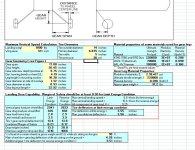
This is one of the spreadsheets Neal Willford (https://www.flyingmag.com/a-precision-approach/) published in Sport Aviation some years ago. The sidewalls spread under load, a lot more than most folks think. In this example, the tread is squashed to the bead at 36 psi given the limit energy condition.

RV7 Tire Deflection.jpg
 
That tire is toast. You might get a few more landings out of it, but then again you might not. replace it.

You're going to have to pull it off to replace that wadded up inner wheel pant bracket anyway. Unless you're in the boonies and being chased by something scary there's no benefit at all to flying it that way and tons of potential downside.
 
Replace the tire. If your budget can't afford it, then your budget certainly can't afford what might happen next.
The problem with a flat spot is that the tire will seek out this same spot the next time you brake too hard.
As a former racer, I know you might be able to get acceptable balance (especially with a static balance), but the real danger is
blowing the tire on the next landing.
 
I think we all agree the tire needs to be replaced. So please, please do that. But I want to know the back story of how both the inner and outer brackets that hold the wheel pants got destroyed. Whatever happened, I'll bet it made a terrible noise.
 
Hi Dan,

A correction. What you’ve described is a forced vibration due to the out-of-balance condition of the tire. True landing gear shimmy is a stability phenomena and not a forced vibration phenomena. In that respect, landing gear shimmy is like aeroelastic flutter (but without the aerodynamics). But I agree, an out-of-balance tire will get your attention at the resonant frequency and most will erroneously call it shimmy.

BTW, the tug is working great!

Thanks Carl. You're right, proper terms are important. It's good to have smart friends!
 
Wow. That's some high-level engineering terms right there. Working in industry engineering and maintenance down South all my career, I'm more used to having vibrations described as "You can just barely feel it" at one end of the scale, to "Shaking like a dog crappin' a peach seed" at the really bad end of the scale. :rolleyes:
 
Back
Top