Van's Air Force

The definitive Van's Aircraft support community! Buying, building or flying an RV? Join our exclusive family of mentors and enthusiasts!

Fiberglass Cloth, What to Buy?

N804RV

Well Known Member
Friend
Anyone have recommendations on what weights and weave for cloth? Also the Carbon Fiber for making the windscreen fairing more rigid across the top? The supplier offered a 4" tape. He said I could get carbon fiber in a bi-directional weave, but there's a minimum pre-cut size to buy.

Also flox, micro-balloons and such; is there a special type or a recommended amount to buy?

I've already priced out the West systems epoxy and hardener. I was gonna just start with a gallon size since they're just down the road from me.

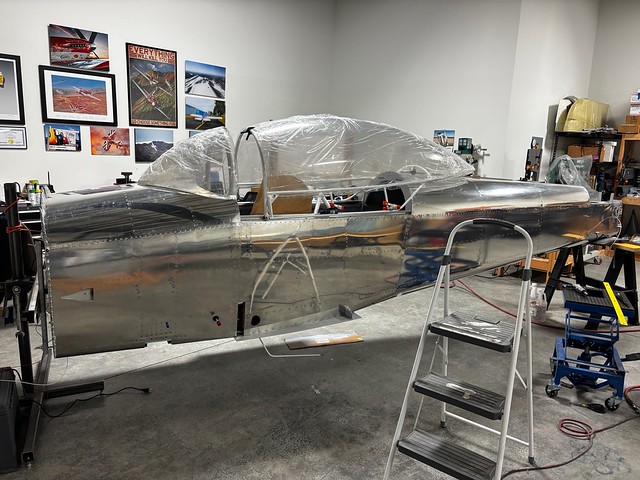
55013090690_4395b91b12_z.jpg
 
Last edited:
Dan's the Man. Read every thread.

I'm not expert, but I used this from Spruce. It's not a nice tape, but easily cut.
282 STYLE CARBON FIBER CLOTH 60" WIDE

I bought rolls of fiberglass tape. 1,2,3 & 4 inch. Very handy for small stuff.

Micro Balloons, Flox and Cab-O-Sil are usually in a 1lb bag. I nab empty gallon size jugs from recycling. Windshield wash jugs are pretty strong. I rinse them and dry then transfer the products. Easy to dispense.

I buy the gallon epoxy and quart gardeners (205,206) as well but I use Yorker bottles for daily dispensing. The cans make a mess.

Buy two rolls of peel ply. You will use a lot.

Visit a mattress store. They always have tons of the 4mil plastic used to wrap the mattresses and box springs. It's free and works great for layups.

Save the kids pudding and fruit cups. Wash and use for mixing.

Tongue depressors from a dollar store for mixing.

Buy a gram scale.
Wax, Heavy packing tape, Yellow Frog tape. Frog tape goes down first. Make marks on it. Packing tape over that. Wax it. No problem with layups sticking. Marks are visible through the layup.

Next one I got from my Mentor Dave Paule. Vinegar. It cleans up epoxy. Non idea how, but it works. Just keep it away from layups. Good for cleaning it off tools and hands.

I have an Excel epoxy calculator. Shoot me an e-mail if you want it. Plug in dimensions and it spits out quantites of products from epoxy to primer.
Wirejock at yahoo dot com
 
Just a thought...

On my RV-8 windshield and fairing, I used Aeropoxy PR2032/PH3660 resin/hardener instead of the West Systems products, for two reasons: The Aeropoxy is slightly stronger, and it doesn't begin losing its strength in very hot conditions as quickly as West Systems products -- conditions that might be found in, say, a windshield fairing sitting in the hot sun at a summer fly-in. It also doesn't exotherm (get hot and begin curing early) as easily as West Systems, when mixed in large quantities.

It's a little more fiddly to get the mix ratio correct, because it doesn't have the same handy pumps as the West Systems stuff. (I used a balance scale and some marked plastic cups, and it work out great.)

Having said all of that, I know plenty of RVs that have used West Systems resin for the entire project, with no apparent issues.
 
Anyone have recommendations on what weights and weave for cloth?

7781 8-harness and 7500 plain weave.

The 8-harness will wrap around a bowling ball, but the tight weave means it is harder to wet out, and easier to trap air.

Here's a 7781 application example, four stacked plies wet out between 4-mil plastic sheets, the wrapped around a complex form as one piece. Just keep smoothing it into place with gloved hands.

One ply, dry wrapped to make a pattern:
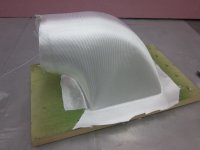
Dry Wrap.jpg

Four plies, stacked on plastic, wetted, and about to get a top sheet in order to roll out the excess resin:
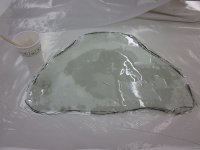
Fabric Wet.jpg

Four plies wrapped on the form for cure. A strip of peel ply around the inlet keeps the wet glass nice and tight. Thickening the future mounting flange illustrates a good use for tape.
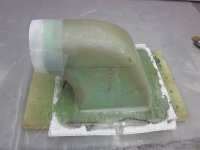
Fabric Wrapped.jpg

7500 is for panels without serious compound curves. Experiment, you'll see. Open weave, easy to wet and stipple. Builds thickness fast, at 0.009" to 0.010 per ply unbagged.

Below, 7500 wetted and rolled between plastic, then cut to size. Peel one side, transfer to the mold or form, peel the other side, and stippled into place. Generally there is little reason for glass work to be messy.
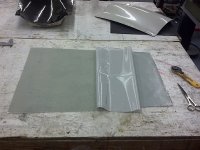
Glass Trim.jpg

Time spent on mold and form finish is always time well spent, because it means there is little need for filler and finishing on the flight component. This panel is shown as removed from the mold, edge trim only.
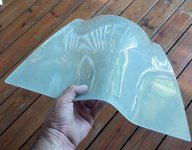
Raw Part.jpg

Also the Carbon Fiber for making the windscreen fairing more rigid across the top?

I'm not convinced there is any real merit in adding carbon to the windshield fairing. Maybe if you're trying to build one extremely thin, but that's for drag reduction, not durability.

Ken, is that 4" carbon tape unidirectional? If so, it's useless for a reinforcement over the top of the canopy.

 
Last edited:
Back
Top