Van's Air Force

The definitive Van's Aircraft support community! Buying, building or flying an RV? Join our exclusive family of mentors and enthusiasts!

F1 Initial Cowl Fitting - Looks good!

Ironflight

VAF Moderator / Line Boy
Mentor
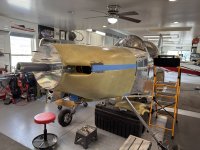
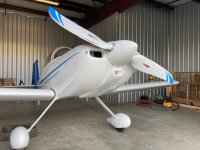
Spent this afternoon doing the initial fit of the F1 cowling - remember that this is a 20+ year old kit/cowling…and it fits pretty well with minimal trimming! Of course, there is lots of fine tuning to do, and the rear has to be trimmed to fit….

I decided to go with the 2” naval cannon option to take care of critters on the runway when I’m landing…..😉

IMG_7354.jpeg
 
Spent this afternoon doing the initial fit of the F1 cowling - remember that this is a 20+ year old kit/cowling…and it fits pretty well with minimal trimming! Of course, there is lots of fine tuning to do, and the rear has to be trimmed to fit….

I decided to go with the 2” naval cannon option to take care of critters on the runway when I’m landing…..😉

View attachment 95627
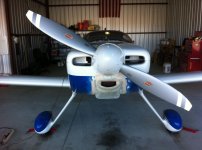
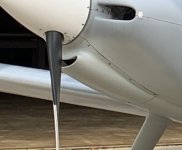
Smiley Face intakes are the best 👍

1755830857538.png
 
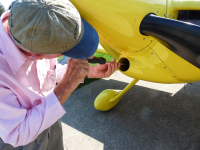
So this is the first time I have used the “EZ Cowl” device created by HFS (David Howe) and it just simplifies the process incredibly! No prop in the way, for one thing. Having not only a perfect reference for the front end, but something that easily and quickly support it in that position is the other. The only tricky part is making sure you do the arithmetic right to get the mounting plate the right distance fromt eh crankshaft flange - I suggest doing it several times and then measuring it again!

More to come….
 
So this is the first time I have used the “EZ Cowl” device created by HFS (David Howe) and it just simplifies the process incredibly! No prop in the way, for one thing. Having not only a perfect reference for the front end, but something that easily and quickly support it in that position is the other. The only tricky part is making sure you do the arithmetic right to get the mounting plate the right distance fromt eh crankshaft flange - I suggest doing it several times and then measuring it again!

More to come….
All the measuring "stuff" is in my instruction package, even with an example, which, if I got it right should make the "math" a bit less stressful ...

I recommend allowing for the thickness of the flywheel, but leaving it out when installing the cowling simply for interference reasons - but to each his own.

HFS

EZ-COWL maker
 
Paul, with the A-10 apparently about to be retired for real this time, if you don't slow down you will be just in time to plug the gap!
 
I really like the smooth line of the F-1 cowling which eliminates the pinch at the firewall of the HR II cowls at the landing gear. Different firewall pattern.
 
I really like the smooth line of the F-1 cowling which eliminates the pinch at the firewall of the HR II cowls at the landing gear.
Not sure what "pinch" you're referring to. My HR II cowl fits fine around the landing gear.

Cowl looks great Paul.
 
Looks great! Question for my own curiosity. Are those titanium gear legs? They look like they'd slide right into a regular RV-4 mount.
 
Looks great! Question for my own curiosity. Are those titanium gear legs? They look like they'd slide right into a regular RV-4 mount.
Yes, titanium, and I have no idea if they’d fit an RV-4 - they are definitely longer than those on any -4 I have seen….
 
Not sure what "pinch" you're referring to. My HR II cowl fits fine around the landing gear.

Cowl looks great Paul.
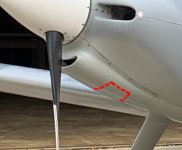
The F1/F4 and the HR2 differ at the lower firewall. The HR2 is markedly narrower, perhaps 2" on each side. That's the pinch... or many call it the Coke bottle. It's really the only sure way to tell the difference between the F1/F4 and the HR2 externally. Everything else varies depending on builder choices...i.e. the canopy, the tails, the wings, etc...

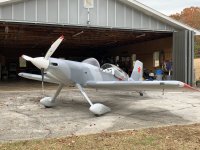
Look at the fuselage area just above the gear leg. See how the white HR2 dishes in? The look at the gray F1 in the same area... no dishing... just a straight side.
 

Attachments

  • Callahan HR2.jpg
    Callahan HR2.jpg
    112.7 KB · Views: 94
  • SN 33 Harrelson.jpg
    SN 33 Harrelson.jpg
    2.8 MB · Views: 92
The F1/F4 and the HR2 differ at the lower firewall. The HR2 is markedly narrower, perhaps 2" on each side. That's the pinch... or many call it the Coke bottle. It's really the only sure way to tell the difference between the F1/F4 and the HR2 externally. Everything else varies depending on builder choices...i.e. the canopy, the tails, the wings, etc...

Look at the fuselage area just above the gear leg. See how the white HR2 dishes in? The look at the gray F1 in the same area... no dishing... just a straight side.
Ahh, got it, makes sense now. This explains the tight fit on the hinge pin at the lower side corners. I'm dealing with that now and thinking I'll remove the lowest hinge on each side.
 
Paul, take the time to do a separate intake fairing. Sure makes cowl on-off easy, and it's nice when you want to take a quick look into the lower regions, or make an idle adjustment, or...

ScreenHunter_2927 Aug. 23 11.48.jpg

P5050005.JPG
 
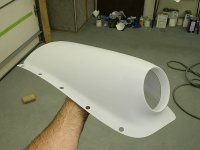
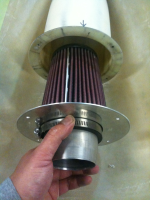
Years ago Jim Winings and I made two molds for a round inlet scoop that uses a K&N cone filter. Much more filter area. I've lost track of who has the molds.

1755971300616.png
 
That inlet is big enough to supply inlet air for a PT-6! Without a really generous lip on the inlet, there will be some spillage drag.
Like this:
View attachment 95773
...aspirational goals...

It was worth about 1" of MAP increase over ambient IIRC. You're right (of course), the lips could have used some more filler... "The Noem Radii..." ;)

The biggest PITA was connecting the servo inlet to the airbox, and leaving the duct long enough (2"), the little access door could have been much larger...ah well; next time.
 
Years ago Jim Winings and I made two molds for a round inlet scoop that uses a K&N cone filter. Much more filter area. I've lost track of who has the molds.

View attachment 95781
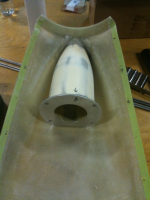
I wonder if Rod Bower ended up with them? He had molds for inlets that fit most all the models of RV-cowls. Each model is slightly different, so it takes an inventory of molds. Rod's inventory is now at the new owner of Fairings, etc. In the mean time, I have just finished a plug for a new scoop for RV-8. Changed the contours some (mostly cosmetic) and OF COURSE added a more generous lip radius. HP Aircraft will 'soon' be offering that new scoop. We can make it a light enough glass layup that it will probably conform to the cowls on other models, then need some reinforcement to lock in the fit to the different cowl shape.
 
The biggest PITA was connecting the servo inlet to the airbox, and leaving the duct long enough (2"), the little access door could have been much larger...ah well; next time.

We addressed this. Machined a tapered die to press on the aluminum coupler to taper the end of the tube. Slips easily into the short piece of scat.

1756152387553.png

I wonder if Rod Bower ended up with them? He had molds for inlets that fit most all the models of RV-cowls.
I don't think so but will ask Jim's wife if she knows whatever happened to it.

The mold for the filter housing was made out of a round piece of wood fence post turned with a rasp on a metal lathe.

1756152661841.png
 
Looks great! Question for my own curiosity. Are those titanium gear legs? They look like they'd slide right into a regular RV-4 mount.
No. They absolutely will not slide into an RV-4 mount. Not even close.
Yes. They are titanium.
Yes. They are expensive.
Yes. They are very light compared to steel.
 
Paul, and others with similar problems,

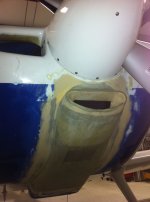
If you add a secondary door to the lower scoop, it is MUCH easier to install the SCAT hose onto the airbox and the servo. Sort of like this:
F1 smiley inlet SCAT door access.JPG
 
Back
Top