Van's Air Force

The definitive Van's Aircraft support community! Buying, building or flying an RV? Join our exclusive family of mentors and enthusiasts!

Engine storage

Ben Ellis

Well Known Member
Sponsor
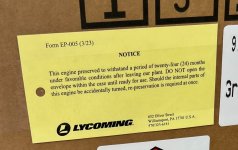
I just received my IO-390-EXP119. The box has a yellow notice indicating that the engine is preserved to withstand 24 months under favorable conditions after leaving the plant and that I should not open the envelope around the engine until ready for use. The engine box is sitting off the ground in a covered area outside my house and is also covered with a tarp. I'm building in my basement. To get the engine in my basement, I will have to remove it from the box and bag to use the lifting hooks. I will likely not hang the engine until Spring.

So I have two options--leave it covered and safe from precipitation outside during a NYC winter, or go against the directions on the yellow notice telling me not to remove it from the bag so that I can move it to my basement, where I have a dehumidifier and the temps stay around 70 year round.

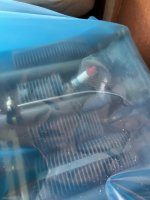
I called Lycoming to get their advice and they said they will get back to me. The person I spoke with didn't know that they have a 24 month preservation period, and I also can't find anything about that online. So it's not clear to me or Lycoming what preservation measures were taken. Lycoming mentioned that the bag is vacuum sealed, but I'm questioning that given that the bag seems pretty loose around the engine. I also expected that there would be desiccant plugs, but it looks like it just has normal spark plugs. Even if I wait to get it in my basement, I will have to take it out of the bag to hang it and work on the FWF and it will be out of the bag for many months before being first run.

If you were me, what would you do?

 

Attachments

  • Front view.jpg
    Front view.jpg
    393.4 KB · Views: 69
  • Spark plug.jpg
    Spark plug.jpg
    406.7 KB · Views: 69
  • Lycoming Notice.jpg
    Lycoming Notice.jpg
    225.6 KB · Views: 69
No advice, just an info that my TB YO-360 received a couple of month ago is packed exactly the same. I have it store on the second floor of our maintenance outfit, in a dry concrete building, and will install it beginning of 25.
But I had to recover that envelope which is taped onto the pallet, so sliced the plastic bag just enough to get to that envelope, and taped the opening closed once I was done. All this to say that there was definitely no vacuum at the time I made the slit.
 
I would open the plastic bag and bring the engine inside the house where temperature is stable.
Also I would put it on a wooden pallet and cover it with a plastic cover. It does not have to be hermetically sealed.
Stable temperature of 70 F is fine and if you can keep relative humidity @ 50% or lower this will prevent rust.
I would under no circumstances leave the engine outside.

Good luck
 
I added up the cost to move it indoors, and install a dehumidifier: not even an AMU.

When I compared that to the all-up purchase price... and the delays... it was an easy decision.
 
Definitely at the very least keep it in a temperature normalized area, use the crate as a table if you need to. It's what you won't see that could be an issue.
 
You could rent a climate controlled storage space.
If you do bring it in, don't rotate the crank or remove any bottom plugs or exhaust covers. They are holding in preservation oil.
 
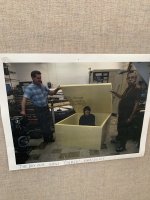
If you can’t get the engine to a temperature controlled environment bring the temperature controlled environment to the engine. Build a box out of 2” foil backed insulation board and heat it to a constant temp above the dew point with any of the many temperature controllers like the Inkbird.
 

Attachments

  • IMG_2421.jpeg
    IMG_2421.jpeg
    1.8 MB · Views: 69
Last edited:
Thanks all for the replies. I can definitely get the engine to a dry, temperature controlled environment (my basement). It just means I have to go against the directions on the yellow notice and open the bag the engine is in. Once in the basement, I'd either seal it back into the bag with some desiccant or just keep it in a really dry environment with desiccant plugs, etc. Either way, it's coming out of the bag in 4-6 months when I'm ready to do FWF and will live outside of the bag forever after that. I'm starting to think the bag is not so necessary, but I'll let you guys know what Lycoming says when they get back to me.
 
Just got a call back from Lycoming and they recommended that I remove the engine from the bag, move it to the basement, put it back in the bag with desiccant bags and plugs, and then zip tie it. They told me that all they do in the factory to seal the engine is put the engine in the bag, use a shop vac to remove air, and then zip tie the bag. I don't believe there is any desiccant in the bag. Given that the zip tie doesn't make the bag air tight and there is no desiccant in the bag, I don't see how the bag does much good. It seems like it could do harm by trapping moist air that could condense on the engine. The person I spoke with also didn't know anything about the 24 month preservation period mentioned in the yellow notice on the box, so I question how accurate that is.
 
You can know the % humidity inside your engine bag with an inexpensive humidity indicator, and you can drop the humidity with silica beads.

For $40 you can make it like a desert and know that its as dry as a desert with the indicator.

I just left my hangar. My engine was at 16% humidity inside the case. The Sahara is 13% - 15%.
 
Last edited:
Question about the blue bag, is it anything special? I've used Zerust products which are a vapor corrosion inhibitor in the gun safe. They make a very large bag that has the VCI in it https://www.zerustproducts.com/prod...-cars/engine-storage-bag-plain-closure-4-mil/
The capsules used in the safe https://www.zerustproducts.com/prod...-parts/vapor-capsule-electronics-tools-parts/

Any reason not to use these?
Vapor space inhibitors releases the preservative into the enclosed air. My opinion is this is best suited for ferrous assemblies but would probably be acceptable for your engine. Desiccant is cheap and can be "rechargable" so I'm not sure if the VSI bag would worth any unknown risk to paint, etc.

As for your gun safe. I'd personally be a bit weary if you're storing anything with wood in there, especially any with a nice grade. Not saying it would ruin anything but I don't know; especially for that wood where they only finish/protect the outside visible surfaces (many Brownings). Oil can creep and be visible in the finish but no clue if there would be enough VSI oil to do so. Protect those nice investments.
 
Last edited:
Back
Top