Van's Air Force

The definitive Van's Aircraft support community! Buying, building or flying an RV? Join our exclusive family of mentors and enthusiasts!

Elevator down stop question

inktomi

Well Known Member
Sponsor
Hi!

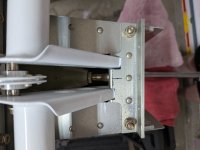
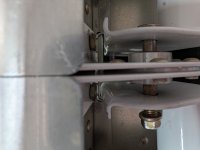
I'm trying to finalize my elevator travel, and have filed the up travel to 28.4 left and 28.1 right (both hitting at the same time, could be some minor measurement difference due to manually centering elevators).

I see the max down swing is 25 degrees, and I see that both stops should contact at the same time between 20-25 degrees.

I'm worried that filing out the down stops so that they contact at the same time will lead to exceeding the travel. As I've filed so far, with only the right side in contact, I'm already at 25.8 down on the right, and the left is not yet in contact at the same degree swing. This is already over the max down of 25.

I'm using a Mitutoyo digital protractor and zeroing by clamping the counterweight arm before zeroing the protractor. Is this right?

I'm sure I could be off a few tenths of a degree or something, so I wanted to ask for ideas before potentially making it worse. I could believe that I'm around 25 right now.
PXL_20250621_181646205.jpg
PXL_20250621_184640421.jpg
PXL_20250621_185008161.jpg
 
Hi!

I'm trying to finalize my elevator travel, and have filed the up travel to 28.4 left and 28.1 right (both hitting at the same time, could be some minor measurement difference due to manually centering elevators).

I see the max down swing is 25 degrees, and I see that both stops should contact at the same time between 20-25 degrees.

I'm worried that filing out the down stops so that they contact at the same time will lead to exceeding the travel. As I've filed so far, with only the right side in contact, I'm already at 25.8 down on the right, and the left is not yet in contact at the same degree swing. This is already over the max down of 25.

I'm using a Mitutoyo digital protractor and zeroing by clamping the counterweight arm before zeroing the protractor. Is this right?

I'm sure I could be off a few tenths of a degree or something, so I wanted to ask for ideas before potentially making it worse. I could believe that I'm around 25 right now.
Hi Matt,

I had a similar issue and just made a new, longer stop to start with. It only took a few hours to make, drill off the old one, rivet the new one on and file etc. My measurements were further out of spec than yours though. Might be worth checking with Van's!
 
Thanks, since it would mean replacing the part anyway, I filed it till the other elevator touched. I'm at 25.8/.9 now with both touching the stop. I'll email Vans and see what they think as well.

I do suspect that using the digital protractor is causing me to try to be more careful than I think I need to be. If I were using a manual protractor I don't think I could see tenths of a degree, so I'm somewhat inclined to say "this is fine" and move on. I'll give the final word to Van's though.

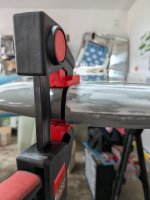
Depending on how I clamp the elevators, I can sort of get about a degree of difference in them, with the fiberglass on they're not perfectly aligned thickness wise with the stabilizer which makes clamping them a bit awkward.

Thank you again.
 
I'll try to find the tolerances in the docs. I thought that there would be something like that.

I'm a few tenths under 26 degrees up, so if there is at least a degree of tolerance allowed there then if be good.

I did email vans.
 
Interestingly the tolerances for the control surface travel are listed in section 15 of the KAI on flight testing
 

Attachments

  • IMG_0547.jpeg
    IMG_0547.jpeg
    3.7 MB · Views: 39
Since each elevator contributes 1/2 of the total up/down force, it's appropriate to take the average of your two measurements to come up with a single deflection number.
 
Yea, the directions in section 8 say to file to the maximum deflection listed in section 15. I didn't do that, in case of issues, figuring at the end I would file them to the limits. The issue is that the front stop is not really long enough for my elevators, and so I exceed the up travel in order to get both elevator horns to touch the stop. I'm within a degree of 25 degrees up though.
 
Whatever the outcome, based on those photos I think you will find that the final deflection angle will change once those bolts are done up, so please be sure you check the final angle once you've torqued all the bolts.

Could I also suggest that you open up the "slots" in the control stop to make them wider? With them being such a fine tolerance, a combination of a little wear over time and some air-loads could put you in a situation where you might not achieve full travel at a critical time. You might find the clearances change once the bolts are torqued in any case.

Cheers.
 
That's a good idea about the bolts. I'll do that and recheck today. I didn't tighten the top bolt in the hinge, but I did tighten the bottom one that holds the two horns together with the push tube.

I did also remove that center area of the stop that sticks out. I filed it to the line I had drawn in the center.
 
Just an update. I received the info from Vans. They think 25.9 degrees is fine and to build on.

I sort of agree, we have such accurate tools today that we can obsess about exact angles, but a lot of you have been flying planes built before these tools were easily available. Vans pointed out that all your planes are flying just fine, and so this isn't worth worrying too much about.

I'll clean up the edges and open up the slot on the forward stop some to avoid any chance of binding, but otherwise call this good.
 
Back
Top