
So I’ll start by saying that electrical systems are not my strength! When we started the aircraft today, the ammeter showed a 50-amp discharge and the battery voltage slowly dropped. We recycled the masters and it went back to normal for about 10 minutes. We decided to try a run-up and it was fine until the ammeter suddenly showed an 8-amp discharge with another slow voltage drop. As we were taxiing back to the apron, it returned to 0 amps again. This happened right after replacing the prop control cable. Could we have shorted a wire somewhere during the work? Does it sound like the alternator? We also had a near complete discharge of the EarthX battery overnight about 3 months ago (forgot to turn off masters). The battery came back to life after that with a charger. Could it be a battery problem?

Van's Air Force
You are using an out of date browser. It may not display this or other websites correctly.
You should upgrade or use an alternative browser.
You should upgrade or use an alternative browser.
Electrical discharge
- Thread starter BrianP
- Start date


You abused the battery. My book says it is no longer approved for flight. Replace it.
If you do manage to breathe some life into this bad battery, let it retire to a life in a John Deere or such.
Carl
If you do manage to breathe some life into this bad battery, let it retire to a life in a John Deere or such.
Carl

From the EarthX website:We also had a near complete discharge of the EarthX battery overnight about 3 months ago (forgot to turn off masters)... Could it be a battery problem?
"The ETX-Series of batteries have over discharge protection and is designed to prevent a continuous active drain on the battery to the point of damaging the battery, such as leaving your key in the on position, master switch on your aircraft, or parasitic draw as examples."

You abused the battery. My book says it is no longer approved for flight. Replace it.
If you do manage to breathe some life into this bad battery, let it retire to a life in a John Deere or such.
Carl
Say what???

It's easy to test the batteries ampacity. Discharge it using a load through a cheap meter that measures mAh. If the battery does not have 80% of its ampacity left replace it. I test each one of my Earth-X batteries every 2 years to test ampacity.So I’ll start by saying that electrical systems are not my strength! When we started the aircraft today, the ammeter showed a 50-amp discharge and the battery voltage slowly dropped. We recycled the masters and it went back to normal for about 10 minutes. We decided to try a run-up and it was fine until the ammeter suddenly showed an 8-amp discharge with another slow voltage drop. As we were taxiing back to the apron, it returned to 0 amps again. This happened right after replacing the prop control cable. Could we have shorted a wire somewhere during the work? Does it sound like the alternator? We also had a near complete discharge of the EarthX battery overnight about 3 months ago (forgot to turn off masters). The battery came back to life after that with a charger. Could it be a battery problem?
Those symptoms indicate that you alternator stopped charging for various intervals. Way too many variables with too little info provided to even guess as to why.So I’ll start by saying that electrical systems are not my strength! When we started the aircraft today, the ammeter showed a 50-amp discharge and the battery voltage slowly dropped. We recycled the masters and it went back to normal for about 10 minutes. We decided to try a run-up and it was fine until the ammeter suddenly showed an 8-amp discharge with another slow voltage drop. As we were taxiing back to the apron, it returned to 0 amps again. This happened right after replacing the prop control cable. Could we have shorted a wire somewhere during the work? Does it sound like the alternator? We also had a near complete discharge of the EarthX battery overnight about 3 months ago (forgot to turn off masters). The battery came back to life after that with a charger. Could it be a battery problem?
Kathy from Earth X informed me recently they will be updating their Earth X batteries for our experimental aircraft with the same specs that govern their TSO line: (New temperature guidelines) Seems I've been pushing the upper limits on my FWF battery mounted low for years.  They also use the same BMS.
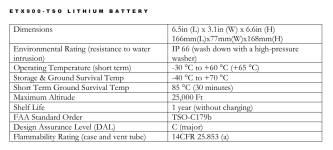
They also use the same BMS. Kathy from Earth X informed me recently they will be updating their Earth X batteries for our experimental aircraft with the same specs that govern their TSO line: (New temperature guidelines) Seems I've been pushing the upper limits on my FWF battery mounted low for years.
View attachment 98683
This is probably a dumb question, but I also have my EarthX mounted on the firewall and have been wondering about this:
How do you know what the operating temperature of the battery is when flying??
No, great question and happy to share. For my 14 and 10 there are 2 J type thermocouples (O ring type) coiled up from the GEA24 FWF that can be placed at any location I choose. For the 14 I have them normally mounted down the front of each battery for temp monitoring. They are coiled up and can extend 4 or 5 ft to any location I choose to monitor. For the 10 since the batteries are in the rear of the plane let the EarthX LED abnormal indicator system monitor temps. I also have coiled up O-ring type thermocouples on each side FWF.This is probably a dumb question, but I also have my EarthX mounted on the firewall and have been wondering about this:
How do you know what the operating temperature of the battery is when flying??


Thanks for that info - cool setup!!
So we ended up changing the battery and still having issues. Started the RV-8 with no abnormalities noted on the ammeter or voltmeter. Initial readings were normal — voltage steady at 14.4V and ammeter indicating a 0–1 amp charge. During run-up, upon application of run-up power, the ammeter indicated a 19-amp discharge. This discharge persisted even after power was reduced, and the only way to restore normal indication was to recycle the alternator master switch. The low-voltage light did not illuminate during the 19-amp discharge; it only illuminated when the alternator master was turned off. During the discharge event, the voltage gradually decreased from 14.4V to 13.8V.
Additionally, at idle, the ammeter has on occasion shown a large discharge exceeding 80 amps, after which the ammeter indication failed and displayed an “X.” Normal operation could only be restored by recycling the alternator master. Any thoughts?
Additionally, at idle, the ammeter has on occasion shown a large discharge exceeding 80 amps, after which the ammeter indication failed and displayed an “X.” Normal operation could only be restored by recycling the alternator master. Any thoughts?
See post 7. Unsure why you are replacing the battery to address an obvious charging problem.Any thoughts?
Unless you wired the light yourself or set the alarm parameters yourself, the indication is meaningless. You know you have a low voltage condition, as you SAW the voltage drop.The low-voltage light did not illuminate during the 19-amp discharge; it only illuminated when the alternator master was turned off. During the discharge event, the voltage gradually decreased from 14.4V to 13.8V.
But if it’s just a charging issue, why would you get periodic large draws on the ammeter?Unless you wired the light yourself or set the alarm parameters yourself, the indication is meaningless. You know you have a low voltage condition, as you SAW the voltage drop.
do you understand how your ammeter is installed? Assuming it is measuring popwer in and out of batt. When the alternator is supplying power to the bus, the battery is either taking in power or taking nothing and sometimes shows a discharge of 1 or 2 to fill power gaps. When the alt stops supplying power, the battery has to supply all that power, so it shows power coming out of the battery.But if it’s just a charging issue, why would you get periodic large draws on the ammeter?
Assuming your ampmeter is set up to read battery charge/discharge (which is not common), l’ll ask the obvious:So we ended up changing the battery and still having issues. Started the RV-8 with no abnormalities noted on the ammeter or voltmeter. Initial readings were normal — voltage steady at 14.4V and ammeter indicating a 0–1 amp charge. During run-up, upon application of run-up power, the ammeter indicated a 19-amp discharge. This discharge persisted even after power was reduced, and the only way to restore normal indication was to recycle the alternator master switch. The low-voltage light did not illuminate during the 19-amp discharge; it only illuminated when the alternator master was turned off. During the discharge event, the voltage gradually decreased from 14.4V to 13.8V.
Additionally, at idle, the ammeter has on occasion shown a large discharge exceeding 80 amps, after which the ammeter indication failed and displayed an “X.” Normal operation could only be restored by recycling the alternator master. Any thoughts?
- If you assume your ampmeter readings are correct, the 19 amp discharge from the battery has to be going somewhere. Does your airplane even draw 19 amps? What loads are you running. Sitting in the hangar on an external power supply with both batteries changed, landing and nav lights off, pitot heat off but everything else on my ship draws 10 amps.
- When you turned the alternator off and buss voltage went from 14.4vdc to 13.8vdc, I would expect this to be the normal buss voltage decay.
- Again assuming your ampmeter is reading correct, what load draws 80amps?? If something failed to do this, go look for the smoking (literally) gun.
First rule of nuclear power; “believe your indications unless you prove they are wrong”. I suspect you have enough information to dive into your ampmeter setup. Caveat, a lot of information not yet provided on exactly how your ampmeter is setup so my conclusion is suspect.
Carl

To expound upon Larry’s comment, just to be clear, when he asks; “do you understand how your ammeter is installed?”do you understand how your ammeter is installed? Assuming it is measuring popwer in and out of batt. When the alternator is supplying power to the bus, the battery is either taking in power or taking nothing and sometimes shows a discharge of 1 or 2 to fill power gaps. When the alt stops supplying power, the battery has to supply all that power, so it shows power coming out of the battery.
He is NOT questioning your “ability” to understand the concept. He is asking that question because there is more than one way to install an ammeter. Depending on which way it is installed will determine the way you interpret the reading of the gauge.

Changing the battery was the equivalent of replacing a spare tire after you ran out of gas...Not necessarily a bad thing, but you're still not going anywhere...So we ended up changing the battery and still having issues. Started the RV-8 with no abnormalities noted on the ammeter or voltmeter. Initial readings were normal — voltage steady at 14.4V and ammeter indicating a 0–1 amp charge. During run-up, upon application of run-up power, the ammeter indicated a 19-amp discharge. This discharge persisted even after power was reduced, and the only way to restore normal indication was to recycle the alternator master switch. The low-voltage light did not illuminate during the 19-amp discharge; it only illuminated when the alternator master was turned off. During the discharge event, the voltage gradually decreased from 14.4V to 13.8V.
Additionally, at idle, the ammeter has on occasion shown a large discharge exceeding 80 amps, after which the ammeter indication failed and displayed an “X.” Normal operation could only be restored by recycling the alternator master. Any thoughts?
Your ammeter needs a bit more context; specifically what kind is it (hall effect (donut) or shunt) and where is it connected? (between the battery and the buss, between the alternator and the buss, between battery - and rest of airframe?
How are the "masters" connected? Is the master switch a grounding wire to the battery master relay? What is the alternator "master"? is it also connected to a relay or is it just a simple switch that feeds the alternator field input at the alternator?
Without a thorough and accurate understanding of the connections to/through/from your electrical system, it will be almost impossible to diagnose what's going on.
Maybe your old cable had a better ground path... Check your ground cables from BATTERY TO ENGINE CASE.So I’ll start by saying that electrical systems are not my strength! When we started the aircraft today, the ammeter showed a 50-amp discharge and the battery voltage slowly dropped. We recycled the masters and it went back to normal for about 10 minutes. We decided to try a run-up and it was fine until the ammeter suddenly showed an 8-amp discharge with another slow voltage drop. As we were taxiing back to the apron, it returned to 0 amps again. This happened right after replacing the prop control cable. Could we have shorted a wire somewhere during the work? Does it sound like the alternator? We also had a near complete discharge of the EarthX battery overnight about 3 months ago (forgot to turn off masters). The battery came back to life after that with a charger. Could it be a battery problem?
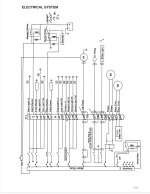
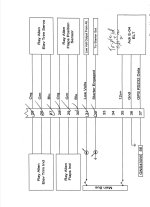
The wiring diagram to that Dynon is going to address the ammeter wiring design.The ammeter is just shown on a Dynon display
thanks! Was rushing out the door as I typed thatTo expound upon Larry’s comment, just to be clear, when he asks; “do you understand how your ammeter is installed?”
He is NOT questioning your “ability” to understand the concept. He is asking that question because there is more than one way to install an ammeter. Depending on which way it is installed will determine the way you interpret the reading of the gauge.
Sadly that doesn’t show us where the shunt or sensor is wired in. No matter, as voltage tells the tale. The battery puts out around 13 volts and the alternator puts out around 14.2. When you see the volts fall off from 14.2, you know that your alternator is mis behaving. You have not given us enough info to help you diagnose what is going on, but it seems clear that you alternator is either dropping off or it is having issues maintaining the set voltage. Will need to find someone to help figure out exactly what is happening.Thanks for all the input. This was the wiring info I got when i bought the plane. View attachment 100461View attachment 100462

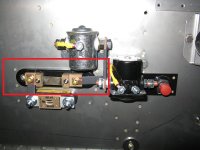
The Dynon system specifies the Dynon shunt unit. It just a calibrated metal to measure current flow and has electrical pickup points on both ends. It should look like this. In the picture, below the shunt is the ANL fuse which is rated at 60 amps. So if the current is only 50amps, the ANL fuse should not blow. 50 Amps is high but depending on your battery, and how much capacity was used to start the engine, you may see over 40 amps in your electrical circuit as the alternator is trying to recharge your battery after the engine has started. It should drop down to nominal current draw after 5 - 10 minutes. My system with no fuel pump and no light, it draws 6 amps. With light and fuel pump on, it will draw 12 amps.I don’t think I got a wiring diagram for the Dynon. If the was a short somewhere causing a periodic 50-80 amp draw, would the circuit breaker not immediately pop?
It helps if you can describe your electrical system behavior when it was operating normally, before the event that you described.
Last edited:
The 50-80 amp draw is what would happen during a scenario where the alternator came back on line after a period of time when it was off line, during which time the ship was running on battery power only, and was trying to supply all the electrical load. All the while slowly being drained. Then when the alternator came back on line, after whatever reason it had been off line, it ramped up the amperage output to try to replenish the depleted battery. The ammeter would then be showing this high amperage output on your gauge.I don’t think I got a wiring diagram for the Dynon. If the was a short somewhere causing a periodic 50-80 amp draw, would the circuit breaker not immediately pop?
This is just one possible scenario but it also depends on how your ammeter is wired.
So…you asked if you could have shorted something when replacing a cable..and while odd…yes…anything could happen when doing maintenance. But your Earthx would have shut itself off, if you did, and would need a reset.
The only way to find out what you have going on is to grab a meter and start sorting out possibilities. 80 amps kinda points you in the direction of your starter…I’ve been running Earthx now for a long time and with their battery management system, that idea that your battery is no good is an old wives tale.
If the battery is charged properly and tests okay..it is. Period. They’re pretty amazing in the low voltage scenario. They don’t suffer the sulfation/ bridging that lead acid or agm batteries do. Pretty bullet proof. If you trip the battery management system and it resets…you’re good.
I did have to send one early one back in for replacement under warranty…when it wouldn’t reset…but that was a long time ago.
In other words…it’s not your battery…99%
Get your multi meter out and start hunting for ground violations ie…shorts.
Alternators fail and are pretty easy to diagnose. Ammeters also fail.
If you compare your voltage and ammeter and keep removing possibilities…you will find the problem.
I’ve done a lot of wire tracing on my helicopter…best way is remove all positives from all busses and check continuity for each switched leg, wire by wire…ring each one out…if you know what resistance should be.
Determine if alternator is working with no extraneous loads…then start adding back one at a time…isolate wire by wire, system by system. Disconnect from battery and alternator till you find your problem.
Looks like starter, fuel pump, flap motor, trim motor, lights, radios…shouldn’t take but an hour to see where your problem is.
I saw several years back a 6 that was demonstrating very high draw after starting. Guy shut it down and it did it again. He said he didn’t hear anything weird…when he started it and I watched outside with the cowl off, sparks were flying off the starter and the Bendix was trying its best to shove the gear into the running ring gear…it sounded like helll…but inside with his super fancy Bose…he didn’t hear a thing.
Weird happens all the time…you just gotta learn to hunt it down.
The only way to find out what you have going on is to grab a meter and start sorting out possibilities. 80 amps kinda points you in the direction of your starter…I’ve been running Earthx now for a long time and with their battery management system, that idea that your battery is no good is an old wives tale.
If the battery is charged properly and tests okay..it is. Period. They’re pretty amazing in the low voltage scenario. They don’t suffer the sulfation/ bridging that lead acid or agm batteries do. Pretty bullet proof. If you trip the battery management system and it resets…you’re good.
I did have to send one early one back in for replacement under warranty…when it wouldn’t reset…but that was a long time ago.
In other words…it’s not your battery…99%
Get your multi meter out and start hunting for ground violations ie…shorts.
Alternators fail and are pretty easy to diagnose. Ammeters also fail.
If you compare your voltage and ammeter and keep removing possibilities…you will find the problem.
I’ve done a lot of wire tracing on my helicopter…best way is remove all positives from all busses and check continuity for each switched leg, wire by wire…ring each one out…if you know what resistance should be.
Determine if alternator is working with no extraneous loads…then start adding back one at a time…isolate wire by wire, system by system. Disconnect from battery and alternator till you find your problem.
Looks like starter, fuel pump, flap motor, trim motor, lights, radios…shouldn’t take but an hour to see where your problem is.
I saw several years back a 6 that was demonstrating very high draw after starting. Guy shut it down and it did it again. He said he didn’t hear anything weird…when he started it and I watched outside with the cowl off, sparks were flying off the starter and the Bendix was trying its best to shove the gear into the running ring gear…it sounded like helll…but inside with his super fancy Bose…he didn’t hear a thing.
Weird happens all the time…you just gotta learn to hunt it down.
I think this is a red herring throwing you off the trail. Not suggesting it didn't happen and may be related to the issues or cause. However, it is not meaningfull at the moment. The only thing that can cause an 80 A draw are the starter or a short. Don't forget that the shunt output is only a few millivolts. Therefore it takes little in the way of wiring issues to cause an inaccurate reading. You also don't yet understand where the shunt is and what it is measuring. I WOULD NOT be assuming the 80A draw was real in my troubleshooting steps here and instead be focusing on the alternator intermittently misbehaving. Certainly possible that this is wiring related or just another plane power saying "see ya."Additionally, at idle, the ammeter has on occasion shown a large discharge exceeding 80 amps, after which the ammeter indication failed and displayed an “X.” Normal operation could only be restored by recycling the alternator master. Any thoughts?
I strongly recommend to people I know or work with that engines ALWAYS be started without headsets. Just one more reason why here. You should ALWAYS be tuned in to the sound your engine makes. Even in flight, with headsets on, you can catch a LOT of abnormal behavior if tuned in and paying attention.I saw several years back a 6 that was demonstrating very high draw after starting. Guy shut it down and it did it again. He said he didn’t hear anything weird…when he started it and I watched outside with the cowl off, sparks were flying off the starter and the Bendix was trying its best to shove the gear into the running ring gear…it sounded like helll…but inside with his super fancy Bose…he didn’t hear a thing.
Assuming you have a standard alternator (B&C) or similar, on the back of the alternator you have the field connector (F).
This wire is relativly thin and it's sensitive to vibration. When it fails a couple of strands break at different ocations.
The AMP-readings will be all over the place. It´s easy to check this connector with a mirror.
Ask me how I know.
Good luck
This wire is relativly thin and it's sensitive to vibration. When it fails a couple of strands break at different ocations.
The AMP-readings will be all over the place. It´s easy to check this connector with a mirror.
Ask me how I know.
Good luck
...and a deeply discharged EarthX ETX battery...The only thing that can cause an 80 A draw are the starter or a short.
But the OP stated this 80amps was a battery discharge, not charge. Makes little sense....and a deeply discharged EarthX ETX battery...
Carl
Actually he said:But the OP stated this 80amps was a battery discharge, not charge. Makes little sense.
Carl
“ . . . The ammeter showed a 50-amp discharge and the battery voltage slowly dropped.”
That kind of sounds like a system trying to recharge a discharged battery by an alternator after the battery was depleted.
The OP hasn't indicated where the shunt is connected - agree - makes little sense...But the OP stated this 80amps was a battery discharge, not charge. Makes little sense.
Carl
I was working under the assumption his setup was measuring current from the battery as that is what he stated and all we have to work under....and a deeply discharged EarthX ETX battery...
if the shunt is installed near an alternator, like most of us do, it will never show a discharge inless the alternator shorts out. Clearly that didn’t happen, as it started working again. If the shunt is installed near the battery, as the poster stated, and the battery was being charged, it would show positive not negative current. Poster said it was a discharge, therefore negative reading. We have to assume he knows that negative is a dischargeActually he said:
“ . . . The ammeter showed a 50-amp discharge and the battery voltage slowly dropped.”
That kind of sounds like a system trying to recharge a discharged battery by an alternator after the battery was depleted.
chrisskymaster
Member
Your Velcro tie wrap will fail over time. Consider something more secureNo, great question and happy to share. For my 14 and 10 there are 2 J type thermocouples (O ring type) coiled up from the GEA24 FWF that can be placed at any location I choose. For the 14 I have them normally mounted down the front of each battery for temp monitoring. They are coiled up and can extend 4 or 5 ft to any location I choose to monitor. For the 10 since the batteries are in the rear of the plane let the EarthX LED abnormal indicator system monitor temps. I also have coiled up O-ring type thermocouples on each side FWF.
View attachment 98709View attachment 98710
Southern Pete
Well Known Member
Ignore the ammeter, use the voltmeter.
Use a multimeter to understand the voltage at various points in your system.
If the voltage is low there is an alternator problem.
If the voltage is normal, and the wiring is not damaged, the battery cannot be discharging.
Use a multimeter to understand the voltage at various points in your system.
If the voltage is low there is an alternator problem.
If the voltage is normal, and the wiring is not damaged, the battery cannot be discharging.
