Van's Air Force

The definitive Van's Aircraft support community! Buying, building or flying an RV? Join our exclusive family of mentors and enthusiasts!

EFII System 32 (issues & concerns)

bt3vex

Active Member
Back Story:

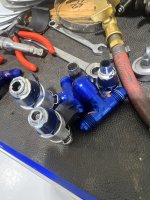
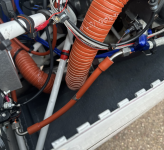
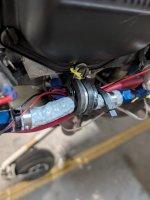
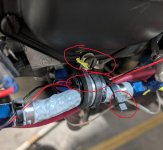
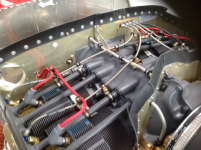
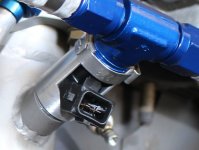
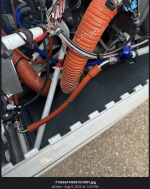
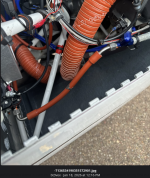
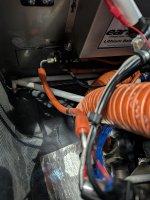
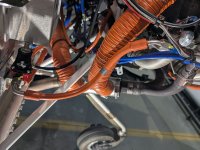
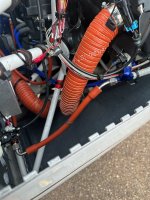
Back in August I was forced to land due to my Fuel Injectors shearing off. (They were the older aluminum fittings) Also according to Rob my fuel hose between the firewall and cylinder #3 did not allow enough room for engine vibration (See Picture). I did have TS flightlines build the fuel hose setup and that seems to be on lots of planes with no issues. Also for that set-up I did not have an Adel clamp in-between the injectors for added support. Regardless of the cause lets fast forward.

I now have the upgraded stainless steel fittings and trying to not repeat the same sequence.


Questions:

  1. Yes or No to the Adel clamp? (I feel it makes things too tight because the #1 & #3 or #2 & #4 cylinders move independently of each other, and if I create a clamp point there wont be any room for wiggle. Thoughts or Opinions?
  2. Length of hose from firewall to #3? (I got a hose that is now 2" longer and creates a slight "S" from the #3 to the firewall. However I feel it now needs support which would potentially defeat the purpose of the longer hose) Thoughts or Opinions?
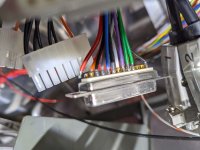
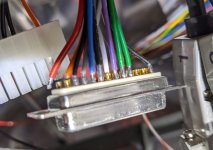
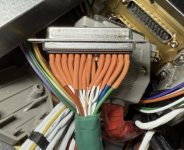
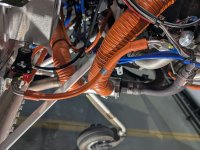
  3. Keep or lose the system? I have now experienced 3 problems with the system 1. Fuel Injectors failure, 2. faulty soldering on the ECU harness causing the #1 ECU to not work (See Picture), 3. Bad throttle sensor. I am beginning to lose faith in my fuel delivery system and it makes me terrified as it could have killed me at least 2 times now.
 

Attachments

  • -7136534190351572901.jpg
    -7136534190351572901.jpg
    543.1 KB · Views: 235
  • Injectors.jpg
    Injectors.jpg
    2.6 MB · Views: 231
  • IMG_20200401_141728.jpg
    IMG_20200401_141728.jpg
    1.4 MB · Views: 221
  1. Length of hose from firewall to #3? (I got a hose that is now 2" longer and creates a slight "S" from the #3 to the firewall. However I feel it now needs support which would potentially defeat the purpose of the longer hose) Thoughts or Opinions?
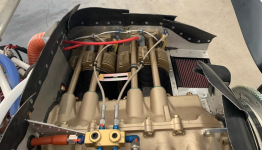
This is my thought only and hopefully others chime in. I am on my second EFII system after putting over 700 hours on my first in a 14A. You'll need that S bend in the fuel return to the FPR as the engine and firewall move differently. I did not add support to this line as I wanted it to be able to have a longer run to move. I did make sure that the fitting going into the FPR (mine was a 45 as the FPR was located more inboard) angle was such that it was not pulling down (or up) on the last injector. It's hard to tell but yours appears it is pulling slightly down on the fuel rail. Since you are trying to defeat gravity, it needs to hold it slightly up. You can rotate your 90 to make it more "balanced".

Good luck and safe flying !


Screenshot 2026-01-18 143739.png
 
Last edited:
This is my thought only and hopefully others chime in. I am on my second EFII system after putting over 700 hours on my first in a 14A. You'll need that S bend in the fuel return to the FPR as the engine and firewall move differently. I did not add support to this line as I wanted it to be able to have a longer run to move. I did make sure that the fitting going into the FPR (mine was a 45 as the FPR was located more inboard) angle was such that it was not pulling down (or up) on the last injector. It's hard to tell but yours appears it is pulling slightly down on the fuel rail. Since you are trying to defeat gravity, it needs to hold it slightly up.

Good luck and safe flying
This is my thought only and hopefully others chime in. I am on my second EFII system after putting over 700 hours on my first in a 14A. You'll need that S bend in the fuel return to the FPR as the engine and firewall move differently. I did not add support to this line as I wanted it to be able to have a longer run to move. I did make sure that the fitting going into the FPR (mine was a 45 as the FPR was located more inboard) angle was such that it was not pulling down (or up) on the last injector. It's hard to tell but yours appears it is pulling slightly down on the fuel rail. Since you are trying to defeat gravity, it needs to hold it slightly up.

Good luck and safe flying !


View attachment 107529
Do you have an Adel clamp in-between the injectors tied to the rocker cover like in this picture? That's how Robert said to do them now? I think this creates more tension though.
 

Attachments

  • Adel Clamp.jpg
    Adel Clamp.jpg
    589.3 KB · Views: 128
EFII is also proven with decades of use. Any new car you purchased in the last 30+ years has been EFII.
Cars are not airplanes, totally different animals, ie: not likely to die if the motor quits.
Same reason auto conversions are generally frowned upon as reliable alternative powerplants.
 
Looking at the photos here gives me the willies. On the one below I see 3 problems: you used a valve cover screw to attach the Adel clamp. There's a gap under the Adel tab/washer stack due to the sheet metal stiffening rib of the valve cover around the perimeter. Plus that screw clamps on a gasket, so it will never be tight, and it will loosen even more over time. And the yellow paint does nothing to hold that together. And then you used a rolled-up piece of tape to fill the gap to the too-large Adel. That tape will extrude out over time. And then you left a tail on the zip tie, perfect for slicing your hand. Cut those flush!

1768778845191.jpeg

Second photo. Are these soldered DB connectors supplied by EFII or did someone else do that? Get a good mil-spec crimper and get rid of the soldered connector. Also, the wire looks like standard vinyl Amazon-grade stuff. Is it really teflon or tefzel as it should be?

1768779621733.jpeg

The above may sound pretty harsh, but there's no room for substandard workmanship on something as critical as engine management parts, as you already found on your off-field landing. I'm calling you out on this to hopefully prevent another one!!!

I hope you find an EAA tech guru to look over your shoulder (one who actually understands engine systems).
 
Of course, the devil's always in the details! And @bt3vex has proven that multiple times!

While true, if these issues were systemic, don’t you think others would be having the same issues? There are many folks running the system without these issues. I tend to agree with dmattmul that there was insufficient slack to account for the vibration of these 60 year old engines. As for the wiring issue, yep looks like a bad solder joint. I much prefer solid barrel pin s crimped with the proper tool.

As always, people always jump right to mechanical FI and mags. That horse has been flogged to the point where there isn’t anything remaining…no use going there.

Either way, I hope the OP gets his airplane back in the air soon.
 
Looking at the photos here gives me the willies. On the one below I see 3 problems: you used a valve cover screw to attach the Adel clamp. There's a gap under the Adel tab/washer stack due to the sheet metal stiffening rib of the valve cover around the perimeter. Plus that screw clamps on a gasket, so it will never be tight, and it will loosen even more over time. And the yellow paint does nothing to hold that together. And then you used a rolled-up piece of tape to fill the gap to the too-large Adel. That tape will extrude out over time. And then you left a tail on the zip tie, perfect for slicing your hand. Cut those flush!

View attachment 107549

Second photo. Are these soldered DB connectors supplied by EFII or did someone else do that? Get a good mil-spec crimper and get rid of the soldered connector. Also, the wire looks like standard vinyl Amazon-grade stuff. Is it really teflon or tefzel as it should be?

View attachment 107552

The above may sound pretty harsh, but there's no room for substandard workmanship on something as critical as engine management parts, as you already found on your off-field landing. I'm calling you out on this to hopefully prevent another one!!!

I hope you find an EAA tech guru to look over your shoulder (one who actually understands engine systems).
Thank you for your advice, the wire harness came from the factory like this. I never thought of the wire used being subpar but you bring a valid point. The Adel clamp is just for reference for the question posed because the manufacturer recommends putting one there, however the issues as you mention ring in my head, also it seems too little room for any movement and would create another strain on the injectors, and has been removed because i did not like it. I wanted to know what others have done. As for that pesky zip tie I'll clean that up soon once I feel comfortable enough to fly.
 
Cars are not airplanes, totally different animals, ie: not likely to die if the motor quits.
Same reason auto conversions are generally frowned upon as reliable alternative powerplants.
Wow, and all this time I was thinking cars and planes are the same…

The OP is not using an automotive engine conversion. Nice try at conflating, but sorry I need to call you on it.
 
The solder joints I can see on the D-sub look cold and prone to failure like already happened to the red wire.

If it were me I would:
  • Inspect and repair all electrical connections and consider replacing extant soldered D-sub connectors with crimped ones that use machined size 20 pins and sockets M39029/64-369 and M39029/63-368.
  • Re-plumb the injectors with SDS EFI components. If the EFII injectors are Magneti Marelli IWP “pico” they will fit the SDS mounts or SDS can furnish the injectors.
  • Do an FMEA on the electrical power system. The EFII System 32 install manual shows SPOFs that can be eliminated.
  • Implement my Z101-inspired electrical power system with B&C main alternator and Monkworkz MZ-30 vacuum-pad generator. Ref my “Power Schem N1921R MZ-30L on engine bus WITHOUT Brian Adams Skyview Hub…” here. It shows SDS but works with any EFI+I, just put everything engine related on the engine/essential bus.

Magneti Marelli IWP data sheet

Attached photos are from SDS EFI website.
 

Attachments

  • IMG_0723.png
    IMG_0723.png
    805.4 KB · Views: 99
  • IMG_0724.png
    IMG_0724.png
    610.6 KB · Views: 98
Last edited:
The solder joints I can see on the D-sub look cold and prone to failure like already happened to the red wire.

If it were me:
  • Inspect all electrical connections and consider replacing extant soldered D-sub connectors with crimped ones that use machined size 20 pins and sockets M39029/64-369 and M39029/63-368.
  • Re-plumb the injectors with SDS EFI components. If the EFII injectors are Magneti Marelli IWP “pico” they will fit the SDS mounts or SDS can furnish the injectors.
  • Do an FMEA on the electrical power system. The EFII System 32 install manual shows SPOFs that can be eliminated.
  • Implement my Z101-inspired electrical power system with B&C main alternator and Monkworkz MZ-30 vacuum-pad generator. Ref my “Power Schem N1921R MZ-30L on engine bus WITHOUT Brian Adams Skyview Hub…” here. It shows SDS but works with any EFI+I, just put everything engine related on the engine/essential bus.

Magneti Marelli IWP data sheet

Attached photos are from SDS EFI website.
Thank you for the information. SDS will not let me do a hybrid system unfortunately (already asked). Going to re-do all electrical components with d-subs.
 
I’d remove it. If the vendor can’t be trusted to use proper crimp connectors, or doesn’t understand why you can’t hang a fuel rail off injectors hose clamped to modified AN fittings pointed down then what else did they not understand? How many strikes would you give them? 4? 5? Especially when strike 1 should have been a fire. You already know what to do, go do it….

1768800928679.jpeg
 
Second photo. Are these soldered DB connectors supplied by EFII or did someone else do that? Get a good mil-spec crimper and get rid of the soldered connector. Also, the wire looks like standard vinyl Amazon-grade stuff. Is it really teflon or tefzel as it should be?

View attachment 107552
My SDS system also uses solder cup connections. I had assumed these were no good and had decided to re-wire with crimped pins, but asked Ross if he thought it was a good idea:
“I wouldn't do that. We build the ECU side of the harness for you. Just a lot of labor for you. 20K+ soldered harnesses 20+ million hours collectively in 31 years. Zero failures on the DB connections”
 
I’d remove it. If the vendor can’t be trusted to use proper crimp connectors,
You understand EFII is not the only EFI system using soldiered connectors it seems. Look familiar? :unsure:

Screenshot 2026-01-19 071003.png
 
Last edited:
Interesting. I have EFII that came with my Titan engine. There are no solder junctions anywhere, at least external to the LRUs. The ECUs came with pigtails for each connector, all crimp style.

Edit = IIRC
 
The image is real fuzzy.
I would at least re-flow all the solder connectors.
(You Need to be comfortable how that is done though, one can make things worse with a Harbor Fright soldering iron verses a quality temp controlled unit with quality solder)

-cappy
 
My SDS system also uses solder cup connections. I had assumed these were no good and had decided to re-wire with crimped pins, but asked Ross if he thought it was a good idea:
“I wouldn't do that. We build the ECU side of the harness for you. Just a lot of labor for you. 20K+ soldered harnesses 20+ million hours collectively in 31 years. Zero failures on the DB connections”
Nothing wrong with solder cup DB connectors. I have many in my harnesses across my planes. They require more skill than crimped connectors however. The pic in the first post is simply poor workmanship. The cups were not heated enough and the solder didn't fuse well to the cups. Poor workmanship is poor workmanship; Don't blame thje parts or the process.
 
Nothing wrong with solder cup DB connectors. I have many in my harnesses across my planes. They require more skill than crimped connectors however. The pic in the first post is simply poor workmanship. The cups were not heated enough and the solder didn't fuse well to the cups. Poor workmanship is poor workmanship; Don't blame thje parts or the process.
The ones in the original post are directly from the factory. That is one of my concerns in all this. I luckily caught it on the ground. I resoldered it, but i do question the likelihood of others failing now. Just like my injectors that failed and forced me in a field. I lack trust in this system after all my problems.
 
The ones in the original post are directly from the factory. That is one of my concerns in all this. I luckily caught it on the ground. I resoldered it, but i do question the likelihood of others failing now. Just like my injectors that failed and forced me in a field. I lack trust in this system after all my problems.
Ive been watching this thread. Jeff contacted me after his incident. At that time he had 60 hours on the installation. I'll state that the hose lengths were his hose dimensions, and based on that, we built them. We replaced the offending hose with a 2 inch longer version, per his request. All of our EFii FWF installs are custom---since not everyone will put accessories in the same locations. Especially for the RV7s. The 10s and 14s are pretty set (especially the SDS version where Ross was very helpful in supplying parts for mockup). Tom
 
Interesting. I have EFII that came with my Titan engine. There are no solder junctions anywhere, at least external to the LRUs. The ECUs came with pigtails for each connector, all crimp style.

Edit = IIRC
To the best of my knowledge, and I maybe wrong, but TCI (Continental/Titan) does not off a EFII option, so I assume some other shop installed this?
 
Back in August I was forced to land due to my Fuel Injectors shearing off. (They were the older aluminum fittings).....

I now have the upgraded stainless steel fittings and trying to not repeat the same sequence.

Are these still cut from aluminum tube?

168227-e03e1f50853b254c6316082ef8b334fa.jpeg

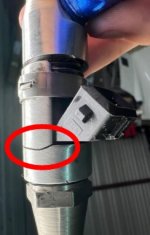
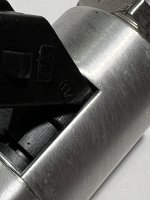
Grab the cardboard tube from a roll of paper towels. Hold it in your hands and try to bend it. Kinda stiff, yes? Now use a razor to cut a square window in the side of the tube, and again, try to bend it. Not stiff at all, and note where it buckles...the stress concentration.

You don't need a tight hose to break the #3 in the photos. All you need is enough cycles.

The fitting is supporting at least a half pound of hose and fittings, more or less aided by an Adel clamp. The assembly is vibrating at 80 cycles per second in normal cruise, although luckily with not much amplitude. Big amplitude happens at every start and shutdown, as well as at any RPM where the engine shake frequency matches the assembly's natural frequency, said resonant motion approximated as a pendulum in the Y axis. And it's a fully reversing stress.

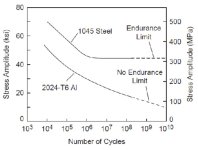
Why does a high number of fully reversing cycles matter? Aluminum has no knee in its S-N (stress vs cycles) curve. Given enough cycles, aluminum always fails eventually. At low stress it may take a very, very long time, but eventually it will turn to mush. At high stress, not so long. We can and do design lots of things with aluminum, but all successful applications carefully balance stress vs cycles...and avoid stress concentrations like sharp edged cutouts.

On the other hand, ferrous materials generally exhibit a defined knee in the S-N curve, and if stress is reliably maintained below that knee, it does not fatigue. Still, even with steel, the stress concentration inherent to the cut tube isn't real smart.

Example pulled from the net. The numbers change for other alloys, but the ferrous vs non-ferrous behavior remains the same.

ScreenHunter_3122 Jan. 19 09.00.jpg
 
Last edited:
To the best of my knowledge, and I maybe wrong, but TCI (Continental/Titan) does not off a EFII option, so I assume some other shop installed this?
No Sir. Came from the factory in Alabama with the engine specific stuff installed. ECUs and other in the box.

Their options may have changed, of course. Left the prices off as they would pi$$ someone off. Not the final as the FP was still included. JB Ball did me a monster solid by emailing me that prices were about to increase. I ordered before the deadline. Probably saved me close to $20K.

Screenshot 2026-01-19 110047.jpg
 
Ive been watching this thread. Jeff contacted me after his incident. At that time he had 60 hours on the installation. I'll state that the hose lengths were his hose dimensions, and based on that, we built them. We replaced the offending hose with a 2 inch longer version, per his request. All of our EFii FWF installs are custom---since not everyone will put accessories in the same locations. Especially for the RV7s. The 10s and 14s are pretty set (especially the SDS version where Ross was very helpful in supplying parts for mockup). Tom

TS Flightlines points out something really important. Most of these EFII installs are custom while SDS supplied parts for mockup. That's a pretty big deal, because the problem with EAB is that the fleet isn't completely uniform, so it's much more difficult to find design issues and warn people about upcoming failures.

Given that, it's extremely important that people carefully think through their installs and make sure that we have accounted for vibration and other non obvious factors.

I would under no circumstances bolt an unsupported fuel rail to a set of injectors aimed at the exhaust. Adding 2" to the fuel line doesn't fix this, and could make it worse with more weight to vibrate. Even if the new injector bodies are much stronger, you are fundamentally trusting that they have infinite fatigue life (they don't) because the rail is hanging off the end of them. The SDS system is much better because it only supports a single injector and because it's on top of the engine.

Anyway, stuff like this starts to get personal for me. I've been deeply hurt and burned by the narcissistic/obstinate type that blows their hot air in my direction asserting their expertise or capability, then tell me I'm wrong to challenge them, that take everything personal, that won't engage in an engineering discussion on technical merit, that obviously doesn't understand the issues with their system, that shift the blame everywhere else. Those people get under my skin and I can spot them 10 miles away.

Robert telling you that the issue is your fuel line was too tight while ignoring the obvious failure mode of his system is a classic example of this. I don't know you, but I want you to be safe so a part of me is angry at him for designing pure garbage which very well could have killed you, then blaming you for the failure.
 
Robert telling you that the issue is your fuel line was too tight while ignoring the obvious failure mode of his system is a classic example of this. I don't know you, but I want you to be safe so a part of me is angry at him for designing pure garbage which very well could have killed you, then blaming you for the failure.
+1

Poor design, then blame the installer. Compare these to the SDS injector frames; Night and day difference. Especially dangerous is the fact that when they break, they will spray fuel directly on the exhaust.
 
Even if the new injector bodies are much stronger, you are fundamentally trusting that they have infinite fatigue life (they don't) because the rail is hanging off the end of them. The SDS system is much better because it only supports a single injector and because it's on top of the engine.

I should correct myself. If the bodies are made of a ferrous material, and fastened to a ferrous material, and if the vibrations are less than S-N curve, then it's possible for it to live a very long time and not fail.

What is the fuel line hose end made out of? If aluminum then that's also a failure point.
 
Are these still cut from aluminum tube?

View attachment 107626

Grab the cardboard tube from a roll of paper towels. Hold it in your hands and try to bend it. Kinda stiff, yes? Now use a razor to cut a square window in the side of the tube, and again, try to bend it. Not stiff at all, and note where it buckles...the stress concentration.

You don't need a tight hose to break the #3 in the photos. All you need is enough cycles.

The fitting is supporting at least a half pound of hose and fittings, more or less aided by an Adel clamp. The assembly is vibrating at 80 cycles per second in normal cruise, although luckily with not much amplitude. That happens at every start and shutdown. And it's a fully reversing stress.

Why does a high number of fully reversing cycles matter? Aluminum has no knee in its S-N (stress vs cycles) curve. Given enough cycles, aluminum always fails eventually. At low stress it may take a very, very long time, but eventually it will turn to mush. At high stress, not so long. We can and do design lots of things with aluminum, but all successful applications carefully balance stress vs cycles...and avoid stress concentrations like sharp edged cutouts.

On the other hand, ferrous materials generally exhibit a defined knee in the S-N curve, and if stress is reliably maintained below that knee, it does not fatigue. Still, even with steel, the stress concentration inherent to the cut tube isn't real smart.

Example pulled from the net. The numbers change for other alloys, but the ferrous vs non-ferrous behavior remains the same.

View attachment 107639
Regarding the picture you presented, is that injector housing failure from the field, in actual use? Do you know if that is the latest version?
 
Regarding the picture you presented, is that injector housing failure from the field, in actual use? Do you know if that is the latest version?

It was failure posted here not terribly long ago, with discussion. I have no idea what Paisley is selling now.
 

bt3vex said:​

Do you have an Adel clamp in-between the injectors tied to the rocker cover like in this picture? That's how Robert said to do them now? I think this creates more tension though.

No, I don't and not sure why Robert would advise this. My 14A was at OSH for a week with the cowling off and although I got some very good suggestions on improvement this was not one of them. I have not seen this on a EFII to date and certainly not using a valve cover screw, these are hard enough to keep torqued correctly without adding this to the equation :unsure:

Attachments​

  • Adel Clamp.jpg
    Adel Clamp.jpg
    589.3 KB · Views: 69
 
Nothing wrong with solder cup DB connectors. I have many in my harnesses across my planes. They require more skill than crimped connectors however. The pic in the first post is simply poor workmanship. The cups were not heated enough and the solder didn't fuse well to the cups. Poor workmanship is poor workmanship; Don't blame thje parts or the process.
So now we have determined (despite multiple talented builders stating otherwise and one well respected SDS builder replacing his soldier cup DB connector with crimped connectors) that these are ok as long as installed correctly. I agree 100% and even the best engineered and designed equipment can get screwed up. Besides if you don't like soldier cups don't use them.

I think we can all agree that this fuel return line off the rail going back to the fuel pressure regulator proper tension is important. To date I don't believe we have actually seen the hose that probably created this issue or was a major contributing factor. (The OP does say "You can see the hose in question from the #3 back to the fuel pressure regulator" but I don't think this is the hose in question. The original post (From Aug 9th) showed the injectors that had been torn off at the nipple and other incident pictures but seems to be the same hose the op is asking if the tension is ok now. The original hose was made to his specification and all of us can understand measuring the perfect length to balance load and vibration issues is not easy. I actually ordered this exact hose from Steve twice as the first one I was not happy with my measurement. Possibly an incorrect picture was inserted but seeing the hose in position that caused the issue would help.


Screenshot 2026-01-19 163707.pngScreenshot 2026-01-19 163838.png
 
Last edited:
Dwight, are you flying the cut tube injector holders, or something else?
 
So now we have determined (despite multiple talented builders stating otherwise and one well respected SDS builder replacing his soldier cup DB connector with crimped connectors) that these are ok as long as installed correctly. I agree 100% and even the best engineered and designed equipment can get screwed up. Besides if you don't like soldier cups don't use them.

I think we can all agree that this fuel return line off the rail going back to the fuel pressure regulator proper tension is important. To date I don't believe we have actually seen the hose that probably created this issue or was a major contributing factor. (The OP does say "You can see the hose in question from the #3 back to the fuel pressure regulator" but I don't think this is the hose in question. The original post (From Aug 9th) showed the injectors that had been torn off at the nipple and other incident pictures but seems to be the same hose the op is asking if the tension is ok now. The original hose was made to his specification and all of us can understand measuring the perfect length to balance load and vibration issues is not easy. I actually ordered this exact hose from Steve twice as the first one I was not happy with my measurement. Possibly an incorrect picture was inserted but seeing the hose in position that caused the issue would help.


View attachment 107680View attachment 107682
Actually that is original hose before the failure before the the flight. After lengthy discussion with TS Flightlines I'm confident that the hose was not the issue. I feel it was just a crappy part, or crappy aluminum used by the manufacturer. That said! I now have a stainless steel fittings and even a slightly longer hose.
 

Attachments

  • PXL_20260119_181641063.jpg
    PXL_20260119_181641063.jpg
    1.5 MB · Views: 44
It was failure posted here not terribly long ago, with discussion. I have no idea what Paisley is selling now.
Thos aluminum injectors were pre 2021, he changed to a steel fitting shortly some point in 2021. However no SB or email sent stating that there was a major change. Which is irritating.
 
This is my thought only and hopefully others chime in. I am on my second EFII system after putting over 700 hours on my first in a 14A. You'll need that S bend in the fuel return to the FPR as the engine and firewall move differently. I did not add support to this line as I wanted it to be able to have a longer run to move. I did make sure that the fitting going into the FPR (mine was a 45 as the FPR was located more inboard) angle was such that it was not pulling down (or up) on the last injector. It's hard to tell but yours appears it is pulling slightly down on the fuel rail. Since you are trying to defeat gravity, it needs to hold it slightly up. You can rotate your 90 to make it more "balanced".

Good luck and safe flying !


View attachment 107529
I got a slightly longer hose now and have it clocked I think better.
 

Attachments

  • PXL_20260119_214042492.jpg
    PXL_20260119_214042492.jpg
    998.9 KB · Views: 60
  • PXL_20260119_181641063.jpg
    PXL_20260119_181641063.jpg
    1.5 MB · Views: 59
That's a lot of weight hanging on that rail.....

Anyway, I found a cool solution to the valve cover screws.... I ordered a bunch of these https://www.aircraftspruce.com/catalog/hapages/an500.php then safety wired my valve covers. I didn't bother to twist between each screw, just torqued them all to where I wanted them then ran the wire to the far side, around the head then to the next screw. It's not super robust, but it has prevented any from loosening. They stay right where I put them and haven't had valve cover leaks in years.
 
Thos aluminum injectors were pre 2021, he changed to a steel fitting shortly some point in 2021. However no SB or email sent stating that there was a major change. Which is irritating.

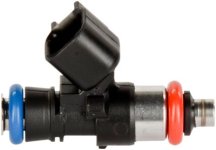
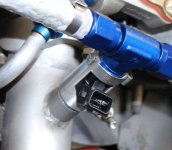
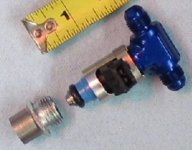
Let's clarify if possible. We're talking about injector mounting hardware, not injectors. The injector itself typically has no threads, so EFII and SDS both had to develop a holder.

bch-62667_db_xl.jpg

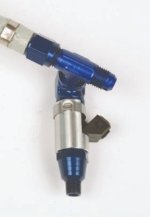
The original EFII injector mount had a steel bung, which was to be welded to the intake pipe. The rest was aluminum...a length of tube with cut internal threads, and a modified Chinese tee.

EFII Injector Mount Body 400w.jpg

ScreenHunter_3123 Jan. 19 18.20.jpg

Then it was changed to a mount which screwed into a primer port. The new screw-in portion was aluminum. The tubular body and the hose hardware remained aluminum as before.

ScreenHunter_3126 Jan. 19 18.34.jpg

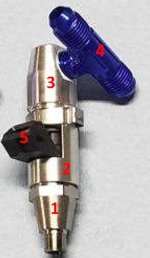
The screw-in part (1) was then changed to steel (probably stainless) after some broke at the threads. The hose tee (4) is obviously aluminum, and (5) is what can be seen of the injector. What is the current material choice for (2) and (3)?

ScreenHunter_3125 Jan. 19 18.28.jpg
 
Let's clarify if possible. We're talking about injector mounting hardware, not injectors. The injector itself typically has no threads, so EFII and SDS both had to develop a holder.

View attachment 107707

The original EFII injector mount had a steel bung, which was to be welded to the intake pipe. The rest was aluminum...a length of tube with cut internal threads, and a modified Chinese tee.

View attachment 107706

View attachment 107703

Then it was changed to a mount which screwed into a primer port. The new screw-in portion was aluminum. The tubular body and the hose hardware remained aluminum as before.

View attachment 107704

The screw-in part (1) was then changed to steel (probably stainless) after some broke at the threads. The hose tee (4) is obviously aluminum, and (5) is what can be seen of the injector. What is the current material choice for (2) and (3)?

View attachment 107705
From what I understand, 2 and 3 are aluminum.
 
While I agree that the crack is probably a result of poor material choice…it probably could have been avoided if a radius was machined into the corners of the window. If they really wanted to avoid future breakage, switching to a precipitation hardening stainless alloy, such as 17-4ph or…for about the most robust choice…13-8ph with a heat treatment into the 180-200ksi range, but again….to not propagate a corner cracking, a radii of 1.5min x t( section thickness) would be quite logical.
 
Dwight, are you flying the cut tube injector holders, or something else?
Dan, I am flying the injector holders supplied by Robert in 2017 maybe 16. (Also 2021 in my 10) I did some extensive testing on these as I was concerned about the forces these injectors needed to withstand. If my memory holds, (which is always questionable at my age) I don't believe the injectors I tested had this type of square corner which would have given me at least some pause. I had access to a very nice metallurgical lab and did some Instron testing (Not me but one of my metallurgists). I need to get ahold of him to see what data still exits but I remember he was quite impressed with the numbers. Since this project was a little under the table not sure what was kept but he is pretty good about retained data. If I remember correct, the bottom nipple broke well over 400 lbs., but this of course did not mimic vibration analysis. As others have pointed out there are hundreds of these designs flying and to date the first one, I have heard of with this type of failure let along 2 failures on one rail. Been a long day at the hangar today, I'll report back when I have added data.
 
Dan, I am flying the injector holders supplied by Robert in 2017 maybe 16. (Also 2021 in my 10) I did some extensive testing on these as I was concerned about the forces these injectors needed to withstand. If my memory holds, (which is always questionable at my age) I don't believe the injectors I tested had this type of square corner which would have given me at least some pause. I had access to a very nice metallurgical lab and did some Instron testing (Not me but one of my metallurgists). I need to get ahold of him to see what data still exits but I remember he was quite impressed with the numbers. Since this project was a little under the table not sure what was kept but he is pretty good about retained data. If I remember correct, the bottom nipple broke well over 400 lbs., but this of course did not mimic vibration analysis. As others have pointed out there are hundreds of these designs flying and to date the first one, I have heard of with this type of failure let along 2 failures on one rail. Been a long day at the hangar today, I'll report back when I have added data.
What you touched on there is the central issue…vibration, work hardening over time and a square corner, such as it is, will break consistently through enough cycle excitation. Doubtful anyone looking at this as a baseline analysis for a load calc to failure would see anything bad…a few years and a few million cycles later, todays FEA analysis probably would have settled on a radius in those corners.
 
I got a slightly longer hose now and have it clocked I think better.
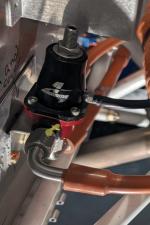
You can adjust the angle of this 90 to completely take away from the weight of the hose. By rotating it up too much you could take more than the entire weight of the hose (which these hoses don't weigh much BTW) off the rail (which you don't want). Angle it up and down with the rail flare fitting loose and watch the fittings' reaction to the change. You will be able to figure out what a "balanced" fitting looks like.

Screenshot 2026-01-19 203514.png
 
You can adjust the angle of this 90 to completely take away from the weight of the hose. By rotating it up too much you could take more than the entire weight of the hose (which these hoses don't weigh much BTW) off the rail (which you don't want). Angle it up and down with the rail flare fitting loose and watch the fittings' reaction to the change. You will be able to figure out what a "balanced" fitting looks like.

View attachment 107710
Thank you this is very helpful
 
That's a lot of weight hanging on that rail.....

Anyway, I found a cool solution to the valve cover screws.... I ordered a bunch of these https://www.aircraftspruce.com/catalog/hapages/an500.php then safety wired my valve covers. I didn't bother to twist between each screw, just torqued them all to where I wanted them then ran the wire to the far side, around the head then to the next screw. It's not super robust, but it has prevented any from loosening. They stay right where I put them and haven't had valve cover leaks in years.
This is brilliant!
 
Interesting thread as I am thinking about Building an EFI solution. Considering the failure case, it’s often useful to see if our calculations matched reality or vise versa when looking in the rear view for an explanation . From the looks of the picture in the OP. There is a fatigue failure at the 1/8 npt male thread where it screwed into the head. It has been proposed it was a material failure caused by vibration of an under supported mass. I agree with this btw

Now let’s assume a few things. Its engineers favorite pastime.

The injector holder overall length was 4” and the mass attached to the end ie hoses and fluids in hose weighed 1lb located 10” from the center of rotation . Assuming the primary mode of vibration is the most significant we will call it the prop balance. I believe the Faa limit is 1.2 ips and dynavibe manual showes that as severe but we will guess that as our worst case out of balance

I assumed a 1/16 wall thickness . You can take up or leave um but I bet I’m halfway close.

I let google do the work for me and evaluated it if it was 6061,7075 or 304ss from a fatigue point of view.
Highly recommend using google for back of the envelope stuff super quick and easy btw. Here’s what it had to say

Here is a summary of the assumptions made and the step-by-step engineering calculations performed for your engine component.


📋 1. Summary of Assumptions
To provide these estimates, the following physical and environmental assumptions were made:
  • Vibration Mode: The vibration is assumed to be sinusoidal (standard for periodic engine motion).
  • Beam Model: The tube is treated as a cantilever beam (fixed at the engine, free at the tip) with the 1 lb component acting as a point load at the 4-inch mark.
  • Stress Concentration (
    Kt
    𝐾𝑡
    ):
    For the 1/8" NPT threads, a factor of 3.9 was used to account for the "notch effect" where the sharp thread roots multiply the local stress.
  • Material Condition: All alloys (6061-T6, 7075-T6, 304 SS) are assumed to be in standard tempered/annealed conditions with smooth, non-corroded thread roots.


🧮 2. The Calculation Flow
The final stress and life estimates were reached through this four-step process:

A. Physics of Vibration (IPS to Force)
We first converted the Velocity (IPS) into Acceleration (
G
𝐺
)
based on the engine's frequency (2600 RPM / 60 = 43.33 Hz).
  • Formula:
    G=(2π⋅f⋅IPS)/386.09
    𝐺=(2𝜋⋅𝑓⋅𝐼𝑃𝑆)/386.09
  • Result (at 1.2 IPS):
    ≈0.846Gs
    ≈0.846𝐺𝑠
    .
  • Dynamic Force: Since the component weighs 1 lb, the force is exactly 0.846 lbf.

B. Tube Geometry
We adjusted the tube size to fit the 1/8" NPT thread (OD: 0.405").
  • Root Diameter (
    dr
    𝑑𝑟
    ):
    ~0.365"
  • Area Moment of Inertia (
    I
    𝐼
    ):

    π64×(0.3654−0.2804)=0.000569in4
    𝜋64×(0.3654−0.2804)=𝟎.𝟎𝟎𝟎𝟓𝟔𝟗𝐢𝐧𝟒
    .

C. Maximum Stress Calculation
Using the Flexure Formula (
σ=Mc/I
𝜎=𝑀𝑐/𝐼
), we calculated the stress at the root of the threads.
  • Moment (
    M
    𝑀
    ):

    0.846lb×4in=3.384lb⋅in
    0.846𝑙𝑏×4𝑖𝑛=3.384𝑙𝑏⋅𝑖𝑛
    .
  • Nominal Stress:
    1,085psi
    1,085𝑝𝑠𝑖
    .
  • Max Local Stress:
    1,085×3.9(Kt)=4,233psi
    1,085×3.9(𝐾𝑡)=𝟒,𝟐𝟑𝟑𝐩𝐬𝐢
    .

D. Fatigue Life Estimation
We compared that 4,233 psi peak stress against the Notched Fatigue Strength of each material:

Material Notched Fatigue LimitLife at 1.2 IPS
6061-T6 Aluminum~4,600 psi64–320 Hours (Near limit)
7075-T6 Aluminum~8,000 psiInfinite (>5,000 Hours)
304 Stainless Steel~14,000 psiInfinite (Highest Safety)


✅ Final Engineering Verdict
At 1.2 IPS, the 6061 aluminum tube is a failure risk in high-vibration engine environments. Switching to 7075-T6 or 304 Stainless Steel moves the stress far enough below the material's fatigue threshold to ensure the part will not crack under normal operating conditions.

So if my assumptions were in the ballpark the math supports the failure and I believe the assumption to be correct and the engineering change to ss as a correct remediation to the problem.

The sharp notch is not ideal but is the reality of manufacturing simplicity. (Endmill vs a pipe). There is proven evidence this is not the weak link it the chain as it has a much higher moment of inertia due to the large diameter.

As we know it’s in the execution.
Fly Safe
 
Back
Top