

Van's Air Force
You are using an out of date browser. It may not display this or other websites correctly.
You should upgrade or use an alternative browser.
You should upgrade or use an alternative browser.
EarthX Cooling Needed?
- Thread starter rockitdoc
- Start date


Ever measure temps at the battery?I have been running ETX 900 for several years in my -14A and no issues and no special cooling ducting.

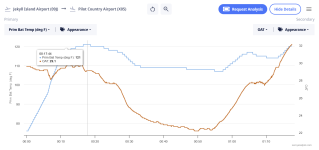
This is typical of battery temp (Vans plan upper firewall location RV-14A) with a blast tube (5/8 in.) not located on the battery but on a small linear actuator that's on the oil cooler inlet air damper near the battery. OAT is in C so ~ 76 F ambient on take-off. Landed ambient temp was lower 90's F. Can see temps in the mid 120's on the ground and in-flight with temps in the mid 120's after shutdown until oil door is opened. 6 years ETX900 still showing over 80% of its ampacity left.
Last edited:

We’ve had an EarthX on the firewall of our Tundra for seven years now, in a standard battery box - no issues at all.
I have seen 182 degrees under the cowl on a hot day after a short stop, before starting engine. The EarthX (or any type of battery) probably accelerates aging when this happens. The problem is that there is no blast air available when the battery needs it most  .
.
.
Last edited:
Curious where you have your temperature sensor located. I can move mine around (and have) and see nothing close to this where my battery is located (stock 14A location, upper co-pilot side top of firewall). I do measure temps much higher lower on the FWF behind the engine and exhaust manifold. My upper Earth X battery is still in my airframe after 700 hrs. and 9 years since purchase, my battery located lower on the firewall (Where it sees temps in the 160 F range no blast tube and 145 with a blast tube) was replaced after 500 hrs. and 7 years after purchase. I replaced it when it failed the 80% ampacity test at CI. After shutdown I have seen temps increase 15F if I don't open the oil door and ~ 5 F if I open the door. Cathy at Earth X told me it is temperature related and although a blast tube is not functional with the engine off it does reduce temps for the majority of the time the engine is running.I have seen 182 degrees under the cowl on a hot day after a short stop, before starting engine. The EarthX (or any type of battery) probably accelerates aging when this happens. The problem is that there is no blast air available when the battery needs it most
I have an EarthX 680c in the lightweight skeleton battery box on my RV7. I wondered about this so I put a cheap thermometer sticker on it and saw a max of 150f, presumably when it heat soaked after shutdown. That was during summer when OAT was regularly hitting 100 degrees and it was probably around 110 in my old steel T hangar with the sun hitting it. I also have no idea how accurate those little stickers are so who knows.
I think I recall that 150 is the max according to EarthX, but it sat on the shelf for about a year and it's been in the plane now for close to 2 years and still going strong.
I think I recall that 150 is the max according to EarthX, but it sat on the shelf for about a year and it's been in the plane now for close to 2 years and still going strong.
Correct, this is the full published spec:I have an EarthX 680c in the lightweight skeleton battery box on my RV7. I wondered about this so I put a cheap thermometer sticker on it and saw a max of 150f, presumably when it heat soaked after shutdown. That was during summer when OAT was regularly hitting 100 degrees and it was probably around 110 in my old steel T hangar with the sun hitting it. I also have no idea how accurate those little stickers are so who knows.
I think I recall that 150 is the max according to EarthX, but it sat on the shelf for about a year and it's been in the plane now for close to 2 years and still going strong.

So, 60 C (140 F) max. operating temp, 65 C (149 F) for 30 mins (short term), 70 C (158 F) long term ground survival temp and 85 C (185 F) short term ground survival.
Those cheap Amazon stick on temp strips are amazingly accurate for the price.

jmra72a
Well Known Member
Yes, I had this problem. The EarthX battery light would go off advising me of an overheating condition. Did some investigation and found the cowl baffle seal just in front of firewall mounted battery had collapsed. I repaired the seal and the EarthX over temp warning stopped.
I shoved a multi meter thermocouple from below while on the ground. Also the EFIS reported CHTs at 300 after being parked for ~15 min and oil - 180. That was a lot of heat radiating from the engine back to the firewall where the battery is mounted, with dark paint on top cowl under the sun and no wind, OAT 100+. I know this was not very scientific since i didnt measure the battery temp directly, but still pretty harsh conditions for delivering cranking amps and then recharging at high rate while taxiing with little airflow . I don't fly often at these temps and my EarthX still has nearly full capacity after a few years of use.Curious where you have your temperature sensor located.

Temperatures after installation were up to 144F during flights with OAT at 40F. This temperature rose to 148F on landing with oil door open.
I insulated the box and installed a blast tube. Temperatures are now 134F during flight (40F OAT) and 138F after with oil door open in a 55F hangar. We'll see how this changes this summer.
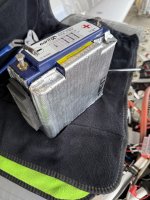
I insulated the box and installed a blast tube. Temperatures are now 134F during flight (40F OAT) and 138F after with oil door open in a 55F hangar. We'll see how this changes this summer.

Rdog420
Well Known Member
I thought the BMS kept them from overheating?Anybody with an EarthX 900 find it necessary to add cooling ducts for a firewall forward installation?

The BMS will "throw a code" when the internal temperature hits >85°C (185°F) -- 2 sec on, 2 sec off, repeats.I thought the BMS kept them from overheating?
The BMS manages current in and out and amongst the cells, has undervoltage/overvoltage as well as overcurrent (short circuit) protections. It's not clear from the docs that the BMS does anything about temperature aside from the aforementioned code.

Swiss14A
Active Member
We have a Earthx ETX680 attached to the firewall in a slightly modified (bended) standard battery box provided in the kit (Vans) and had an oberheat warning during a summer flight. After insulating the battery like rockitdoc did in post #15, the issue never came up again. But e thermal sticker shows max temp of 150°F on the battery, probably after shutdown… we don‘t have a cooling duct, that would be the next step. Although I am not sure if it‘s really healthy to blow temperatures in the 0°F range onto the battery on a cold winter day ober the Alps…
The 5/8 blast tube would come off the back of the rear baffle so would not be ambient. I've measured temps almost everywhere FWF but not the rear baffle. Possibly someone else has? (And I used a blast tube in Ohio winters and no downside effect on my ETX900 mounted FWF, 8 yrs and still passes the 80% ampacity test)We have a Earthx ETX680 attached to the firewall in a slightly modified (bended) standard battery box provided in the kit (Vans) and had an oberheat warning during a summer flight. After insulating the battery like rockitdoc did in post #15, the issue never came up again. But e thermal sticker shows max temp of 150°F on the battery, probably after shutdown… we don‘t have a cooling duct, that would be the next step. Although I am not sure if it‘s really healthy to blow temperatures in the 0°F range onto the battery on a cold winter day ober the Alps…
Sorry for the dumb question, but where are you pointing the blast tube?The 5/8 blast tube would come off the back of the rear baffle so would not be ambient. I've measured temps almost everywhere FWF but not the rear baffle. Possibly someone else has? (And I used a blast tube in Ohio winters and no downside effect on my ETX900 mounted FWF, 8 yrs and still passes the 80% ampacity test)
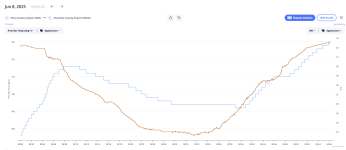
Since I have a linear servo actuating my oil door, I pointed the blast tube at a spot, so the linear actuator and the front of the battery box are hit with cooler air. My ring thermocouple is located behind the battery box between the firewall and battery. This is the reading last summer in Florida.
Note OAT is in C but displayed on the G3X in F. Not sure why.
Note OAT is in C but displayed on the G3X in F. Not sure why.
it would be interesting to plot charge/discharge current over the same chart. there may be very little current flowing through the battery in normal flight since it only acts as a buffer to smooth out alternator ripple. i have blast air pointing to the mags and that creates some flow over the battery as well which may be all it needs.Since I have a linear servo actuating my oil door, I pointed the blast tube at a spot, so the linear actuator and the front of the battery box are hit with cooler air. My ring thermocouple is located behind the battery box between the firewall and battery. This is the reading last summer in Florida.
Note OAT is in C but displayed on the G3X in F. Not sure why.
View attachment 107483
I have a temp probe about an inch away from it and usually read anywhere between 120F to 145F depending on the OAT. It has never got to the temp that would trigger the warning of the battery. This is without any cooling duct.Ever measure temps at the battery?
I moved my blast tube to aim at the top of the battery. It was previously aimed at the front face. Flew yesterday (OAT 40F), and the battery temperature never exceeded 118F. After shutdown, the temp rose to 140F so I will aim a blower at the oil door to circulate cooler air from the hangar into the battery area FWF, especially in summer.
