


Van's Air Force

The definitive Van's Aircraft support community! Buying, building or flying an RV? Join our exclusive family of mentors and enthusiasts!

E-Propeller digital pitch protractor

seagull

Well Known Member
E-Props has supplied two different digital protractors over the years. Since I have two complete propellers, I decided to compare the gauges.

The smaller protractor is rechargeable and measures in 0.05° increments at our typical pitch settings. When I checked both gauges on the same propeller, I found they differed by about 0.75°, with the smaller gauge consistently reading lower.

I bring this up because it's easy to focus on matching a specific pitch number instead of matching performance. E-Props blades are very consistent, so blade shape isn't the variable. If your digital protractor reads a little differently than someone else's, you'll still end up with a similar pitch, but the number on the display may not be directly comparable.

The takeaway is that the digital protractor gets you very close, but a flight test is still the best way to dial in the final pitch for your airplane.
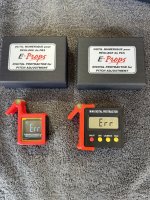
IMG_1263.jpeg
 
Since I already owned a digital inclinometer, I declined buying another when purchasing a ground adjustable prop. I ended up making my own fixture to hold the inclinometer. The directions with my ground adjustable suggest running at full power on the ground to determine the RPM at full power before flying it. They said that an adjustment of 1 degree of blade angle will change the maximum RPM BY 100, and suggested fine tuning the prop angle so the engine is at full throttle/redline on the ground.
 
I think more important is precision... Will the gage consistently give the same reading when applied under identical conditions? If the gage does not repeat, then how can you set three different prop blades to the same pitch?

When I fly my 12 with 3-blade E-prop, a convenient check of relative blade pitch is when the sun shines on the back side of the propellor. The sun “strobes” each blade, and if the frozen images align, then all three blades share the same pitch angle setting…
 
I think more important is precision... Will the gage consistently give the same reading when applied under identical conditions? If the gage does not repeat, then how can you set three different prop blades to the same pitch?

When I fly my 12 with 3-blade E-prop, a convenient check of relative blade pitch is when the sun shines on the back side of the propellor. The sun “strobes” each blade, and if the frozen images align, then all three blades share the same pitch angle setting…
Both the older and current protractors they provide are equally repeatable. The new “smaller” digital protractor will show .05 degrees which allows a more precise setting.
 
I addition to precision and repeatability of the digital instrument itself is the ability to repeat mechanical setup on the prop blades. The 3D printed plastic holder must be able to be placed on each blade exactly the same. The prop blades must also be positioned exactly the same. Try this… remove and reinstall the digital protractor w/ 3D mount on the same blade. Leave the blade position unchanged so it removes that variable. Does the gage unit hang the same and give the exactly same reading each time it is replaced on the prop?
 
I addition to precision and repeatability of the digital instrument itself is the ability to repeat mechanical setup on the prop blades. The 3D printed plastic holder must be able to be placed on each blade exactly the same. The prop blades must also be positioned exactly the same. Try this… remove and reinstall the digital protractor w/ 3D mount on the same blade. Leave the blade position unchanged so it removes that variable. Does the gage unit hang the same and give the exactly same reading each time it is replaced on the prop?
3D printing? I’m not that high tech. I put tape on the blades at the correct distance from the tip to measure the angle. With the flywheel set perfectly vertical and the rising blade at absolute horizontal. My fixture was made with wax paper, JB weld, some wire, and a flat bit of metal long enough to hold the digital inclinometer with a couple rubber bands.

My fixture is a prop shaped loop that slides onto the end of the blade. Even if I don’t get the same digits as you do with yours. I am absolutely sure that I can verify that I get the exact same digits every time when I do my 3 bladed prop.
 
I addition to precision and repeatability of the digital instrument itself is the ability to repeat mechanical setup on the prop blades. The 3D printed plastic holder must be able to be placed on each blade exactly the same. The prop blades must also be positioned exactly the same. Try this… remove and reinstall the digital protractor w/ 3D mount on the same blade. Leave the blade position unchanged so it removes that variable. Does the gage unit hang the same and give the exactly same reading each time it is replaced on the prop?
I was surprised to find the E-Prop digital protractor and printed fixture very repeatable within itself. I did the test you described plus resetting the same blade multiple times and resetting zero on the protractor, and always came up with the same reading within the same protractor. I did a comparison with 3 of the E-Prop supplied ones. What was different was the readings were all slightly different between them. What I found more important was the variation with temperature. The readings within the same device would shift as it warmed up during the testing. I learned that turning on and setting the protractor out in the work area 15 minutes before starting the check solved this.
 
I’m interested in knowing what is seen when bright sunshine illuminates the backside of the prop when in cruise flight… You will need to set a course so that sun’s angle reflects on the backside of the prop arc and reflection is at ~ 10 o’clock position relative to pilot’s view point. The sun will strobe (freeze frame) each of the three blades so you can discern relative angle between the blades. Ideally, all three reflections are superimposed and you see only one reflection. Or, two blades may be matched and the third reflection is offset. Worse case is three separate reflections that are spaced apart.

When I first started flying my E-Prop, I had two matched blades and one slightly offset. The two that were matched “glistened” and you could tell two blades were making the one image. I remeasured all three blades, and sure enough… one blade needed adjustment.

I’m going to take better notice of sunlight reflecting off back side of prop. I will try to take a photo… I also want to investigate the reflected angles when engine speed is varied. So far, I have only done this at cruise power setting. I’m having fun in the sun….. :cool:
 
Back
Top
