
I am looking for some ideas on how to install 2 earthx batteries plus the 3 contactors. I was planned to use Earthx’s light weight battery boxes but I haven’t come up with a good way to install the contactors with this setup. Now I am thinking about creating a tray with angle and attaching another angle for the contactors. But, I would love to see other solutions if you can share.

Van's Air Force
You are using an out of date browser. It may not display this or other websites correctly.
You should upgrade or use an alternative browser.
You should upgrade or use an alternative browser.
Dual EarthX with 2 battery contactors and a cross-feed
- Thread starter Jromy
- Start date

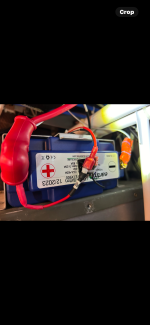

I am looking for some ideas on how to install 2 earthx batteries plus the 3 contactors. I was planned to use Earthx’s light weight battery boxes but I haven’t come up with a good way to install the contactors with this setup. Now I am thinking about creating a tray with angle and attaching another angle for the contactors. But, I would love to see other solutions if you can share.
Here is my setup: https://www.strikhedonia.com/plugging-away-wiring/

I built a custom battery shelf and mounted all 3 contactors on it in the standard location.I am looking for some ideas on how to install 2 earthx batteries plus the 3 contactors. I was planned to use Earthx’s light weight battery boxes but I haven’t come up with a good way to install the contactors with this setup. Now I am thinking about creating a tray with angle and attaching another angle for the contactors. But, I would love to see other solutions if you can share.
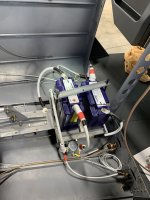
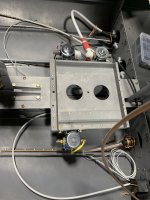

Two PC-625 batteries on a modified Van’s stock RV-10 tray.
Two master relays (one for each battery). For normal operation both masters are shut placing the batteries in parallel. The master relays feed the “non-vital” buss (stuff other than avionics) as well as the tradional engine start and alternator output connections. The 30 amp relays feed the panel, aligning one battery to each half of the panel (independent of the master relays). The setup provides for multiple backup modes.
Carl
Two master relays (one for each battery). For normal operation both masters are shut placing the batteries in parallel. The master relays feed the “non-vital” buss (stuff other than avionics) as well as the tradional engine start and alternator output connections. The 30 amp relays feed the panel, aligning one battery to each half of the panel (independent of the master relays). The setup provides for multiple backup modes.
Carl
Attachments
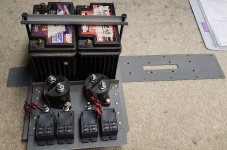

`There's a 3D supplier that does an excellent job with providing battery holders for 2 ETX Earth X batteries, highly recommend. Contact holders not that difficult to fab.I am looking for some ideas on how to install 2 earthx batteries plus the 3 contactors. I was planned to use Earthx’s light weight battery boxes but I haven’t come up with a good way to install the contactors with this setup. Now I am thinking about creating a tray with angle and attaching another angle for the contactors. But, I would love to see other solutions if you can share.

Lithium in the cabin, is that really a good idea?I have one Earthx on top of the tunnel between the pedals.

That's almost as scary as flying a home-built airplane!Lithium in the cabin, is that really a good idea?
lithium iron phosphate is much safer than lithium ion. These type may expand, but they do not explode and are not prone to spontaneous combustion.Lithium in the cabin, is that really a good idea?
Last edited:
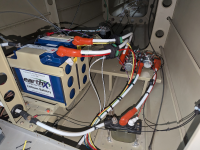
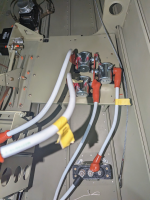
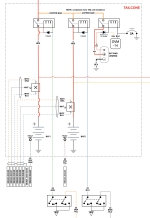


Yes, it's an external power port.What is the purpose of the third contactor?
In the case of rdamazio, it looks like it is for an external power supply? and that contactor is energized by a 2A pullable breaker in place of a 'master switch'.?
It's energized by the third pin on the power port (which by design is shorter and thus connects only after good contact has been made on the higher-current pins):
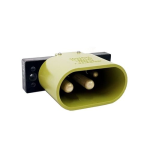
So I can plug in external power without connecting it to either battery. Most external power supplies have an on/off switch so I saw no reason to also put one in the airplane.
The circuit breaker exists for overvoltage protection - if you mistakenly connect a 28V power supply, the crowbar (OVM-14 by B&C) will become a short and it'll trip the circuit breaker, preventing the rest of the plane from getting the higher voltage for more than a few ms.

UnPossible
Well Known Member
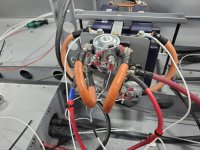
UnPossible
Well Known Member
This was during the build, and the wiring has been tidied up a bit.
UnPossible
Well Known Member
This was during the build, and the wiring has been tidied up a bit.
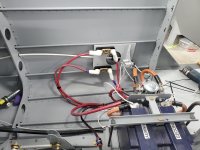
Yes, I agree. We have an electric generator in the hangar with a 14 V lithium iron battery that by mistake was connected to a 28 V charger.lithium iron phosphate is much safer than lithium ion. These type may expand, but they do not explode and are not prone to spontaneous combustion.
Plastic around the terminal melted and it started to smoke and i disconnected the power.
It continued to smoke for about ten minutes, I had to open the doors.
My lithium iron battery is FWF in an air cooled box.
Good luck
I am currently mounting my contactors (I use Gigavacs). My two EarthX 900s are up front over the ruder pedals. Two of the contactors go onto the sides of the battery holder. The cross bar one is currently planned to go onto the quadrant cable mount.
Attachments

Cross-Feed question. I see some are placing the cross-feed between the main and aux bus and some are placing it on the 2 b-leads. Maybe other places it could go. Is there an advantage where it is placed?
I was hesitant to adding an external power supply as I was concerned that if needed there was something wrong with my 2 Earth-X batteries and using an external power supply might start the engine but would not know if my batteries would actually hold a charge. Plus, the risk of someone using 24 volts which RDAMAZIO seems to have found an eloquent solution.
I was hesitant to adding an external power supply as I was concerned that if needed there was something wrong with my 2 Earth-X batteries and using an external power supply might start the engine but would not know if my batteries would actually hold a charge. Plus, the risk of someone using 24 volts which RDAMAZIO seems to have found an eloquent solution.

I decided not to include an external power system. With an electrically dependent engine, I would likely never use it. If the ship batteries are insufficient then I am not going. That said, I did include charge ports for the batteries and can use my optimate chargers as ground power for working on the avionics.
I’m sure you’re aware that battery chargers are not ground power units…I decided not to include an external power system. With an electrically dependent engine, I would likely never use it. If the ship batteries are insufficient then I am not going. That said, I did include charge ports for the batteries and can use my optimate chargers as ground power for working on the avionics.
I'm sure you aren't aware that the optimate chargers I chose have a regulated 8 amp output mode, specifically designed for that purpose.I’m sure you’re aware that battery chargers are not ground power units…

Optimate TM-275 v2 10 amp Battery Charger/Maintainer/Power Supply (12-13.2V Batteries)
The Ultimate Optimate Lithium Battery Charger & Power Supply: TM-275 9.5Amp Lithium (LiFePo4) for 13.2V batteries! Shop now!
 earthxbatteries.com
Last edited:
I’m curious.
- For you earthx guys mounting battery(s) forward, what are you doing to make up for the W&B issue of not having a standard battery aft?
- For all you earthx guys mounting battery(s) inside the cabin (or aft of the baggage compartment) are you only installing vented batteries?
Carl
- For you earthx guys mounting battery(s) forward, what are you doing to make up for the W&B issue of not having a standard battery aft?
- For all you earthx guys mounting battery(s) inside the cabin (or aft of the baggage compartment) are you only installing vented batteries?
Carl
I have two etx900’s mounted aft of the baggage compartment; standard non vented batteries.I’m curious.
- For you earthx guys mounting battery(s) forward, what are you doing to make up for the W&B issue of not having a standard battery aft?
- For all you earthx guys mounting battery(s) inside the cabin (or aft of the baggage compartment) are you only installing vented batteries?
Carl
As far as the W&B goes, mounting them forward will likely require carrying ballast aft during solo or two person ops. Unless they want to fly at the forward cg limit or have A/C or BRS installed aft.
PilotjohnS
Well Known Member
Are you saying you are running two earthx batteries in parallel, for discharge and charging? I would check with earthx. This usually a no no.
I have two ETX900s mounted aft of the baggage area; that was an answer to the OPs question.Are you saying you are running two earthx batteries in parallel, for discharge and charging? I would check with earthx. This usually a no no.
As far as the electrical architecture, I am running a modified Z-14 split bus with crosstie. I have two alternators, two batteries, and a crosstie...essentially two separate electrical systems. The batteries are parallel for starting, then isolated to their respective system. The crosstie gives me the ability to power either or both systems from a single source, if necessary.

I have the same z-14 architecture.I have two ETX900s mounted aft of the baggage area; that was an answer to the OPs question.
As far as the electrical architecture, I am running a modified Z-14 split bus with crosstie. I have two alternators, two batteries, and a crosstie...essentially two separate electrical systems. The batteries are parallel for starting, then isolated to their respective system. The crosstie gives me the ability to power either or both systems from a single source, if necessary.
Currently still on PC680s but I am attracted to the power and weight savings of the EarthX.
One thing that I had pondered is that in the event of say an alternator failure, you would close the cross tie and therefore be charging both batteries in parallel from the remaining alternator. So you would need to close the cross tie and switch off the master on the failed alternator side to be safe.
Not a total showstopper but something to keep in mind, especially if forgetting puts your entire remaining elec system at risk of BMS induced shutdown.
This is the Nuckolls recommendation for a Z-14 and an RV-10 and how I have wired mine - with locally grounded batteries aft.Cross-Feed question. I see some are placing the cross-feed between the main and aux bus and some are placing it on the 2 b-leads. Maybe other places it could go. Is there an advantage where it is placed?
I was hesitant to adding an external power supply as I was concerned that if needed there was something wrong with my 2 Earth-X batteries and using an external power supply might start the engine but would not know if my batteries would actually hold a charge. Plus, the risk of someone using 24 volts which RDAMAZIO seems to have found an eloquent solution.
The advantage of the cross tie up the front is that you can then only need 4AWG down the length of the plane for each batt.
Maybe I’ve misinterpreted Rdamazios diagram but does he have a x-tie? Looks like the batts always parallel if both masters on?
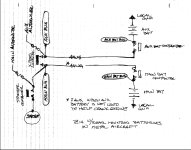
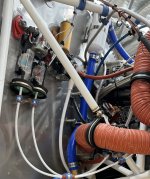
Hi RichardThis is the Nuckolls recommendation for a Z-14 and an RV-10 and how I have wired mine - with locally grounded batteries aft.
The advantage of the cross tie up the front is that you can then only need 4AWG down the length of the plane for each batt.
Maybe I’ve misinterpreted Rdamazios diagram but does he have a x-tie? Looks like the batts always parallel if both masters on?
Slight thread drift here. I notice you're using a stud to carry power through the firewall. Do you have a part number or source for that stud? Do you have any information about its maximum operating temperature?
Thanks for any info.
There is some information from EarthX via DanH in this thread https://vansairforce.net/threads/simplified-approach.214391/post-1668736, which indicates this is not a problem for typical installations.Are you saying you are running two earthx batteries in parallel, for discharge and charging? I would check with earthx. This usually a no no.
Hi DanHi Richard
Slight thread drift here. I notice you're using a stud to carry power through the firewall. Do you have a part number or source for that stud? Do you have any information about its maximum operating temperature?
Thanks for any info.
See attached.
Attachments
Non vented EarthX 900 between rudder pedals on top of tunnel, with 22 Lb piece of lead mounted in the tail. Can Load CG just about anywhere in the envelope. 973 # useful load.I’m curious.
- For you earthx guys mounting battery(s) forward, what are you doing to make up for the W&B issue of not having a standard battery aft?
- For all you earthx guys mounting battery(s) inside the cabin (or aft of the baggage compartment) are you only installing vented batteries?
Carl
Attachments
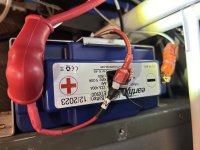
Bill,Non vented EarthX 900 between rudder pedals on top of tunnel, with 22 Lb piece of lead mounted in the tail. Can Load CG just about anywhere in the envelope. 973 # useful load.
Thanks. I figured either lead aft or a heavy AC unit.
I note with interest your numbers. On my first RV-10 build empty weight was 1659 lbs. This is with full base coat/top coat paint, dual EFIS in a IFR panel, interior, stock engine with the Hartzell BA prop and perhaps an extra 10 pounds over stock to account for the James cowl and plenum. It also included the two PC-625 batteries aft (total install weight of ~28#). So the useful load on this plane was 1041 lbs.
While I understand the interest in lightweight batteries, applicability to RV-10s may not be as impactful as other RVs that don’t need the aft weight.
Carl
I have a chute in the back which, at 80 lb, moves the CG backwards by two inches. By moving the batteries up front, I regain 1 inch. I gain a bit more by not having long heavy wires and also the contactors up front. I also have AC which moves the CG backwards by 1/2 inch. I made a graph that outlines how many pounds at what arm move the CG one inch (red) or two inches (green). For example, at the arm where the battery is, 28 lb move the CG by one inch.I’m curious.
- For you earthx guys mounting battery(s) forward, what are you doing to make up for the W&B issue of not having a standard battery aft?
- For all you earthx guys mounting battery(s) inside the cabin (or aft of the baggage compartment) are you only installing vented batteries?
Carl
Attachments
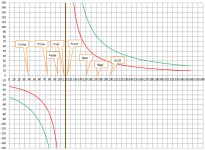
A good illustration of -10 loading; It is very easy to move the cg aft, much more difficult to move it forward.I have a chute in the back which, at 80 lb, moves the CG backwards by two inches. By moving the batteries up front, I regain 1 inch. I gain a bit more by not having long heavy wires and also the contactors up front. I also have AC which moves the CG backwards by 1/2 inch. I made a graph that outlines how many pounds at what arm move the CG one inch (red) or two inches (green). For example, at the arm where the battery is, 28 lb move the CG by one inch.

I do not understand why such complicated electrical systems are required for a single engine piston airplane. My Dynon Avionics have standby batteries, My Dynon D3 backup AI is independent, my Ipad/iphone provide navigation backup and I change my Odyssey battery every 2 years. I have had 1100 trouble free hours in my 10.
This post is for those of you that are still planning on what to do with your electrical system. I prefer KISS (Keep it simple stupid) when I approach these kind of things.
I have one battery, one power switch, one alternator switch, one alternator and Emags that do not require a power source with a running engine.
If something electrically goes wrong in flight with or without 2 batteries it is time to land.
This post is for those of you that are still planning on what to do with your electrical system. I prefer KISS (Keep it simple stupid) when I approach these kind of things.
I have one battery, one power switch, one alternator switch, one alternator and Emags that do not require a power source with a running engine.
If something electrically goes wrong in flight with or without 2 batteries it is time to land.
The beauty of this hobby is that everyone is free to choose what they want.I do not understand why such complicated electrical systems are required for a single engine piston airplane. My Dynon Avionics have standby batteries, My Dynon D3 backup AI is independent, my Ipad/iphone provide navigation backup and I change my Odyssey battery every 2 years. I have had 1100 trouble free hours in my 10.
This post is for those of you that are still planning on what to do with your electrical system. I prefer KISS (Keep it simple stupid) when I approach these kind of things.
I have one battery, one power switch, one alternator switch, one alternator and Emags that do not require a power source with a running engine.
If something electrically goes wrong in flight with or without 2 batteries it is time to land.
Your choices represent your opinions which are just as valid as anyone else’s.
More complicated electrical systems are a byproduct of progressing technology, some of which makes our aircraft electrically dependent. It doesn’t make these systems wrong, only different. Is an airplane with these systems for everyone? No, but again, that doesn’t make the design choices wrong.

Perfectly acceptable. I have a setup to charge my main or aux battery separately or in parallel, in addition to selection of one or both for using ground power. I also have a cross-feed contactor between my A and B busses in the event either battery fails, or the respective alternator fails.Are you saying you are running two earthx batteries in parallel, for discharge and charging? I would check with earthx. This usually a no no.

Lithium Battery Series / Parallel Operation
Check out our fact information sheet on the Lithium Battery Series and Parallel Operation. Get a breakdown of the basics, BMS, Parallel Operation and more!
earthxbatteries.com
Last edited:
