Van's Air Force

The definitive Van's Aircraft support community! Buying, building or flying an RV? Join our exclusive family of mentors and enthusiasts!

Do I need a gap between the fuel tank skin and the leading edge skin?

idubrov

Well Known Member
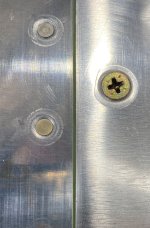
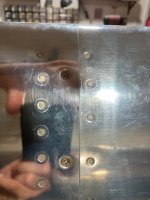
Do I need a gap between the fuel tank skin and the leading edge skin? I have absolutely none (see the photo), but I remember seeing an advice to leave some gap for painting reasons.

If I do so, how much of the gap do I need? Any advices how to trim the skin (I can probably just use a file, but I suspect that maintaining a straight edge might be a bit of a challenge?
IMG_9091.jpeg
 
I see no reason that paint needs a gap. Yours is nice and tight and the paint will look much better than with a gap. If it were mine, I would be very happy with the result you got and happily paint over it.

I have only painted 5 vehicles, so have some experience, but not an expert.
 
Personally I would want some small gap. Not much, maybe .016, to avoid a messed up paint line if they have to come off some day. I've had my tanks off a couple of times over the years, to fix bad fuel senders. Ran a knife down the gap and they went back on fine.
 
Personally I would want some small gap. Not much, maybe .016, to avoid a messed up paint line if they have to come off some day. I've had my tanks off a couple of times over the years, to fix bad fuel senders. Ran a knife down the gap and they went back on fine.
+1

Paint will chip off that very nice tight joint so better to have a small gap. This will happen through natural movement in service, not just if you have to remove the tanks for any reason.
 
+1

Paint will chip off that very nice tight joint so better to have a small gap. This will happen through natural movement in service, not just if you have to remove the tanks for any reason.

+1 too.
No gap or v small gap results in the paint cracking randomly at the surface over time even if you don’t remove the tanks.
If you do ever remove them then a reasonable gap 016 or a little more will be useful

IMG_7031.jpeg
 
Do I need a gap between the fuel tank skin and the leading edge skin? I have absolutely none (see the photo), but I remember seeing an advice to leave some gap for painting reasons.

If I do so, how much of the gap do I need? Any advices how to trim the skin (I can probably just use a file, but I suspect that maintaining a straight edge might be a bit of a challenge?

View attachment 94584
how to trim?

Get a 1X1 and/or 1X2 board anywhere from 6”-18”, 80-100 grit sandpaper, and wood glue. Cut a piece of sandpaper that will cover one side of the board. Glue it to the board. I use multiple different lengths of boards for various jobs. This straight edge board will help keep the edge uniform as you sand.
 
how to trim?

Get a 1X1 and/or 1X2 board anywhere from 6”-18”, 80-100 grit sandpaper, and wood glue. Cut a piece of sandpaper that will cover one side of the board. Glue it to the board. I use multiple different lengths of boards for various jobs. This straight edge board will help keep the edge uniform as you sand.
This is on the right track. You can get a long, maybe two ft, sanding board from an auto body supply shop. They should also have rolls of sandpaper with sticky back that you cut to lengths. Usually used to smooth large flat surface. Sorry I don't have a link right offhand but google is your friend.
danny
 
Do I need a gap between the fuel tank skin and the leading edge skin? I have absolutely none (see the photo), but I remember seeing an advice to leave some gap for painting reasons.

If I do so, how much of the gap do I need? Any advices how to trim the skin (I can probably just use a file, but I suspect that maintaining a straight edge might be a bit of a challenge?

View attachment 94584
I used a long HF sanding device and rolls of sandpaper they sell in various grits to sand my cowling and canopy. Worked great.
 
A sharp file would be better than sandpaper, however if you were to choose to use sandpaper just a reminder not to use carborundum paper on aluminium.
 
The 10" flat curved tooth file (Vixen file) from Cleaveland tool excels at this task. It's what I used for exactly this job.
Exactly! I forgot about how well that works on aluminum. I only used the HF sander on fiberglas and plexi.
 
The 10" flat curved tooth file (Vixen file) from Cleaveland tool excels at this task. It's what I used for exactly this job.
That's what I used for this job as well. Once I had the gap I wanted I finished the job with a deburring wheel. I ended up mounting and removing the tanks half a dozen times during the process - removing a little at a time.
 
A no gap condition will not allow for expansion when it's hot, and can lead to buckling , which will crack paint and stresses the joint. Always need a gap. I believe the plans show it...I too use a vixen file and then hit it with the scotchbrite disk.
 
Back
Top