


Van's Air Force

The definitive Van's Aircraft support community! Buying, building or flying an RV? Join our exclusive family of mentors and enthusiasts!

Diode bridge question along with main electrical architecture review

auburnaviator

Well Known Member
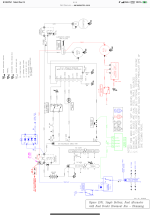
I am trying to develop/design the main electrical architecture for my RV10 and have decided on a single battery, dual alternator system with dual Pmags. I have gone through all of Bob Nuckols Z diagrams and have determined that a simplified/slightly modified for rear battery Z101diagram fits my needs. My question relates to the diode bridge in this simplified model. The bridge in question is at the top of the diagram and is the normal feed path to the Clearance delivery bus when the Master Relay is powered on. Is it necessary and if so, why? Or can I just run an appropriately sized wire with appropriate sized FLW and don’t need the diode bridge?

My modifications to this diagram other than diode bridge question:
1. Run main power distribution bus from firewall pass through lug on main feed line from master relay to starter relay instead of off of the master relay.
2. Delete the brownout booster section in green.
3. Main Alt will be internally regulated PlanePower 60amp alternator that comes in stock RV10 FWF kit supplied by Vans.
4. B/U Alt will be either Monkworkz MZ-30 or B&C BC410.
5. Main power distribution bus will be a VPX-Pro
6. Clearance Delivery bus can be used as emergency bus in case of master relay failure since it is fed off of the battery side of the master relay along with B/U alternator. Will have 6AH IBBS with G5, PFD, GEA all being dual fed by VPX.

This is my first crack at this so what issues do you guys see with the above plan?

Thanks,
Zach

IMG_0693.png

 
Without the diode the relay will be paralleled with the contactor, the main bus will be powered when the relay is energized which defeats the purpose of the CD bus, also, hit the starter button and the relay is fried. Beware unintended consequences when making changes to Z templates or any well-developed design.

I use a Schottky diode versus the silicone appliance diode Bob Nuckols specs. IMO he is being too frugal, might date to when Schottky diodes electrically isolated from the case were not available, Schottky has about 1/2 the voltage drop/power dissipation versus Silicone. There are multiple choices in the SOT-227B (minibloc) package. I use DSS2x61-0045A on a 401K heatsink firewall forward which my calculations indicate is good for 30A with a Schottky diode based on the Wakefield heat sink and IXYS diode TDSs. BTW1 paralling the two diodes in the SOT-227B case does not increase current capacity, BTW2 the 401K is what B&C calls 8 watt heat sink, the larger 403K heat sink they call 15W.

I prefer the MZ-30L, no question it starts and runs with no battery present, makes 30A at 1800 Lycoming RPM.
 
Last edited:
The diode prevents the main bus from being powered from the clearance delivery bus. This is necessary in situations such as:
1. When using the clearance delivery function, to minimize the battery drain
2. When using the clearance delivery bus as an emergency bus, to keep the load below the capacity of the aux alternator
 
1. If the starter relay fails in the closed position (burnt contacts) the starter will continue to run until toasted and the battery needs to be replaced.
Also more than 200 A for several minutes on a AWG 4 cable may start a fire.
This is why the master relay is in series with the starter relay. Turning master relay OFF (burnt starter relay) can save you a lot of trouble.
The tricky part with electrical construction is all the failure modes that has to be anticipated.
One thing to consider, a part that is not installed can not fail.

Good luck
 
I suggest eliminating the Clearance Deliver buss all together. I do engine start before getting my clearance as it provides much needed time for oil temps to come up.

Other than that you have a basic single battery, dual alternator system. If you want to have some power from the battery feeding some avionics if the master solenoid goes south you will need to have a feed from the battery side of the master solenoid. Many easy ways to do this, but harder if using a VPX.

Side note - I never have brown out on engine start, but I’ve seen it on other planes. Battery(s) capacity, battery health, avionic power distribution design and start procedures are how you prevent this problem.

Side note #2 - If you have not yet purchases the Plane Power alternator I suggest you delete it from your FWF package and take the credit. Use the 60 amp B&C alternator and associated B&C voltage regulator instead.

Carl
 
Last edited:
Without the diode the relay will be paralleled with the contactor, the main bus will be powered when the relay is energized which defeats the purpose of the CD bus, also, hit the starter button and the relay is fried. Beware unintended consequences when making changes to Z templates or any well-developed designs.
Thanks John,
Will definitely keep the diode bridge know that I understand its importance and use.

I use a Schottky diode versus the silicone appliance diode Bob Nuckols specs. IMO he is being too frugal, might date to when Schottky diodes electrically isolated from the case were not available, Schottky has about 1/2 the voltage drop/power dissipation versus Silicone. There are multiple choices in the SOT-227B (minibloc) package. I use DSS2x61-0045A on a 401K heatsink firewall forward which my calculations indicate is good for 30A with a Schottky diode based on the Wakefield heat sink and IXYS diode TDSs. BTW1 paralling the two diodes in the SOT-227B case does not increase current capacity, BTW2 the 401K is what B&C calls 8 watt heat sink, the larger 403K heat sink they call 15W.

I prefer the MZ-30L, no question it starts and runs with no battery present, makes 30A at 1800 Lycoming RPM.
I will look in to using the Shottky diodes as less voltage drop across the diode is a definite positive. I was already leaning towards the MZ as it has a greater output starting at lower RPM’s and maintains that increase over the B&C all the way to max 30A. It also has a smaller weight/footprint which makes 90deg oil adapter an easier addition (something for another thread).
 
1. If the starter relay fails in the closed position (burnt contacts) the starter will continue to run until toasted and the battery needs to be replaced.
Also more than 200 A for several minutes on a AWG 4 cable may start a fire.
This is why the master relay is in series with the starter relay. Turning master relay OFF (burnt starter relay) can save you a lot of trouble.
The tricky part with electrical construction is all the failure modes that has to be anticipated.
One thing to consider, a part that is not installed can not fail.

Good luck
Understand about failed starter relay and being able to shut off master relay to kill the starter in that case. I have even seen starter warning lights wired in to panels if the starter remains engaged after the starter button is released. (That light is a consideration that I have given). I am confused as to why you brought it up though. I don’t think any of my modifications would remove the Master’s ability to safely eliminate this failure mode did it?

To give an answer to your second statement about wire size, a modification that I failed to list is I have already run 2AWG wire from battery to firewall due to the long battery run needed for the RV-10.
 
I suggest eliminating the Clearance Deliver buss all together. I do engine start before getting my clearance as it provides much needed time for oil temps to come up.
Other than that you have a basic single battery, dual alternator system. If you want to have some power from the battery feeding some avionics if the master solenoid goes south you will need to have a feed from the battery side of the master solenoid.
Carl, Thanks for the response. As for the Clearance Delivery bus, I agree with what you are saying about needed oil warm up times. This is just what Bob has called it in this diagram and my purpose for this bus is more like you have alluded to in your second statement about this being a separate bus before the Master and also separate from the VPX In case of a rare failure there. By putting my 6AH IBBS with G5, PFD, and GEA on this bus I can lose the Master Contactor and/or the VPX and still be just fine.
Many easy ways to do this, but harder if using a VPX.
You say “many easy ways, but harder with the VPX”, can you elaborate on why the VPX makes this a more difficult task and then more importantly can you please list some of the ways or point me to some diagrams (I’m a visual learner kind of guy) on a way to put a bus before the Master. I thought Bob’s solution that I posted worked for this but that is also the reason I am posting and asking the questions.
Side note - I never have brown out on engine start, but I’ve seen it on other planes. Battery(s) capacity, battery health, avionic power distribution design and start procedures are how you prevent this problem.
As I noted in Modification #2, my plan is to eliminate the brown out section (shown in green on this diagram). I agree with your logic about battery health, design, and start procedures.
Side note #2 - If you have not yet purchases the Plane Power alternator I suggest you delete it from your FWF package and take the credit. Use the 60 amp B&C alternator and associated B&C voltage regulator instead.Carl
The Plane Power alt has already been purchased through Vans FWF kit and has been sitting in the shop for a while now waiting on me to figure this wiring thing out. Although, with as many comments as I’ve seen that relate to this, I am tempted to make the switch and sell the new/unused PP unit. Maybe a topic for another thread.
Beware unintended consequences when making changes to Z templates or any well-developed designs.
I really appreciate all of the replies so far. As John so eloquently states, “Beware unintended consequences”… I am new to this and trying to make/mold a tried and true method into something that works for me. With that comes questions and the need for mentorship from those with more knowledge than myself.

Thanks,
Zach
 
Carl, Thanks for the response. As for the Clearance Delivery bus, I agree with what you are saying about needed oil warm up times. This is just what Bob has called it in this diagram and my purpose for this bus is more like you have alluded to in your second statement about this being a separate bus before the Master and also separate from the VPX In case of a rare failure there. By putting my 6AH IBBS with G5, PFD, and GEA on this bus I can lose the Master Contactor and/or the VPX and still be just fine.

You say “many easy ways, but harder with the VPX”, can you elaborate on why the VPX makes this a more difficult task and then more importantly can you please list some of the ways or point me to some diagrams (I’m a visual learner kind of guy) on a way to put a bus before the Master. I thought Bob’s solution that I posted worked for this but that is also the reason I am posting and asking the questions.


Thanks,
Zach
Zack,

With a focus on IFR installs, to “bridge around” the VPX to keep power to the avionics seems to me to be not worth the effort for whatever little gain, at that point, the VPX offers.

I’ll also note your plan to have your 6AH IBBS as the power to get you on the ground does not meet my level of risk tolerance. For my plane 6AH provides just 30 minutes of full avionics panel IFR.

I’ve posted on this in the past so if you like I can email you what I do. Just PM me your email address.

Carl
 
Zack,

With a focus on IFR installs, to “bridge around” the VPX to keep power to the avionics seems to me to be not worth the effort for whatever little gain, at that point, the VPX offers.

I’ll also note your plan to have your 6AH IBBS as the power to get you on the ground does not meet my level of risk tolerance. For my plane 6AH provides just 30 minutes of full avionics panel IFR.
I understand that I will not be able to power my whole panel off of the IBBS and that is not my intention.

My thinking on this to get down to just the IBBS when looking at failures: I would have to lose the Master Relay or VPX, then lose the B/U alternator, then burn through my main batteries useful load to be at my IBBS 6AH. The IBBS is only powering a G5, PFD, and GEA which is just under 3 amps worth of load if I did my calculations correct. Once the IBBS dies I will still have my G5 with its b/u battery.

Am I looking at the wiring incorrectly to come to this conclusion?

I’ve posted on this in the past so if you like I can email you what I do. Just PM me your email address.

Carl
Will PM with my email address as I am definitely open to looking at new ideas and if nothing else just trying to expand my knowledge base on the subject.
Thanks again,
Zach
 
Hi Zach,

You may be interested in my electrical power schematics.

Application is RV-6A with SDS EFI+I. It has an engine / essential bus which you could call essential bus, just delete the EFI+I items.

I started with Z101 rev B but when Monkworkz was introduced I put MZ-30L on the engine / essential bus so it is no longer Z101.

One of the failure modes it my power schematic accommodates is fire-in-the-cockpit-main-master-off, the essential bus is still up. It also respects FAR 23.1361 Master Switch Arrangement.

My RV-6A version is in folder 1) A) It's a PDF called "Elec Power Schem N1921R MZ-30L on engine bus...".

I also have a version for metal tractor aircraft with rear battery that is less detailed (brainstorming the basic configuration). It is in a brainstorming folder 1) E) "MZ-30L on engine bus - production Intent brainstorm templates - Config 5 and Config 5 Rear Battery". It's a PDF called "Elec Schem Monkworkz MZ-30L on engine bus Config 5 Rear Battery..."

Start at https://drive.google.com/drive/folders/1u6GeZo6pmBWsKykLNVQMvu4o1VEVyP4K?usp=sharing
.
 
Last edited:
1. If the starter relay fails in the closed position (burnt contacts) the starter will continue to run until toasted and the battery needs to be replaced...

Hi Avanza,

I believe you misinterpret what Zach said. He will have the starter contactor downstream of the master contactor. I had to read it several times and put my thinking cap on and understand the "firewall pass thru lug" is not shown. An example of why it's better to communicate with schematics rather than words.
.
 
Last edited:
Hi Zach,

Ref post #1

Question... why are you looking at the Flemming version of Z101 from 2020-05-27? Bob created this for a Mr Flemming for reasons I don't recall.

The latest Z101 is rev B from 2020-09-07 at http://www.aeroelectric.com/PPS/Adobe_Architecture_Pdfs/
.
John,
Thanks for the replies. I was looking at the Fleming version due to the fact that (in my mind) it was not built for an electric dependent aircraft due to the engine bus (shown in magenta on the current Z101B version) being deleted. Since I am running dual Pmags I do not need this added bus. Since I am not using the clearance delivery bus for its intended purpose I suppose I could delete it and use the engine bus to suit my needs. The Fleming model was already posted so I just ran with that one.

I am basically looking for the best way to have the MZ-30 and my IBBS be on the battery side of the Master Relay. This would (in my mind) give redundancy for a total VPX failure, main Alternator failure, or a failure of the Master Relay and still leave plenty of instrumentation for IFR flight (G5, PFD/GDU460, GEA) for a considerable amount of time (at least 2 hrs).

Hi Zach,

You may be interested in my electrical power schematics.

Application is RV-6A with SDS EFI+I. It has an engine / essential bus which you could call essential bus.

I started with Z101 rev B but when Monkworkz was introduced I put MZ-30L on the engine / essential bus so it is no longer Z101.

One of the failure modes it accommodates is fire-in-the-cockpit-main-master-off, the essential bus is still up. It also respects FAR 23.1361 Master Switch Arrangement.

My RV-6A version is in folder 1) A) It's a PDF called "Power Schem N1921R MZ-30L on engine bus..." The one for you to look at is "WITHOUT Brian Adams Skyview Hub"

I also have a rear battery version that is less detailed. It is in a brainstorming folder 1) E) "MZ-30L on engine bus - production Intent brainstorm templates - Config 5 and Config 5 Rear Battery". It's a PDF called "Elec Schem Monkworkz MZ-30L on engine bus Config 5 Rear Battery..."

Start at https://drive.google.com/drive/folders/1u6GeZo6pmBWsKykLNVQMvu4o1VEVyP4K?usp=sharing
.
I have actually looked at your website and documents quite a bit during my build. In the case of electrical you were one of my first go to websites but when I saw that you were doing an electric dependent engine I went elsewhere as most of those are dual battery dual redundant buses with a xfeed etc… I guess I didn’t dive deep enough and wasn’t confident enough in my abilities to try and modify your design. I was looking for (and have been looking for almost 6 months now) a direct plug/play solution that will fit my needs exactly but have yet to find anything. Thus when I saw the Fleming model that was a modified Z101 which I knew was Bob’s newest design and it only required some minor tweaks I ran with it. For better or worse…

So, I am definitely still learning and open to any/all suggestions and designs for a single rear battery, dual alternator, VPX based design…


Regards,
Zach
 
Hi Zach,

Note the sections of the Z101 TEMPLATE that are colored other than black are optional depending on one’s needs, delete colored sections at will. Bob Nuckolls’ goal with his latest template, Z101, is to have a single universal template for our simple single engine aircraft that use traditional aircraft engines.
.
 
Hi Zach,

Note the sections of the Z101 TEMPLATE that are colored other than black are optional depending on one’s needs, delete colored sections at will. Bob Nuckolls’ goal with his latest template, Z101, is to have a single universal template for our simple single engine aircraft that use traditional aircraft engines.
.
I understand that part which is why I had the original question of is the diode bridge necessary to feed the Clearance Delivery bus as it was originally part of the engine bus. When the engine bus was deleted on the Fleming design the diode bridge remained to feed the CD bus. I didn’t know if that was a mistake or if it still had to be there.

Please keep the comments coming!
 
I understand that part which is why I had the original question of is the diode bridge necessary to feed the Clearance Delivery bus as it was originally part of the engine bus. When the engine bus was deleted on the Fleming design the diode bridge remained to feed the CD bus. I didn’t know if that was a mistake or if it still had to be there.

Please keep the comments coming!
Hi Zach,

I see what you're saying. In the Flemming design compared to Z101B the bridge rectifier package changed from magenta to blue making it part of the CD/BO/aux bus circuit. In Z101B one of the diodes should be magenta and one blue.
 
Hi Zach,

I see what you're saying. In the Flemming design compared to Z101B the bridge rectifier package changed from magenta to blue making it part of the CD/BO/aux bus circuit. In Z101B one of the diodes should be magenta and one blue.
Correct, I think when Bob built the bridge rectifier template in his CAD program he built it as one unit to place anywhere he wants in his drawings. The downside to this is when you try to apply color to it, it colors the entire template. At least that is my thinking on what happened.
 
Hi Zach,

You may be interested in my electrical power schematics.

I started with Z101 rev B but when Monkworkz was introduced I put MZ-30L on the engine / essential bus so it is no longer Z101.

I also have a version for metal tractor aircraft with rear battery that is less detailed (brainstorming the basic configuration). It is in a brainstorming folder 1) E) "MZ-30L on engine bus - production Intent brainstorm templates - Config 5 and Config 5 Rear Battery". It's a PDF called "Elec Schem Monkworkz MZ-30L on engine bus Config 5 Rear Battery..."

Start at https://drive.google.com/drive/folders/1u6GeZo6pmBWsKykLNVQMvu4o1VEVyP4K?usp=sharing
.
John,
I have been reviewing your MZ+30L Config 5 drawing this morning and have some questions.
1. It appears that if you lose the Main Alt you have no ability to power it with the MZ. I am sure this is by design since this was built for an electric dependent aircraft and you don’t want to overload the MZ. Is that correct?

2. I am trying to design a system where if I lose the Main Alt the MZ picks up the main bus automatically and I lose nothing. If I need to load shed items I can do it through the VPX to reduce the load on the MZ. Routing the MZ B lead to the battery side of the Master Contactor (per Z101) solves this I believe.

3. General question on the MZ regulator. You have the Main Alt regulator on the cold side (cabin side) of the firewall but the MZ regulator on the hot side (engine side). I know the MZ regulator is sensitive to heat due to it having a blast tube built in. Could it be moved to the cold side of the firewall also? I haven’t read through the installation manual so this could all be addressed there.

4. General Z101B question with regards to Fusible Link Wires. I thought common practice for FLW is to decrease gauge by 1 size. However, there are many places in Z101B where Bob decreases the gauge by 2 sizes. For instance Main Alt and Aux Alt B lead both decrease by 2 sizes. 8AWG-12AWG and 10-14AWG respectively.

I am in the process of drafting a design now mainly based on the Fleming Z101 design. I will post in a new thread once I get it drawn up.

Regards,
Zach
 
John,
I have been reviewing your MZ+30L Config 5 drawing this morning and have some questions.
1. It appears that if you lose the Main Alt you have no ability to power it with the MZ. I am sure this is by design since this was built for an electric dependent aircraft and you don’t want to overload the MZ. Is that correct?

2. I am trying to design a system where if I lose the Main Alt the MZ picks up the main bus automatically and I lose nothing. If I need to load shed items I can do it through the VPX to reduce the load on the MZ. Routing the MZ B lead to the battery side of the Master Contactor (per Z101) solves this I believe.

3. General question on the MZ regulator. You have the Main Alt regulator on the cold side (cabin side) of the firewall but the MZ regulator on the hot side (engine side). I know the MZ regulator is sensitive to heat due to it having a blast tube built in. Could it be moved to the cold side of the firewall also? I haven’t read through the installation manual so this could all be addressed there.

4. General Z101B question with regards to Fusible Link Wires. I thought common practice for FLW is to decrease gauge by 1 size. However, there are many places in Z101B where Bob decreases the gauge by 2 sizes. For instance Main Alt and Aux Alt B lead both decrease by 2 sizes. 8AWG-12AWG and 10-14AWG respectively.

I am in the process of drafting a design now mainly based on the Fleming Z101 design. I will post in a new thread once I get it drawn up.

Regards,
Zach
Hi Zach,

1) Config 5 is similar to Z101B:
  • In Z101B the backup alternator B lead is connected to the battery instead of to the main bus.
  • In Config 5 the backup generator B lead is connected through a relay to the battery instead of to the main bus. The relay is necessary because the MZ-30L regulator presents a small passive load to the battery that will run it down over time. Config 5 uses the engine / essential bus relay as the generator B lead relay, Config 1 has a relay dedicated to the Generator B lead.
  • If the main alternator goes down the battery is still present so the battery contactor and the engine / essential bus relay can be energized resulting in the generator being connected to the the main bus.
2) The MZ-30L regulator B lead cannot be connected directly to the battery because it presents a small passive load that will run the battery down over time. I came up with six brainstorm configurations that isolate the B lead from the battery with either a dedicated relay, a Schottky power diode, or the engine / essential bus relay. There's a spreadsheet in folder 1) E) that summarizes the configurations. https://drive.google.com/drive/folders/1u6GeZo6pmBWsKykLNVQMvu4o1VEVyP4K

3) The MZ-30L regulator is mounted on the hot side of the firewall in the Monkworkz install manual, Kitplanes article, and VAF postings. The blast tube is designed to blow directly on the circuit board so intuitively it seems very effective.

4) FLW is sized 2 awg smaller than the protected feeder. One might perceive this as one size down because the wire and cable we use is not normally available in odd AWGs.
 
If you go with the B&C aux alternator the regulator can be set slightly below the regulated voltage for the primary alternator. Then it will automatically begin providing current if the primary starting failing. Because of this the aux alternator can be turned on already but will essentially be idling until something happens. You can then just shutdown the primary alternator and perhaps shed some loads if needed.
 
If you go with the B&C aux alternator the regulator can be set slightly below the regulated voltage for the primary alternator. Then it will automatically begin providing current if the primary starting failing. Because of this the aux alternator can be turned on already but will essentially be idling until something happens. You can then just shutdown the primary alternator and perhaps shed some loads if needed.
True, the Monkworkz MZ-30 has this feature also. This method of operation will be the plan regardless of which b/u alt I use.
 
Back
Top
