Van's Air Force

The definitive Van's Aircraft support community! Buying, building or flying an RV? Join our exclusive family of mentors and enthusiasts!

Dimple scratches, what now

kenandsteph14

Member
Patron
First time builder, dimpling skins for the HS. I have the male die on the bottom of the DRDT2, and (try) carefully scoot the skin around, setting the male die into the holes. 97% are fine, but some take some challenge finding the hole....
Are these scratches on the outside skin something I need to buff out? I'm going to paint, so I know the skins going to get scuffed plenty for that, but I'm concerned with the scratch terminating in my dimpled hole under the flush rivets, and if that could be a cause for cracks forming later.
I've seen that some people mount the male on the top arm of the dimpler and get a laser sight, or I could take more time and be more careful... Im not leaving the blue vinyl on, and where the scratches are, it wouldn't have helped... (Unless people dimple with the vinyl on??)
Thoughts, tips and remedies welcomed and appreciated.
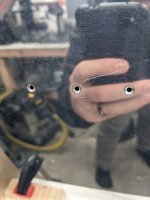
PXL_20250106_054548876.jpg
 
I wouldn’t worry about a few like that.

The short answer is be careful. With practice you’ll get better.
If you put the male on the top you will increase the probability of making an extra hole. Especially early on.

You can set some foam blocks (old foam mattress cut up) around that hold it up and close to level - or build a table that holds it stood off to drag it around but you then risk extra holes as above.

Rest assured by the time you’ve finished you’ll be very good at it.
 
Last edited:
I think that scratches are inevitable if the male die is on the bottom. I always put it on the top and if you are careful that everything is aligned and supported before applying pressure or hitting then the risk of a damaged hole is going to be less likely than scratching. I had about two figure eights on the whole project with the male die above.
 
I think that scratches are inevitable if the male die is on the bottom. I always put it on the top and if you are careful that everything is aligned and supported before applying pressure or hitting then the risk of a damaged hole is going to be less likely than scratching. I had about two figure eights on the whole project with the male die above.
I'm not confident enough in my alignment skills to do that. One miss and you have an extra hole or a figure 8 hole. The cosmetic scratches shown in the OP's post aren't a structural issue and will disappear as soon as he (or his paint shop) scuffs the airplane prior to painting.

Build on...
 
I'm not confident enough in my alignment skills to do that. One miss and you have an extra hole or a figure 8 hole. The cosmetic scratches shown in the OP's post aren't a structural issue and will disappear as soon as he (or his paint shop) scuffs the airplane prior to painting.

Build on...
Yes I agree the scratches in the photo appear non-structural and are probably in the soft alclad layer only and they will disappear during scuffing and priming prior to painting.

I used a foot operated dimpler that allowed the tip of the die to be in the hole before applying pressure so that would have helped with alignment.
 
I also think the scratches will be scuffed out when priming. I remove strips of the plastic on the rivet line and leave the rest on order to minimize scratching. My dimpler is recessed into the middle of a 4' square table so that the flat of the male die is just proud of the table top surface. This makes it easier to raise the skin up when moving to the next hole and not make scratches.
 
The scratches come about because the skin is alclad aluminum. Which has a very thin layer of pure aluminum as an outer layer for corrosion protection. Any piece of debris or tool that runs against the surface will scratch. My best defense was a really clean shop and minimize handling once the plastic filmis pulled off. Primer and paint should fill them in. I tried to leave the film on and use a soldering iron to remove the film around the holes, but these left worst scratches, the alclad is just too soft. This is what separates the men with pollished airplanes from us mere mortals with very fast flying beer cans.
 
Last edited:
Word of warning putting the male die on top. Debris can fall into the female. The pressure will lock the two dies and you will have fun trying to get the part out to separate the dies. I did it once. Just once.
 
Word of warning putting the male die on top. Debris can fall into the female. The pressure will lock the two dies and you will have fun trying to get the part out to separate the dies. I did it once. Just once.
Got ya beat Larry; in a contest you don't want to win BTW. I was blindly c-frame dimpling with the male die on top (for workpiece fitment). Must have bumped the part but I ruined the piece with a misplaced die form. Be smarter than me.
 
I'm not confident enough in my alignment skills to do that. One miss and you have an extra hole or a figure 8 hole. The cosmetic scratches shown in the OP's post aren't a structural issue and will disappear as soon as he (or his paint shop) scuffs the airplane prior to painting.

Build on...
The scuffs on the skin I'll try to be careful to avoid, but I'm not worried about due to painting, it's that it's also into the dimpled hole that I was concerned with, since it'll be hidden under the rivet.
With it non structural in the alclad, gives a bit more peace of mind to just try to prevent it in the future.
 
Over 11,000 Vans aircraft have been built and flown. Half of those builders were below average. I am also certain that this is a common occurrence.

Go back and watch the two hour video Van’s made about laser cut parts and how dimpled holes fail. it is not intuitive and it should give you some confidence that this is a non-event.
All of that said, the accident rate of RVs is the best in the experimental world, and near that of certified aircraft.
 
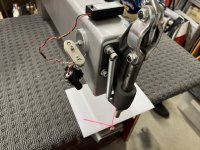
Just in case you want to avoid scratches in future...

Cleaveland used to sell a laser tool to draw a red cross over the tip of the male dimple die. The laser makes it easy to reposition for each rivet hole—first lifting the workpiece (to avoid scratching), then lowering the next rivet hole onto the male dimple die, guided by the red cross.

Cleaveland don't appear to have them on their website at the moment, but a search for "650nm 5mW Red 12mm Cross Laser Module" should find a suitable laser module, then you'll need a 3 volt battery box and some way to position/aim the laser.
IMG_2590.JPG
 
Back
Top