Van's Air Force

The definitive Van's Aircraft support community! Buying, building or flying an RV? Join our exclusive family of mentors and enthusiasts!

Deburring Technique

EJWash

Active Member
Friend
Patron
Hi All,

Deburring holes is no biggy when you can get a square-on approach to the hole with your tool. However, when it comes to tight areas, there's no way to get a square-on approach. I'm working on deburring the holes in elevator C-channel front and rear spars. It's clear that when creating the holes, the tool (punch, router) entered the spar from the outside, and leaves a small burr on the inside (figures!). I located a vendor that sells cloth-backed aluminum oxide sandpaper, 1-1/2" wide, sold by the foot. I made 1-1/2" X 3" 1/4" ply blocks, and secure the sandpaper (400 grit) to the block with two-sided tape. A few passes over the holes removes the burr. Follow-up is with maroon Scotch Brite pad. A downside of this technique is that the grit loads up with aluminum powder pretty fast. Using a vacuum removes some of it, but it's a short life.

I like the results, but I'd like the community's feedback on this technique, as well as other close-quarter deburring technique(s).

Thanks!
 

Attachments
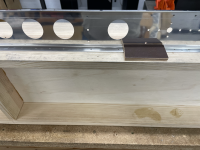
  • tempImagePiGL1H.png
    tempImagePiGL1H.png
    12.5 MB · Views: 124
Last edited:
Hi All,

Deburring holes is no biggy when you can get a square-in approach to the hole with your tool. However, when it comes to tight areas, there's no way to get a square-on approach. I working on deburring the holes in elevator C-channel front and rear spars. It's clear that ion creating the holes, the tool (punch, router) entered the spar from the outside, and leaves a small burr on the inside (figures!). I located a vendor that sells cloth-backed aluminum oxide sandpaper, 1-1/2" wide, sold by the foot. I made 1-1/2" X 3" 1/4" ply blocks, and secure the sandpaper (400 grit) to the block with two-sided tape. A few passes over the holes removes the burr. Follow-up is with maroon Scotch Brite pad. A downside of this technique is that the grit loads up with aluminum powder pretty fast. Using a vacuum removes some of it, but it's a short life.

I like the results, but I'd like the community's feedback on this technique, as well as other close-quarter deburring technique(s).

Thanks!
Tough to beat a set of files.
I've tried almost every gadget. Always go back to a file.
 
I do most of my hole deburring with a nice, flat 135 degree drill bit wrapped with some masking tape. Just give it a spin between the fingers. Probably a 3/16 or so. You're just taking off the burr, not countersinking. Like Mel said, you don't have to be perfectly orthogonal to the hole, especially if using a flatter bit. A pass with your finger will tell you if the burr is gone.

But, like your method, you can also just take a light pass down a row of holes with some sandpaper or abrasive cloth. I usually reserve that method for really tight spaces, like inside the trimtab spar channel.

Get yourself a roll of abrasive cloth, 80 or 120 grit. You can tear off a piece, or make thinner strips for getting in corners and whatnot. For flange ends and similar, one trick is to put an abrasive cloth strip on the edge to be deburred, holding down the cloth with you finger on the cloth-side, over the edge to be deburred, then yank the cloth through the "pinch". Usually only takes one pass, as you are moving a lot of grit over the target edge.

You'll find all kinds of ways to skin the deburring cat as you build. Doesn't need to be fancy.
 
I saw those a while back. Really tempted to get 3/32 and 1/8 sizes. Still weighing the $ -v- elbow grease argument.
I have the 3/32 sized one; they work really well. They are also really easy to break, so you have to be pretty careful when and how you use them. One off-angle drill and you can snap it pretty quickly.
 
Tough to beat a set of files.
I've tried almost every gadget. Always go back to a file.
+1

I don’t even own a deburring tool. If i can’t get a drill bit on it to deburr, it is a small round needle file. Sometimes a flat file. Should mention i also like the little 6 blade countersink bit from hw store. Very small and easily twirl in fingers. Don’t believe i have ever used sandpaper.
 
Aint nothing better than good old Red Scotchbrite ! Fast and effective. Thin material doesn't need more than the burr removal, and over de-burring is worse than none at all. I have a deburr bit (6 flute) fitted into an old wood file handle for when I really need one, but for sheet material, I run a Scotchbrite pad or mini vixen file over it.
 
Hi All,

Deburring holes is no biggy when you can get a square-on approach to the hole with your tool. However, when it comes to tight areas, there's no way to get a square-on approach. I'm working on deburring the holes in elevator C-channel front and rear spars. It's clear that when creating the holes, the tool (punch, router) entered the spar from the outside, and leaves a small burr on the inside (figures!). I located a vendor that sells cloth-backed aluminum oxide sandpaper, 1-1/2" wide, sold by the foot. I made 1-1/2" X 3" 1/4" ply blocks, and secure the sandpaper (400 grit) to the block with two-sided tape. A few passes over the holes removes the burr. Follow-up is with maroon Scotch Brite pad. A downside of this technique is that the grit loads up with aluminum powder pretty fast. Using a vacuum removes some of it, but it's a short life.

I like the results, but I'd like the community's feedback on this technique, as well as other close-quarter deburring technique(s).

Thanks!
A professional A&P, IA who also built a very nice RV-4 told me that no pro mechanic uses the deburring tools recommended by Vans and others. Those tools take to much time and can easily remove to much metal when used by a rookie. He told me every A&P he knows uses a blue ScotchBrite Roloc disc on a right angle die grinder. I followed his advice. It makes deburring fast with no chance of "over doing it". See links below for the items I've mentioned.

HF "Mini" Right Angle Die Grinder
2" Roloc Arbor with assorted discs
5 Pack of Fine 2" De-burring Discs
3" Roloc Arbor with assorted discs


Use the 2" discs for most jobs. Use the 3" discs to get into hard to reach areas like the inside flanges of ribs & bulkheads. Be sure to turn down the air pressure to slow down your die grinder when using the 3" discs. I recommend buying 2 right angle mini die grinders. The $25 extra you spend will save a lot of time, as you won't have to stop to change out the arbor repeatedly. ;)

PS. I generally purchase my ScotchBrite discs from MSC or McMaster-Carr when they are on sale. 2" box of 50, 3" box of 25. Cheaper than HF and better quality [last longer]. Do a search on their web sites. Search for Roloc surface conditioning discs.
 
Last edited:
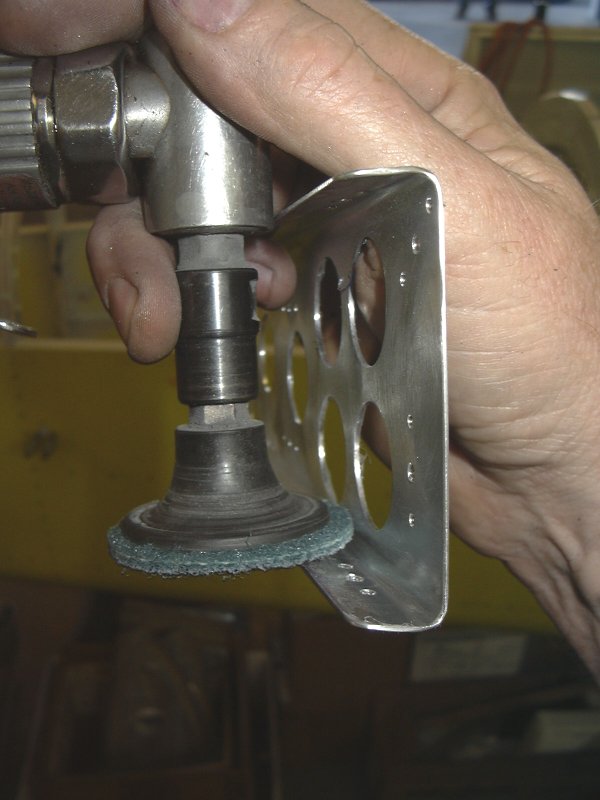
The attached photo shows the limits of deburring the inside of a rib or bulkhead flange with the ScotchBrite method I mentioned earlier. Before you ask, I simply have the tool oriented against an already de-burred and dimpled part. Note, with the 2" arbor, the head of the die grinder may hit the other flange. Using the 3" arbor/disc allows you to get in deeper.

 
The attached photo shows the limits of deburring the inside of a rib or bulkhead flange with the ScotchBrite method I mentioned earlier. Before you ask, I simply have the tool oriented against an already de-burred and dimpled part. Note, with the 2" arbor, the head of the die grinder may hit the other flange. Using the 3" arbor/disc allows you to get in deeper.

Just grab a red Scotchbrite pad and run over it, no die grinder needed. BTW, there are tons of other Scotchbrite cross patches that will go right in there. I'll have to post some pics, but it's really overkill
 
The attached photo shows the limits of deburring the inside of a rib or bulkhead flange with the ScotchBrite method I mentioned earlier. Before you ask, I simply have the tool oriented against an already de-burred and dimpled part. Note, with the 2" arbor, the head of the die grinder may hit the other flange. Using the 3" arbor/disc allows you to get in deeper.

Point made. Thank you.
 
The attached photo shows the limits of deburring the inside of a rib or bulkhead flange with the ScotchBrite method I mentioned earlier. Before you ask, I simply have the tool oriented against an already de-burred and dimpled part. Note, with the 2" arbor, the head of the die grinder may hit the other flange. Using the 3" arbor/disc allows you to get in deeper.

I have a tool for that.
Screenshot_20251114_231450_Samsung Internet.png
 
Back
Top