



Happy Sunday VAF friends!
I thought I would share the results of a recent autopsy of a Plane Power AL12-EI60 (99-1012) alternator; serial number H-R091### generation.
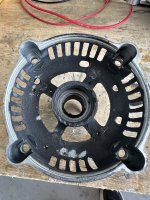
The cavity has a large channel cut into the sides (~.3mm). The wave washer was spinning also, which wore a similar grove in the top of the channel. Axial movement of .8mm was observed.
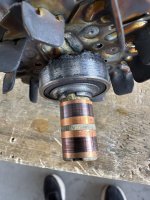
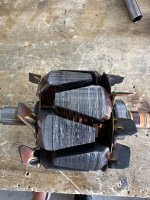
Note the transition between the machining marks and the drag marks on the prawls.
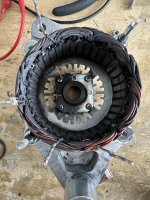
The white ooze is a combination of the magnet wire coating and plastic insulation that lines the 36 channels in the laminate.
Summary:
The SRE bearing spun in its cavity, this allowed the rotor to wobble radially and axially. After awhile the wobble was large enough to let the rotor prawls drag along the stator lamination stack. The resulting heat generated by this friction ultimately caused the insulating polymer of the stator windings to melt/remelt and short the windings to the alternator case.
I looked at the installation and could see where the #1 exhaust stack (which glows cherry-red in flight, ~1000 - 1200°F) was giving the alternator a bit of a 'sunburn'. (Not UV-a|b|c, but Infrared -- think of a toaster.)
I am convinced that the unrestricted view that the alternator has of the #1 exhaust header and/or crossover pipe is largely responsible for this failure mode. --- Get it hot, vibrate it, and don't be surprised of what happens when what happens happens...
Cheers!
B
I thought I would share the results of a recent autopsy of a Plane Power AL12-EI60 (99-1012) alternator; serial number H-R091### generation.
The cavity has a large channel cut into the sides (~.3mm). The wave washer was spinning also, which wore a similar grove in the top of the channel. Axial movement of .8mm was observed.
Note the transition between the machining marks and the drag marks on the prawls.
The white ooze is a combination of the magnet wire coating and plastic insulation that lines the 36 channels in the laminate.
Summary:
The SRE bearing spun in its cavity, this allowed the rotor to wobble radially and axially. After awhile the wobble was large enough to let the rotor prawls drag along the stator lamination stack. The resulting heat generated by this friction ultimately caused the insulating polymer of the stator windings to melt/remelt and short the windings to the alternator case.
I looked at the installation and could see where the #1 exhaust stack (which glows cherry-red in flight, ~1000 - 1200°F) was giving the alternator a bit of a 'sunburn'. (Not UV-a|b|c, but Infrared -- think of a toaster.)
I am convinced that the unrestricted view that the alternator has of the #1 exhaust header and/or crossover pipe is largely responsible for this failure mode. --- Get it hot, vibrate it, and don't be surprised of what happens when what happens happens...
Cheers!
B

