Van's Air Force

The definitive Van's Aircraft support community! Buying, building or flying an RV? Join our exclusive family of mentors and enthusiasts!

Cole-Hersee Piper Plug Location

JDA_BTR

Well Known Member
Patron
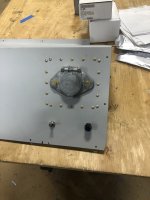
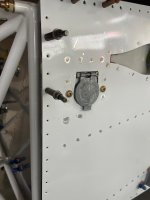
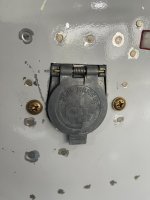
I have the Cole-Hersee piper style external power socket and was planning to install it for an external battery power source in line with the excellent Nuckoll's instructions.

But looking at the big heavy socket, I can't bring myself to cut a hole anywhere! I've read some folks here who have put them in their RV-8. Any pictures of where? I'd like to shamelessly copy a working example....
 
Last edited:
Mine has been under the aft-mounted battery for twenty years - works great, short cable length, and its a safe place for someone who might have to disconnect it after the engine is running…..
 
Mine has been under the aft-mounted battery for twenty years - works great, short cable length, and its a safe place for someone who might have to disconnect it after the engine is running…..
Off to one side or the other I would think? Did you make a doubler for it too?
 
Another option depending on your battery location I'm planning for my RV-4. My suggestion only works if you carry one of the really nice emergency packs for a car (Mines a NOCO BOOST), which I do when traveling very far. I'm installing a plug in within the cockpit center tunnel/under dash so I can have my battery pack essentially "in my lap" or on the floor, and start the plane while seated in cockpit, then unplug and go. These packs are remarkably light and powerful. I carried mine to Sun N Fun , and while I didn't need it for an engine start, it charged my cell phone for 4 days as well.
 
I was able to mount one (piper socket) on the engine mount of an rv7, near the oil door. Usable by just opening the oil door.
 
Paul, did you tie your doubler into the bulkhead frame aft of the location? I've got some 0.032 and some 0.05 sheet wondering how thick is best. The Nuckolls page on it describes a brass sheet too, but not sure that is needed in our application. Seems like the bolts that secure it to the airframe are sufficient for the doubler and it wouldn't need riveting in. What do you think?
 
I put mine in rear baggage compartment for an aft battery placement. IMG_5849.jpeg

I also wound up cutting an access hole in the top shelf of the compartment to disconnect/reconnect the plug & the battery for inspection and access to the aft fuselage. It was a pain to connect it to battery without this - horrible arm geometry.

Also you should check Aeroelectric forum because there are some changes to the original ground power plug design. As I remember, the ground power solenoid can be back powered “closed” if the ground power relay isn’t shut off before battery master is turned on. That means the plug would be energized from battery & I guess there might be some scenarios where this could lead to unforeseen and unfortunate outcomes.
 
Paul, did you tie your doubler into the bulkhead frame aft of the location? I've got some 0.032 and some 0.05 sheet wondering how thick is best. The Nuckolls page on it describes a brass sheet too, but not sure that is needed in our application. Seems like the bolts that secure it to the airframe are sufficient for the doubler and it wouldn't need riveting in. What do you think?
I didn;t tie it in to the bulkhead - it’s close enough, and the belly skin is substantial enough that oil-canning didn;t seem to be an issue. I probably used 0.032”….and you do need to rivet it to the skin around the perimeter to actually “double” the skin - otherwise, you’ve just made a very large washer for the two bolts…. AC43.13 is your friend for doublers….
 
I was able to mount one (piper socket) on the engine mount of an rv7, near the oil door. Usable by just opening the oil door.
I did the same thing as user blaplante. Attached to an aluminum angle, which itself is adel clamped to the engine mount.


As you can see, I also have my battery charger leads kind of wedged up in there for easy access with the oil door open. I protected the wires with lots of heat shrink and silicone fusion tape, but I have never really been 100% happy with doing it this way, electrical-safety-wise. Now that the plane is apart for condition inspection, I'll likely be re-thinking that one.
 
I didn;t tie it in to the bulkhead - it’s close enough, and the belly skin is substantial enough that oil-canning didn;t seem to be an issue. I probably used 0.032”….and you do need to rivet it to the skin around the perimeter to actually “double” the skin - otherwise, you’ve just made a very large washer for the two bolts…. AC43.13 is your friend for doublers….
Thanks Paul. There have been a few things I wish I did earlier, because now it's a pain to dimple the skin for a doubler. But I didn't know exactly where to put this until late in the game! I'll look at AC43.13, perhaps I can use the small head rivets that can be countersunk into the skin with 10 turn of the countersink tool.

I haven't gotten a good method for dimpling assembled skins. I find the rivet dimpling tool inadequate but maybe its just my technique.
 
Looking at this, the hole is big enough I can probably dimple with a squeezer.....
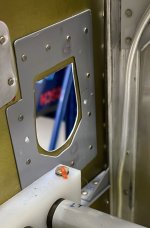
Is there any chance there is an old picture of the doubler going in? AC43.13 is long on patches but short on doublers. I'm sure I can fashion something acceptable but imitation is the sincerest form of flattery.... I'm also thinking AD3 rivets are fine if there are enough of them. AC43.13 has me thinking two rows are needed because of the size of the hole. I also emailed Vans just in case there is something else to think about.
 
Suggest you put it behind and below the instrument panel, or somewhere within the pilots reach inside the airplane. That way when you do need to get a jump start, its a simple matter of unplugging the cable and handing the end to the line guy once you get your airplane started. Vehicle or start cart would be behind the wing in a much safer spot.
 
Looking at this, the hole is big enough I can probably dimple with a squeezer.....
Is there any chance there is an old picture of the doubler going in? AC43.13 is long on patches but short on doublers. I'm sure I can fashion something acceptable but imitation is the sincerest form of flattery.... I'm also thinking AD3 rivets are fine if there are enough of them. AC43.13 has me thinking two rows are needed because of the size of the hole. I also emailed Vans just in case there is something else to think about.
AC43.13 doesn’t specifically say much on doublers, but just think of your doubler as a patch over a small round hole. There is good guidance for that. Larger holes are a little trickier and you have to use the tables provided, but the information is there.
 
Suggest you put it behind and below the instrument panel, or somewhere within the pilots reach inside the airplane. That way when you do need to get a jump start, its a simple matter of unplugging the cable and handing the end to the line guy once you get your airplane started. Vehicle or start cart would be behind the wing in a much safer spot.
Good thought. In my -8 the battery is aft and the proposed location is aft behind the wing as well. I’m not anticipating having to get a jump start as much as just being easily able to charge the battery with a rapid charger without too much hassle. Being able to start with it is just a bonus.

I do think it a little dicey to start with a cable in the oil access door. Agreed.
 
What about sealant/caulk? Seems like it would be smart to apply something to keep water from under the fitting. I don't want to proseal it; is there a good caulk that isn't silicone besides the pro seal?
 
What about sealant/caulk? Seems like it would be smart to apply something to keep water from under the fitting. I don't want to proseal it; is there a good caulk that isn't silicone besides the pro seal?
I also have a question about the receptacle itself. It is designed to have a cable soldered into it, and the Nuckolls pamphlet has us solder a bolt in. Why not just solder the correct gauge welding wire and bring it to the contactor instead of soldering a bolt into the fitting? Will the soldering of the bolt be somehow less likely to come loose than a soldering of a big wire? The run is so short the weight can't matter much.
 
Back
Top