Van's Air Force

The definitive Van's Aircraft support community! Buying, building or flying an RV? Join our exclusive family of mentors and enthusiasts!

closed end pull rivet not so closed

[email protected]

Well Known Member
Patron
picture2lo9.png


started the day chasing down an obvious leak in the left tank... after searching unsuccessfully for some sign on the outside we pulled the tank from the wing and found that several of the ?closed? end pull rivets for the z brackets at stations 5 and 6 were not so closed after all. these special rivets have a partial depth mandrel that does not penetrate the rivet but air was bleeding through the pulled mandrel hole!

it is a bit of a concern that these closed end rivets are not a sure thing.

most of the builder sites that i have seen do not show proseal coverage over these rivet heads... as a preventive measure it would be advisable to go ahead and enclose the heads with proseal.

we cleaned everything up and sealed all of the closed rivets with proseal and pulled the right tank and did the same.
 
I am just about to pressure test my left tank, so I don't know for sure yet but, I went ahead and covered those pop rivet heads anyway with Proseal. Just to look at those pop rivet heads didn't give me a lot of confidence in their sealability.

In fact, I globbed a lot of Proseal all over everwhere I thought fuel could escape on the inside of the tank. We'll see...:rolleyes:
 
Sorry to resurrect this long dormant thread, but I've had a leaky AD-42H happen to me now, too:


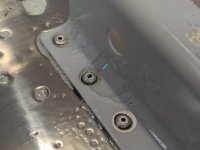
PXL_20250705_221950270 (Small).jpg

Here's a video demonstrating that the leak is from the mandrel hole, and not from around the head:


I've asked Van's support whether they recommend encapsulating the head with ProSeal, or replacing the rivet entirely.
 
Not sure I would want half a rivet bouncing around inside the tank. You should be able to seal that from the outside with proper prep.
 
Just a thought. How about prosealing the hole inside of the rivet and putting a very very small screw or plug in the hole. I don't like the idea of encapsulating a rivet on the outside. Sounds like a temporary fix. Kind like fixing a leak on your roof of your house from the inside.
 
Just a thought. How about prosealing the hole inside of the rivet and putting a very very small screw or plug in the hole.
Hmm, interesting .... :unsure:

I don't like the idea of encapsulating a rivet on the outside. Sounds like a temporary fix.
If the word from Van's comes back, "Encapsulate," what I'll likely do is,
  1. use a syringe (with O-ring?) to force ProSeal into the hole, and
  2. use a light vacuum in the tank while monitoring with a manometer and try to "suck" the ProSeal deeper into the hole, then
  3. if successful, repeat steps 1, 2, and 3, else
  4. encapsulate the manufactured head just like I did with the internal shop heads.
In the case of the Z-brackets, all of the sealing was done on the outside of the tank. Per Van's how-to video, sealant was applied to the underside of the Z-brackets, and was swirled on the ends of the rivets before insertion, with most of the rivet sealant ending up under the manufactured head. Encapsulating the outside would be keeping with the theme. ;)
 
Last edited:
Hmm, interesting .... :unsure:


If the word from Van's comes back, "Encapsulate," what I'll likely do is,
  1. use a syringe (with O-ring?) to force ProSeal into the hole, and
  2. use a light vacuum in the tank while monitoring with a manometer and try to "suck" the ProSeal deeper into the hole, then
  3. if successful, repeat steps 1, 2, and 3, else
  4. encapsulate the manufactured head just like I did with the internal shop heads.
In the case of the Z-brackets, all of the sealing was done on the outside of the tank. Per Van's how-to video, sealant was applied to the underside of the Z-brackets, and was swirled on the ends of the rivets before insertion, with most of the rivet sealant ending up under the manufactured head. Encapsulating the outside would be keeping with the theme. ;)
it's not a big deal... just swirl a dollop of pro seal with a popsicle stick to encapsulate each one.
 
it's not a big deal... just swirl a dollop of pro seal with a popsicle stick to encapsulate each one.
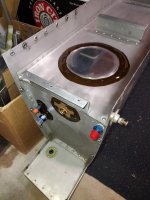
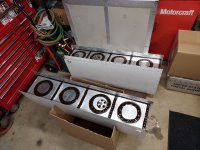
I encapsulate with 1422A 1/2, every seam and rivet/screw. Here is a repair I did to a -10 tank, and a set of -4 tanks. You won't find an airliner that's made which isn't externally encapsulated as well. the "A" sealant is brushed on and flows out into every nook and cranny.TankRV10.jpgSealed baffle covers.jpg
 
Last edited by a moderator:
Bill - Great looking seal job on those tanks... I'm thinking it took a little of that Iron City to get through all that proseal. I'm originally from PGH as well, but I haven't had an IC or IC Light in probably 15 years.
 
Bill - Great looking seal job on those tanks... I'm thinking it took a little of that Iron City to get through all that proseal. I'm originally from PGH as well, but I haven't had an IC or IC Light in probably 15 years.
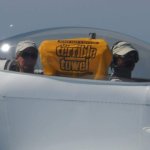
Haha..Dave, I grew up in the South Hills (Upper St Clair) and went to PIA for my A&P. Been in NC since 1982, working Airliners for a living. I still love my Iron City, and always have it on hand...I have it stocked at the local grocery store and select places ! Heres what my buddy from Philly gets when we fly formation...
 

Attachments

  • Terrible Towel at 10K.jpg
    Terrible Towel at 10K.jpg
    30.6 KB · Views: 37
I've asked Van's support whether they recommend encapsulating the head with ProSeal, or replacing the rivet entirely.

To follow up, the word from Kevin at Van's Support is, "It is not uncommon or unheard of for those rear tank baffle sealed rivets to occasionally tear or crack while being set!" He said that either encapsulating or replacing the leaky rivet "... could be considered a possible remedy. "

He went further and added, "Also, producing a ProSeal fillet around the entire perimeter of each Z bracket and coating/encapsulating the entire Z bracket flange (including each rivet manufactured head) could also be considered."
 
Back
Top