Van's Air Force

The definitive Van's Aircraft support community! Buying, building or flying an RV? Join our exclusive family of mentors and enthusiasts!

Christmas Eve Canopy Heartbreak

TASEsq

Well Known Member
Patron
I feel like I need to scrap my whole canopy…

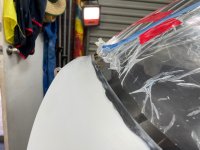
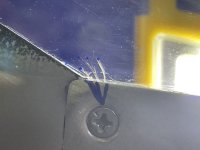
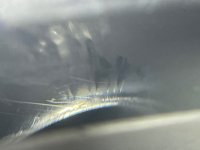
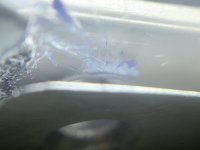
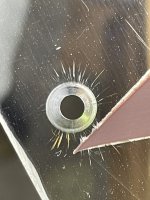
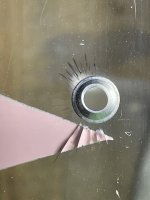
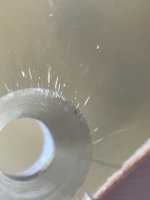
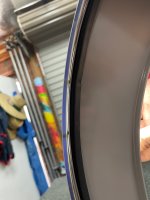
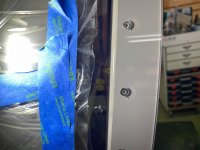
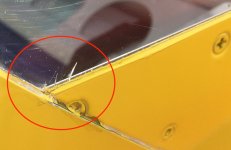
I’ve been working so hard to get a nice edge to my fibreglass fairing, remove the last layer of tape and found this.

I’m very worried I’ll come out on Christmas morning to find my canopy cracked in half.

Is this a massive problem? What do I do!

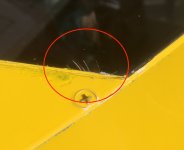
It’s the only place on the whole canopy as far as I can see - this one fastener was tightened the same as all the others.

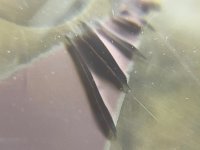
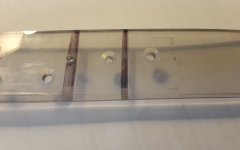
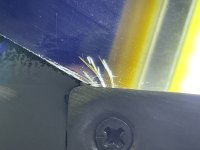
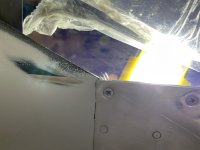
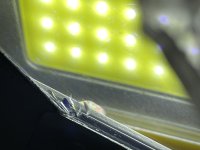
There looks to be 3-5 tiny cracks. I can’t feel them on the inside or the outside with my nail. The longest is 1/4” long.
 

Attachments

  • IMG_4206.jpeg
    IMG_4206.jpeg
    987 KB · Views: 579
  • IMG_4207.jpeg
    IMG_4207.jpeg
    1.4 MB · Views: 574
  • IMG_4208.jpeg
    IMG_4208.jpeg
    874.8 KB · Views: 576
I would at least try to stop drill.
Do so immediately and see what happens in the next few days.
I worry since there are 5 “fingers” that drilling the ends of each will make a little seam of holes. Maybe worse than the cracks.
 
What resin did you use?
Your videos on the fairing have been an excellent resource by the way. Up until this afternoon I thought I was doing a grand job! only had one more coat of paint to go.
 

Attachments

  • IMG_4209.jpeg
    IMG_4209.jpeg
    3 MB · Views: 212
A stress of some kind at that point. What Jim said.
If it makes you feel any better, the exhaust stud on my replaced cylinder failed while tightening up the exhaust today.
Stuff happens. Deal with it and build on.
 
What resin did you use?
Hi Scott,

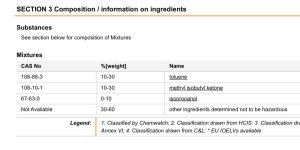
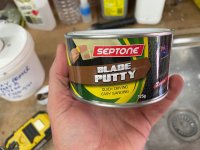
I did use some of this on the outside surface. Perhaps this is crazing from the solvent? I used this in the corner to fill some pinholes etc.
 

Attachments

  • IMG_4211.jpeg
    IMG_4211.jpeg
    112.9 KB · Views: 163
  • IMG_4210.jpeg
    IMG_4210.jpeg
    3.6 MB · Views: 162
It has the classic appearance of chemical induced crazing, which is the reason I asked.
There is a high probability that the filler is what caused it.
Bloody hell. Thanks for the advice.

That might explain why I can’t feel it on the outside or inside?

How would you proceed? Does it need stop drilling? Would weld on 3 work at all? (Maybe not since I can’t feel a crack on the outside for it to wick into)
 
Trent
Back away from the edge....beep beep beep. No seriously take a breather. Don't put a drill bit anywhere near it. Just keep finishing up the canopy and don't try forcing a fix.
If its those striations I'm seeing near the bottom of the picture, you can decide later depending how long they are to possible scuff the area and put a nice coat of paint similar to what some autos have on their front windshield or a thin piece of vinyl wrap to clean it up. Some painters will run a finish bead of proseal around the canopy perimeter after paint.

Otherwise I would not do a thing right now. That crazing if thats what it is isn't going to grow on you.

Contact the manufacturer, Airplane Plastics in Ohio, USA [email protected] 937-669-2677 and see what they suggest.

By the way your fairing came out looking beautiful. Nice clean crisp edge.
 
Last edited:
Trent
Back away from the edge....beep beep beep. No seriously take a breather. Don't put a drill bit anywhere near it. Just keep finishing up the canopy and don't try forcing a fix.
If its those striations I'm seeing near the bottom of the picture, you can decide later depending how long they are to possible scuff the area and put a nice coat of paint similar to what some autos have on their front windshield or a thin piece of vinyl wrap to clean it up.

Otherwise I would not do a thing right now. That crazing if thats what it is isn't going to grow on you.

Contact the manufacturer, Airplane Plastics in Ohio, USA [email protected] 937-669-2677 and see what they suggest.

By the way your fairing came out looking beautiful. Nice clean crisp edge.
Thank you.

I’ve retreated to the bbq with a ginger beer and walked away from the shed.

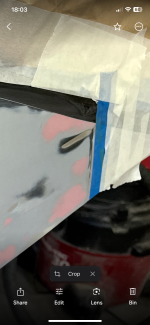
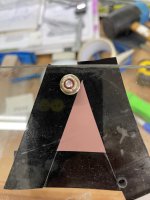
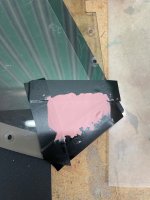
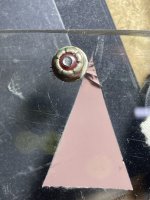
Here is a photo showing where I used the blade putty in the corner to try and add a tiny bit of thickness - it’s the pink stuff. It was put on above the tape and sanded down - under the tape is the bare canopy. I ended up sanding most of this off and using micro in the end to get a better edge. A stupid thing to do -
Scott warned in his videos to be careful what you use. I had used this plenty of times on fibreglass to fill pin-holes. But there was bare acrylic underneath. Rookie error. Idiot!
 

Attachments

  • IMG_4212.png
    IMG_4212.png
    4.1 MB · Views: 264
Last edited:
I’m not sure what I am seeing and I am not a builder.

What it looks like to me is that the lines appear on some clear plastic, like a windshield, right near a screw holding material together. If true, I’d suspect something with the screw being too tight or even some issue with the hole allowing movement during sanding.

I put new windows in my old 172, things were very specific with how they needed to be secured.
 
I feel like I need to scrap my whole canopy…

I’ve been working so hard to get a nice edge to my fibreglass fairing, remove the last layer of tape and found this.

I’m very worried I’ll come out on Christmas morning to find my canopy cracked in half.

Is this a massive problem? What do I do!

It’s the only place on the whole canopy as far as I can see - this one fastener was tightened the same as all the others.

There looks to be 3-5 tiny cracks. I can’t feel them on the inside or the outside with my nail. The longest is 1/4” long.
Trent,

So sorry to see what happened. FWIW, I too used West Systems with black dye. No issues. It's only a guess, but I agree with Scott on the chemical induced cracking.

Regarding what to do, I agree that if you can't live with the cracks, it will probably have to be replaced. I have no experience with this, but I don't recall reading about a solution on this forum.

My suggestion is that you "build on" while making your decision. I would think the aircraft would be safe to fly if you have to wait that long on a canopy. It would be expensive, but you could finish your current canopy and then order all the parts to build a new one. You could at least be flying while working on #2. My guess is other than the canopy itself, the most costly part of the replacement would be the freight given your location.

Again, sorry to read about this,

Fred
 
I certainly would not scrap it. As Arnie suggested contact the manufacturer, Airplane Plastics in Ohio, USA [email protected] 937-669-2677. They are great t work with. I worked closely with them to get the last tinted canopy for my 14. He will have suggestions. As mentioned previously there are ways to cover up the small cracks that are there now.
I have had chemical cracking from Mogas on other airplanes and they don't seem to grow.
 
I feel like I need to scrap my whole canopy…

I’ve been working so hard to get a nice edge to my fibreglass fairing, remove the last layer of tape and found this.

I’m very worried I’ll come out on Christmas morning to find my canopy cracked in half.

Is this a massive problem? What do I do!

It’s the only place on the whole canopy as far as I can see - this one fastener was tightened the same as all the others.

There looks to be 3-5 tiny cracks. I can’t feel them on the inside or the outside with my nail. The longest is 1/4” long.
Looks like you've had some good suggestions for this issue. I just wanted to pipe in and say how valuable your builders log has been to me in my build. I'm a first time builder of just about anything and the detail you provide with pictures is just what I've needed.
 
What a painful event!! I would take the photos to a good plastics fabrication shop and talk with them. I would ask about using a syringe to apply some Weldon #3 into the cracks (it's the water-thin solvent "cement"), which might be able to anneal the edges of the cracks together.

Building my -12 canopy, I used West epoxy with the black dye, too, and doubt that's the problem. Alcohols are bad for acrylics-- they remove the plasticizers and induce cracking at stress points such as drilled holes.
 
I feel like I need to scrap my whole canopy…

I’ve been working so hard to get a nice edge to my fibreglass fairing, remove the last layer of tape and found this.

I’m very worried I’ll come out on Christmas morning to find my canopy cracked in half.

Is this a massive problem? What do I do!

It’s the only place on the whole canopy as far as I can see - this one fastener was tightened the same as all the others.

There looks to be 3-5 tiny cracks. I can’t feel them on the inside or the outside with my nail. The longest is 1/4” long.
Since you can't feel cracks with your fingernail I would not stop drill. Continue as if they are not there, cover your eyes.. Seriously just check the crazing now and then, it might stay that way forever
 
Is this a massive problem?
No, I don’t believe it is.
What do I do!
Leave it alone and Build on!
In 2010 my good friend and build advisor (supervisor) was likely one of the first builders to use Loctite on his 9A canopy. Came out the next morning and all the screws looked like that one spot on yours. After the inevitable dread and heartbreak he used oversized washers and built on. Over 1100 hrs later, no issue!

As others have mentioned, call Jeff at Airplane Plastics. Great people to deal with.

If you have a scrap piece of acrylic, apply some of the same blade putty to it in a similar fashion and also drill and tap a hole and apply some Loctite to the screw before installing. This should give you a pretty good sample of what crazing looks like and that it is, in fact, crazing that you have. Compare the results to your (very small) area on your canopy.
I would mark the ends of the fingers on the side closest the edge to monitor them over time.

This is how a good paint shop seals the aluminum edge. This will cover that little spot on yours, no problem. It looks like a seal but it’s actually caulking!

7191811881.jpeg
 
Thank you.

I’ve retreated to the bbq with a ginger beer and walked away from the shed.
Perfect way to rearrange your brain!! My instructor used to say "well, let's go roll up a cigarette or two and think about this". :LOL: He never smoked a day in his life but that was his way of saying: let's think of something else for a while........
A stupid thing to do -
Rookie error. Idiot!
Silly, perhaps. Stupid: WAY bigger errors than this have been done by first-time builders. This is not Legos. It's a complicated assembly of multiple things.

Um.......no. You are NOT an idiot! Self-deprecation does not become you.....! Let's take a walk down your block and see how many people in your neighborhood are building airplanes in their carriage houses......
 
Last edited:
It has the classic appearance of chemical induced crazing, which is the reason I asked.
There is a high probability that the filler is what caused it.
Uhm, erm...I respectfully disagree. To me, that looks like the adjacent hole wasn't drilled and upsized a bit to allow for expansion, and/or the hole wasn't deburred/finished to a high luster.

I would loosen the adjacent screw by 1/8 - 1/4 turn to take some of the pressure off the hole. Dress the window edge with proseal or equivalent when you get the plane painted.

Build On! Merry Christmas...
 
I think you are ok. Soon after building, my 7A canopy developed some tiny cracks in the forward left and right curved areas. Multiple tiny crack looking lines all within about an inch. Like you, I really could not feel anything and definitely didn't stop drill. The only thing I did was to saturate that small area on each side with thin super glue in hopes that if there was even nearly microscopic access, the glue would wick in and stop any further spread. That was 11 years ago and no changes since. Don't even notice them as they are at best even with the top of the rail. More visible from the inside. BTW, my canopy was placed using only screws.
 
I have seen a number of RV with such cracks in that exact place. I believe it is due to tightening the screw too much which is on the sharpest curve of the canopy. Use some Weld-on #3 and perhaps extend your fiberglass fairing a bit higher to cover it. Most that I have seen did not grow beyond the initial crack.

Good luck
 
Firstly, thank you to all that took the time to reply. It’s 0530 Christmas morning now, and kids are still asleep, and I’m in much less of a panic - mostly due to the support and messages from this forum (and a couple of bourbons). I checked under the tree, but Santa didn’t bring a new canopy for me. Seriously though, appreciate the assistance from everyone!

I have put some tiny sharpie dots on the ends of the cracks to monitor them and will build on. I’ll order some weld on 3 and see if I can wick any in at some point or other - maybe from the screw hole itself with the canopy upside down. Add it to the little jobs list.

I just wanted to pipe in and say how valuable your builders log has been to me in my build. I'm a first time builder of just about anything and the detail you provide with pictures is just what I've needed
This will be a good one to read - I think I’ll title it “RTFSDS”.

Did you use Loctite on your fasteners? That stuff will cause exactly what you are seeing.
No! I was well aware, from a friends RV of the effects of loctite. This is a side rail hole anyways - has a nyloc on the back side.

If you have a scrap piece of acrylic, apply some of the same blade putty to it in a similar fashion … This should give you a pretty good sample of what crazing looks like and that it is, in fact, crazing that you have. Compare the results to your (very small) area on your canopy.
I would mark the ends of the fingers on the side closest the edge to monitor them over time.

This is how a good paint shop seals the aluminum edge. This will cover that little spot on yours, no problem. It looks like a seal but it’s actually caulking!
This is an excellent idea. I have a bit of scrap from the builder I purchased my tools from - he cracked his back window. It’s been used as a practice piece for every task on this canopy so far. May it continue to serve into the future. I will, for sure, apply some blade putty over some tape over the hole and see what happens. Thank you for the excellent suggestion.

I have marked the ends of the fingers of the crack with a small sharpie dot in order to monitor.

I was wondering about sealing that edge! It seemed weird to me that it wasn’t sealed. I know you said some paint shops do it, but do you reckon there would be any reason I couldn’t do it prior to paint? It would certainly cover up the area. I will be doing it along the back window anyway, as per the instructions.

Uhm, erm...I respectfully disagree. To me, that looks like the adjacent hole wasn't drilled and upsized a bit to allow for expansion, and/or the hole wasn't deburred/finished to a high luster.

I would loosen the adjacent screw by 1/8 - 1/4 turn to take some of the pressure off the hole. Dress the window edge with proseal or equivalent when you get the plane painted.

Build On! Merry Christmas...
Merry Christmas as well. The hole was reamed to #27 and treated the same as all the others. I’ve already loosened the screw right off. Will report back on the crazing after the blade putty experiment.
 
I believe the canopies on Vans aircraft are one of the intrinsic weak points. I feel they are prone to cracks because of their size alone. As careful as I was during my build as I mentioned above I have the cracks I described. I believe they are stress cracks. Also these canopies are IMO subject to a much higher risk of cracking in cold weather. For that reason, I am thankful I live along the Gulf Coast of Alabama. My son lives in MA and I will not fly up there except in the warmer season... because the very low temps they experience. Also, If I had been on the Vans canopy design team, I think rather than a huge one piece canopy, I would have suggested maybe from the roll bar forward at least a two if not three piece canopy. I feel this would have completely eliminated the risk of cracking. My view from my seamless canopy is amazing but that worry is always there. Just my thoughts.
 
any reason I couldn’t do it prior to paint?
The big advantage to doing it after paint is you can hide the paint line under the edge of the caulking. Taping off the caulk for paint might not look as good and be a little more difficult. And the tape may leave a texture on the caulk.
 
The big advantage to doing it after paint is you can hide the paint line under the edge of the caulking. Taping off the caulk for paint might not look as good and be a little more difficult. And the tape may leave a texture on the caulk.
I was thinking they would just mask on the canopy and paint the proseal with the rest?
 
View attachment 76998

High probability:

It was a stupid thing to use - it’s easier than Bondo because it’s single part, and can be sanded in an hour. Great for pin holes and small imperfections. Usually…

I got into the trap I think of setting a mental deadline. I’ve been working pretty hard on this fairing and for no reason at all decided to try and have it done by Christmas. Meaning I was doing things which were quicker - like using a layer of rattle can primer, and using this blade putty. Neither of which I paused to consider if the solvent was compatible. Whereas, if I’d just sprayed the Stewart systems primer and waited 24 hours, it fills the pin holes extremely well. It’s just an hour of work a day this way, instead of 5. I’m very annoyed at myself but it is what it is now.
 
Uhm, erm...I respectfully disagree. To me, that looks like the adjacent hole wasn't drilled and upsized a bit to allow for expansion, and/or the hole wasn't deburred/finished to a high luster.

I would loosen the adjacent screw by 1/8 - 1/4 turn to take some of the pressure off the hole. Dress the window edge with proseal or equivalent when you get the plane painted.

Build On! Merry Christmas...
I disagree as well

Pretty much every single RV canopy installation has some level of strain built into the canopy once it is installed because they are not 100% perfectly molded to the net shape of the frame.

This is not ideal, but it is what it is, and in most instances if proper install techniques are used, it won’t end up being a problem.
When an issue does occur that was related only to induced stress (such as improperly, finished edges, or deburred holes), it pretty much universally results in a single crack.
In this instance, the stresses were relieved at a micro level on the surface of the acrylic because of the influence of chemicals that react with the acrylic which causes spiderweb cracking or what we also referred to as crazing.
I have seen the results many times. The outcome is generally the same and the same cause…. Some type of aromatic chemical/solvent reacting on the surface of the acrylic (where the stress is actually the highest) and causing the crazing as some of the surface tension is released.

Probably not a structural concern, other than now that the process is started, that area may be even more susceptible to future damage so great care should be used regarding what solvents contact the canopy in that area.

EDIT: After writing this post I took another look at the photos (on my desk top computer rather than my much smaller phone screen), and Brian might be correct....
The cracks seem to be through more of the thickness than just right on the outer surface like is typical from crazing.
I know that by design, this fwd most screw is much less of an issue on the RV-14 than it is the the RV-7/9, but if it was tightened excessively it still may have had a negative impact.
Though if the cracks weren't visible prior to beginning the layup work, a chemical influence is likely still relevant.
 
Last edited:
It was a stupid thing to use - it’s easier than Bondo because it’s single part, and can be sanded in an hour. Great for pin holes and small imperfections. Usually…
.
Bondo filler contains polyester resin and MEKP which is also kryptonite to acrylic plastic, so it also wouldn’t have been a good choice.
In the video, it mentions that it can be used for filling, small voids and depressions if you choose, but it should only be used in locations that are well away from the actual acrylic canopy.
I have done this many times myself for the same reason you did, because I was pressed for time and needed to do the final finish work ASAP, but always while using extreme caution to not be near the acrylic.
The safest filler is to use the same resin that the fiberglass layup was done with, thickened with micro balloons.
 
Firstly - thanks once again for everyone’s opinions and assistance. The grieving process is real.

The cracks seem to be through more of the thickness than just right on the outer surface like is typical from crazing.

Though if the cracks weren't visible prior to beginning the layup work, a chemical influence is likely still relevant.
The cracks are most definitely inside the acrylic - they don’t seem to extend through to both sides - I can’t feel anything on the surface with my nail on either side. Could they be internal only?

I am unfortunately unsure when they occurred - we tightened the nuts on the airframe, then moved it over to the bench. When we tightened it, it already had the tape layers on the canopy. I wasn’t happy with them and removed and replaced the tape with the canopy on the workbench before starting fibreglass work, and never noticed the cracks with the tape off. Perhaps they occurred due to temp changes while it was on the bench? Or perhaps due to the filler?

Tracing the trajectory it seems the cracks extend back toward the hole? Maybe? (see photo). Maybe this one wasn’t deburred as well as the others (although I thought I took good care with every one). As far as my exposure to different RV’s, of the canopies I have seen cracked at holes, generally seem to always be a single crack. This is more of a little web - albeit extending back to a single source maybe.

Anyway - it’s happened. The cause is a bit redundant at this stage. What to do about it?

I was thinking, once the fairing was complete, of turning the canopy upside down and seeing if I can apply some weld on 3 using a syringe into the hole? Perhaps, if I’m lucky, it would wick into the cracks?

If they are indeed due to an over-tightened nut, do they need to be stop drilled? I’m not really a fan of drilling 5 tiny holes and hoping I hit the ends of the crack.

I’m also thinking of backing all of the nuts off a little bit. When I tightened them, I took them until just snug, then went a 1/4 of a turn more only. This seemed about right to me. Wasn’t sure how tight they were supposed to be. The plans warned against over tightening of course but didn’t give a torque value.
 

Attachments

  • IMG_4226.jpeg
    IMG_4226.jpeg
    1,016.4 KB · Views: 86
For what it’s worth, I removed a couple of screws and was able to space the skin away slightly from the canopy. Looking inside, the cracks do seem to emanate from the countersink surface. It’s very hard to get a photo of course.

I’ve tightened a screw and nut into my practice canopy scrap and applied some filler will report back.
 

Attachments

  • IMG_4235.jpeg
    IMG_4235.jpeg
    3.7 MB · Views: 96
  • IMG_4230.jpeg
    IMG_4230.jpeg
    1.2 MB · Views: 96
  • IMG_4232.jpeg
    IMG_4232.jpeg
    1.4 MB · Views: 95
Just to share, I have had a really good experience/result with Weld-on #3. It is super thin and wicks thru easily. While you have it open, it would not hurt if you put some on that portion of the countersink just to give it a bit of strength if it is a crack.
 
It has the classic appearance of chemical induced crazing, which is the reason I asked.
There is a high probability that the filler is what caused it.
Just want to circle back to your comment Scott.

I installed a screw and nut into a hole I had countersunk in my scrap canopy piece, when setting the depth of my cage. I tightened it to snug, then a quarter of a turn as I did on the real canopy.

It did not crack at all when installed.

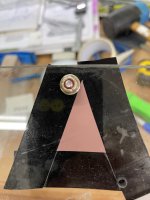
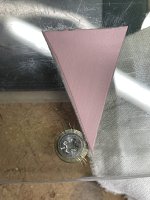
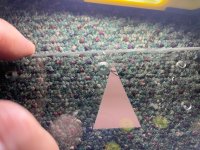
I then taped off a small triangle with the tape over the screw head, as it was on the real canopy and smeared on some blade putty. It was probably slightly closer to the screw hole in the test article than the real canopy.

Initially the blade putty had no effect on the canopy at all. It looked fine. See first photo.

IMG_4235.jpeg

IMG_4233.jpeg

I let it cure for an hour or so, then went out to sand it smooth and your initial comments were spot on.

There were radial cracks, emanating on the surface of the canopy, from what looks like the apex of the countersink cone. These all seem to be on the surface. A small distance away from this, are larger cracks which seem to be inside the canopy glass itself. I cannot feel these larger cracks on the surface. They do look like they extend through the thickness of the material.

Suffice to say, I think I have replicated the issue totally.

IMG_4240.jpegIMG_4241.jpegIMG_4242.jpegIMG_4243.jpegIMG_4245.jpegIMG_4247.jpeg

Interestingly, I had applied some filler in a second area of the canopy scrap, adjacent to a countersink, but with no screw installed - the filler had no effect at all. So what Scott said seems spot on:
In this instance, the stresses were relieved at a micro level on the surface of the acrylic because of the influence of chemicals that react with the acrylic which causes spiderweb cracking or what we also referred to as crazing.
I have seen the results many times. The outcome is generally the same and the same cause…. Some type of aromatic chemical/solvent reacting on the surface of the acrylic (where the stress is actually the highest) and causing the crazing as some of the surface tension is released.

At least I know it wasn’t my ham-fistedness with the spanner, but my decision making with the filler!

The scrap piece will at least now provide a test article, to see if the weld on 3 applied to the countersink will be beneficial.

Will report back on that when I get some next week.
 
I’m at a similar point in my build and feel for you Trent. I would like to learn from your experiences and would like to avoid similar outcomes. I’m curious what the best way would be to deburr and/or polish the countersunk holes?

I have also been curious about the use of Bondo-type fillers as I’ve seen this done a lot. I’ve always been told that polyester or vinylester resins should not be applied to epoxy as they simply won’t adhere properly. Scott mentioned above that the best filler is the same epoxy used for the glass layup, but does say that these other fillers can be used sparingly if distant from the acrylic. I’m wondering what the long-term adhesion is like if used this way?
 
This canopy and I really aren’t getting along.

An update: I used my scrap piece and tried to wick in some weld on 3. This did absolutely nothing. It went into the countersink and just sat there - didn’t seem to wick into the cracks at all. Not even a tiny bit.

IMG_4470.jpeg
What it did do, was leave nasty marks on the canopy surface where it ran down the plastic.

Needless to say, I’m not keen to try this on the original “crazing” cracks. I don’t think it’s going to do anything, and I run the risk of getting runs and ruining things more.

Why you ask did I use the word “original”?

Because when I got to the step where i install the aft seal under the seal retainer, and tighten the “zone 3” nuts, I got a crack on one of the screws. Now these were literally barely tightened - just snug, that’s it. I have no idea what I’ve done wrong.

Then worse, today when flipping the canopy back over from upside down after doing the canopy seals, 2 more of the screw holes got very small cracks.

The best guess I can make is that these sections had very small gaps between the roll bar and the canopy glass? i had not noticed this before. Slight flexing as it was gently rolled over made them crack?

So for the 3 x screw hole cracks, I masked them off around the countersink and tried to wick in some weld on 3. Again, this didn’t seem to wick into the crack as far as I could see. I’m not sure it’s done anything - perhaps sealed the top of the crack at the countersink.

I am totally over the canopy. It’s replaced all my enthusiasm for building with regret and anxiety. I’m afraid to look at this stupid thing!
 

Attachments

  • IMG_4473.jpeg
    IMG_4473.jpeg
    2.3 MB · Views: 102
  • IMG_4472.jpeg
    IMG_4472.jpeg
    3.5 MB · Views: 101
  • IMG_4471.jpeg
    IMG_4471.jpeg
    2.9 MB · Views: 111
This canopy and I really aren’t getting along.

An update: I used my scrap piece and tried to wick in some weld on 3. This did absolutely nothing. It went into the countersink and just sat there - didn’t seem to wick into the cracks at all. Not even a tiny bit.

View attachment 78124
What it did do, was leave nasty marks on the canopy surface where it ran down the plastic.

Needless to say, I’m not keen to try this on the original “crazing” cracks. I don’t think it’s going to do anything, and I run the risk of getting runs and ruining things more.

Why you ask did I use the word “original”?

Because when I got to the step where i install the aft seal under the seal retainer, and tighten the “zone 3” nuts, I got a crack on one of the screws. Now these were literally barely tightened - just snug, that’s it. I have no idea what I’ve done wrong.

Then worse, today when flipping the canopy back over from upside down after doing the canopy seals, 2 more of the screw holes got very small cracks.

The best guess I can make is that these sections had very small gaps between the roll bar and the canopy glass? i had not noticed this before. Slight flexing as it was gently rolled over made them crack?

So for the 3 x screw hole cracks, I masked them off around the countersink and tried to wick in some weld on 3. Again, this didn’t seem to wick into the crack as far as I could see. I’m not sure it’s done anything - perhaps sealed the top of the crack at the countersink.

I am totally over the canopy. It’s replaced all my enthusiasm for building with regret and anxiety. I’m afraid to look at this stupid thing!
Hi Trent
That's a bummer, fwiw I've seen older RVs with crazing (around the roll bar screws) and it didn't get any worse.

What type of countersink cutter was used on the plexi? In the photos the surface looks slightly rough, maybe that is the Weld On 3. Attached is a photo of some scrap that I previously used for some test drilling and these countersinks are made with the same 3 flute type cutter and cage as for rivets and it leaves a relatively smooth surface.

20250110_173133.jpg

Cheers
Paul
 
Hi Trent
That's a bummer, fwiw I've seen older RVs with crazing (around the roll bar screws) and it didn't get any worse.

What type of countersink cutter was used on the plexi? In the photos the surface looks slightly rough, maybe that is the Weld On 3. Attached is a photo of some scrap that I previously used for some test drilling and these countersinks are made with the same 3 flute type cutter and cage as for rivets and it leaves a relatively smooth surface.

View attachment 78134

Cheers
Paul
Same here. I just used my normal 3 flute piloted countersink bit and it looked very smooth. Least I didn’t think it was rough. The hole itself was made with a reamer and deburred on both sides before countersinking.
 
The question is do I need to do anything about these cracks? I’m fearful they will grow. They don’t seem to be all the way through the canopy. I’m extremely frustrated - followed the plans exactly.

For the 2 where there is a bit of a gap, I’m going to try and squeeze in a couple of nylon washers.
 
The question is do I need to do anything about these cracks? I’m fearful they will grow. They don’t seem to be all the way through the canopy. I’m extremely frustrated - followed the plans exactly.
This is a painful dilemma for sure...I have seen small cracks in plexiglass canopies that don't grow any longer over many hundreds of hours, and also seen plenty of canopies that had no cracks at time of assembly but once in service develop crack(s) that spread to the point where the canopy needs to be replaced. Plexiglass canopies are a bit like concrete...sooner or later, cracks will develop somewhere...but that might take 1 hour or many thousands of hours.

If you can live with it psychologically, might make sense to just move on and get the airplane flying. The cracks may never spread or at least not during the years you own the airplane. If they do, you'll eventually have to replace the canopy...but that could happen to canopy #2 even if you replace canopy #1 now.

If it bothers you so much you just can't stand it, then order a new one and replace it now. That's probly what I would do because my inner perfectionist would be too traumatized by knowing that those tiny cracks are there, even if not highly visible and may never spread. I fix/redo lots of things on my airplane that nobody else would ever know or care about it, the problem is I know about it and am not happy until it's done to my satisfaction. It's a disease I don't wish upon anyone...
 
Most has already been stated thru this thread...
@TASEsq, I have very similar micro cracks at the rear bottom corners of my canopy. I had reported this a couple of years ago in another thread, which seems to have dissolved itself in the digital ether...
I bought my aircraft end of 2018, and its first flight was beginning 2005, so going 20 years old with 2.2K hours under its belt. Hangared most of the time. I too was (still am really) worried about these cracks, but they don't seem to grow. No chemical whatever was ever involved in the build, nor maintenance of this canopy. So these cracks are certainly tension cracks.
What have I done since? Loosen them 1 screw on each side, and kept an eye on them cracks. Have myself flown 1800+ hours since owning my steed, and those cracks don't seem to grow, hopefully to stay this way...
 

Attachments

  • IMG_2870.JPG
    IMG_2870.JPG
    498.7 KB · Views: 34
  • IMG_2874.JPG
    IMG_2874.JPG
    429.4 KB · Views: 34
Back
Top