Van's Air Force

The definitive Van's Aircraft support community! Buying, building or flying an RV? Join our exclusive family of mentors and enthusiasts!

CG of ready RV 3

Rainer

I'm New Here
Patron
I am currently building an RV3B and would like to install the UL-Power 390iS engine. This engine is about 44 lbs (20 kg) lighter than a Lycoming O-320 but about as heavy as an O-235 or O-290 engine. Hence my question: Are finished RV3Bs more tail-heavy or more nose-heavy? It would be ideal to know whether an RV 3 with an O-235/O-290 is more nose-heavy or tail-heavy. A fixed propeller with the appropriate weight would be suitable.

Rainer
 
Interesting question. You can play around with battery location. On mine (-3B) with narrow-deck, conical mount 150 hp O-320 and wood prop, so about the lightest possible configuration with an O-320, a PC680 between my feet kept things nicely in the middle of the CG range. To get you a single data point...

Why the small engine, by the way? The 390iS only delivers 145 hp at 2800 rpm (so roughly 140 at a more standard 2700).

Why not go for the 520i? That one comes a lot closer to the IO320 in specs...

(Incidentally, I have in storage this same mid-time, narrow-deck, conical mount 150 hp O-320 that came off my RV3 that at one point in time I might put up for sale. Located 600 km away from you in The Netherlands. PM me if you might be interested....)

(And moderators - please let me know if I need to remove this last line. I am not looking to sell per se, but given that Rainer seems to be working on his engine choice....)
 
I am currently building an RV3B and would like to install the UL-Power 390iS engine. This engine is about 44 lbs (20 kg) lighter than a Lycoming O-320 but about as heavy as an O-235 or O-290 engine. Hence my question: Are finished RV3Bs more tail-heavy or more nose-heavy? It would be ideal to know whether an RV 3 with an O-235/O-290 is more nose-heavy or tail-heavy. A fixed propeller with the appropriate weight would be suitable.

Rainer
The O-320 3B I fly would benefit from losing some weight off the nose; in the approach configuration the aircraft needs full nose-up elevator trim and will still gently pitch down if you let go of the stick(unless you have some ballast in the baggage compartment).

I have some(but much less) experience flying an O-235 powered 3B. This feels noticeably lighter on the nose(if anything a slightly more forward CG would be better for it) but lacks some of the climb and upper cruise speed that the 320 variant has.

An O-320 with a lithium battery, PMags, lightweight flywheel and a lightweight Monkworkz generator would all help the CG move aft but they all cost money!
 
Last edited:
Hi Rainer

I have a RV3A with fuse tank and originally built with the battery in the rear luggage hold as per original plans.
When I bought the aircraft it had a PC680 (14 lb) in this position. Upon weighing the aircraft I found it did not meet the LAA the C of G limits with standard pilot weight and low fuel. I replaced it with an EarthX battery (4 lb) and this allowed it to scrape in.

If I was doing this from scratch I would put the battery up against the firewall with an O-235 in it.

Ed Hicks has a O-235 RV3B, and from memory his battery is up against the firewall. Ed might want to chime in here?

All the best
Rob
 
My RV3 is very chubby and has a gross weight in excess of Vans suggested max gross. Hence, I hesitate to post this, but here goes anyway. I won’t debate the merits of my RV3’s chubbieness or the advisability of a higher gross weight. For ‘reasons’, I’m comfortable with it and it’s a single seat airplane, so…

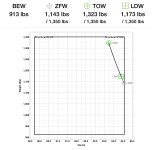
In any case, the forward CG limit is 59.7”. The rear limit is 64.6. My empty CG is 59.44. I have an IO320 with a Whirlwind 3 blade constant speed prop. I have an Odyssey PC680 battery mounted in the baggage compartment. Loaded with a 200# Pilot, 30 gallons of fuel and 30# in the baggage compartment, I’m at 63.7” at takeoff and 64.4” on landing with 5 gallons of fuel.

You can see that there’s room to move the CG forward a bit, but not much aft. At some point, I’m considering switching to an EarthX battery moved toward the front of the aircraft… possibly the tunnel between the rudder pedals.

IMG_2734.jpeg
 
The O-320 3B I fly could definitely do with some weight off the nose; in the approach configuration the aircraft needs full nose-up elevator trim and will still pitch down if you let go of the stick.

I have some(but much less) experience flying an O-235 powered 3B. This feels noticeably lighter on the nose(if anything a slightly more forward CG would be better for it) but lacks some of the climb and upper cruise speed that the 320 variant has.

An O-320 with a lithium battery, PMags, lightweight flywheel and a lightweight Monkworkz generator would all help the CG move aft but they all cost money!
Might want to check the HS for shims or to many shims and where the trim tab is at, when at cruise flight.
mg
 
Okay—so it should be possible to install this engine without any CG problems and play with battery position to aim for a suitable empty CG.
Many thanks to everyone for the information.
 
If I was doing this from scratch I would put the battery up against the firewall with an O-235 in it.

Ed Hicks has a O-235 RV3B, and from memory his battery is up against the firewall. Ed might want to chime in here?

Thanks Rob… yes, my -3B has an O-235 C2A with a wood prop. A PC680 battery is mounted lengthways between the rudder pedals.

Empty CofG is 59.6 inches aft of datum. Aircraft weighs 756lbs empty.

My other -3B that I own with RVJL who posted above, has an O-320 D2A with a wood prop. A PC680 is mounted transversely in front of the main spar carry through. Empty CofG is 58.4 inches aft of datum. Aircraft weighs 832lbs empty.
 
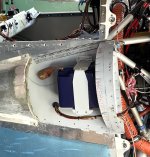
Here's where I decided to mount an EarthX ETX680C battery. I don't think any of their others, unless they are considerably smaller, will fit. The hatch is currently off because I'm still building and working in that area. No CG yet.

The bottom hinge will get riveted. Not shown, there's a vent hole in the aft end of the cowl cheek extension in case the battery ever vents out.

Battery.jpeg

Dave
 
  • Like
Reactions: EdH
I am currently building an RV3B and would like to install the UL-Power 390iS engine. This engine is about 44 lbs (20 kg) lighter than a Lycoming O-320 but about as heavy as an O-235 or O-290 engine.
Ranier, I would suggest some checking in what you believe the difference is in the weights of the Lycoming O-235 vs the O-320.

The O-320 D2A is 255lbs, the O-235 C2A is 242lbs - that's only a 13lb difference, not the 44lbs in your assessment.

I just looked, and the UL Power 390iS is 100kg, or 220lbs.
 
Ranier, I would suggest some checking in what you believe the difference is in the weights of the Lycoming O-235 vs the O-320.

The O-320 D2A is 255lbs, the O-235 C2A is 242lbs - that's only a 13lb difference, not the 44lbs in your assessment.

I just looked, and the UL Power 390iS is 100kg, or 220lbs.
I’d look at the O-290.
 
Thanks Rob… yes, my -3B has an O-235 C2A with a wood prop. A PC680 battery is mounted lengthways between the rudder pedals.

Empty CofG is 59.6 inches aft of datum. Aircraft weighs 756lbs empty.

My other -3B that I own with RVJL who posted above, has an O-320 D2A with a wood prop. A PC680 is mounted transversely in front of the main spar carry through. Empty CofG is 58.4 inches aft of datum. Aircraft weighs 832lbs empty.
Thank you EdH
That are the figures I need to get a picture and calculate ...
 
  • Like
Reactions: EdH
Back
Top