I’m at that point in the Baffling chapter where they have you attach some fittings to three of the top case bolts. Where can I find the correct torque values for those bolts?
Thanks.
Thanks.




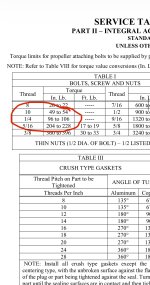
Ok I have to ask where did you get 75in lbs based on the table of limits for a 1/4 in bolt? Or even 90in lbs that a lot of engine builders use?75 inch pounds and please make sure you use new internal star /lock washers when you put everything back together. A lot of engine builders use 90 inch pounds and that is to overcome the resistance of turning the nut on lock washer to get close to the actual torque needed.
Lets not forget how old this document is and how general it is. IIRC, lyc wants grade 8 bolts in the case perimeter. The 8's are harder than the 5's or 3's or AN's and require higher torque values to reach the same clamping force; They are much harder and require more torque to stretch. IMO, there is not a one size fits all torque that can be generalized to thread pitch in today's world. Not saying its wrong to follow this table, but we should all understand how bolt material affects bolt stretch and therefore torque required. I have no idea what this table is based on, but suspect it is for grade 5 or possibly AN spec bolts. I believe AN bolts are pretty close in tensile strength to grade 5 and therefore have a similar stretch.Ok I have to ask where did you get 75in lbs based on the table of limits for a 1/4 in bolt? Or even 90in lbs that a lot of engine builders use?

Lets not forget how old this document is and how general it is.
Maybe I am passing along bad info about the grade 8's on the case. I suspect that "STD" means grade 5 or AN which are very similar, but have seen several posts here saying to use grade 8 on the case; Maybe that is folks making up specs and not following lyc specs. If lyc manual doesn't speify a different bolt type, I agree that the table applies. Just don't understand using the same torque spec for a 120K bolt and a 150K bolt, as the clamping forces would be different. Therefore must assume all the bolts specified by lyc, that don't have specific torque values, are of a similar strength/composition and those folks saying grade 8 on the case are wrong.Even though it’s old it’s still the manual. The parts listed in the parts catalog reference the bolts to use on the case parameter. The aviation mechanic handbook says the recommend torque spec on a 1/4-20 course thread in tension is 40-50 in lbs which is not the correct torque for the engine case. AC 43.13-1B On pg 7-9 says the same thing for this size bolt. But also not the manufacturer’s specification for the bolt torque.
The handbook also says any hardware used must be exactly what the manufacturer manual says which in this case for an O/IO-360 is STD-1414 (for some of the holes), a STD-8 washer, and a STD-160 internal teeth lock washer. Since there is no new revision of the table of limits (after 2020), I would stick to what it says. It may be taking into account the specific bolt and the lock washer used. The table of limits does not specify how they came up with their values.
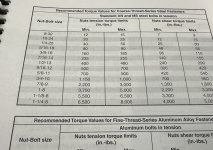
The attached below is just to show the different values listed in the aviation mechanic handbook and is identical to the FAA AC 43.13-1B. Not the torque values needed per the Lycoming Table of Limits referenced here on the above replys to the OP’s question.
Probably an old manual. If the new table limits say its ok then by all means. Been using that value for over 40 years and haven't had an engine leak or come apart yet.Ok I have to ask where did you get 75in lbs based on the table of limits for a 1/4 in bolt? Or even 90in lbs that a lot of engine builders use?
Yup, that’s me, a Mogollon Airpark resident. I’m hoping to schedule a breakfast/gas run to SJN for some of us next week. We always enjoy our visit to El Cupidos.96 inlb
Hey you are my neighbor too!! Mogollon airpark? I'm over in SJN.......holler at me and we'll go get some mexican