May 28, 2026 - Rethinking My Panel and Electrical System
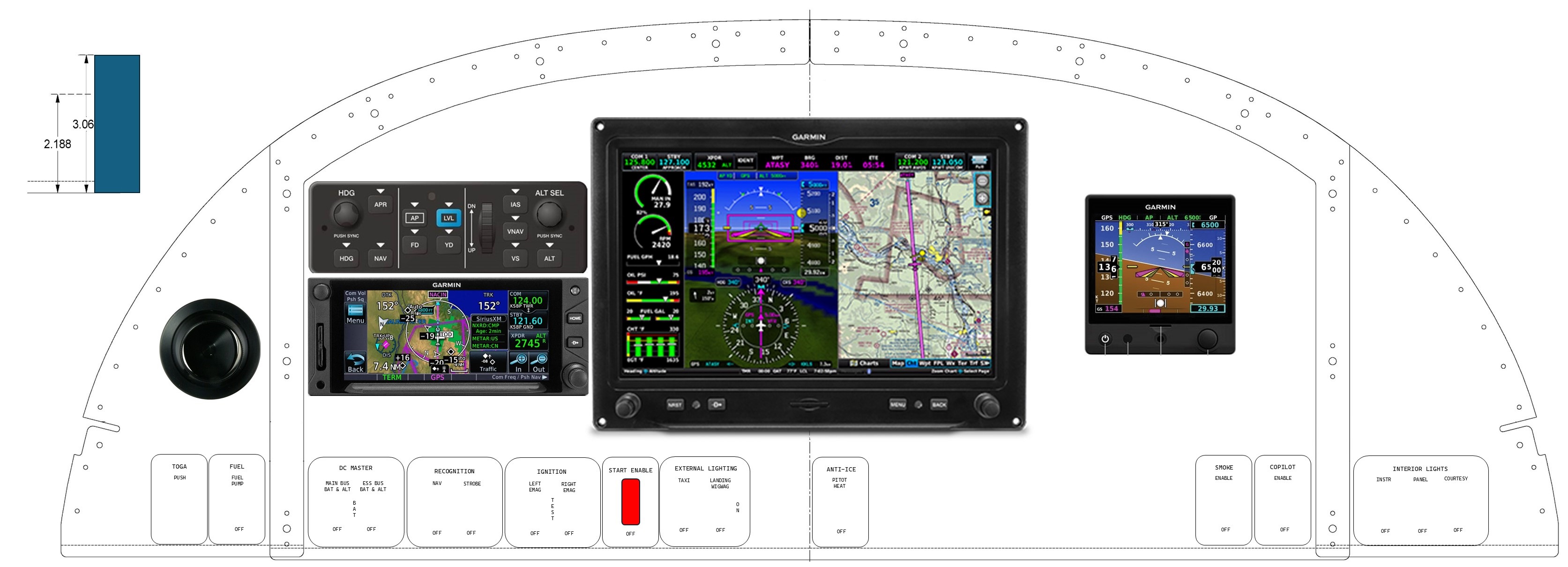
So I have a cockpit design page (upper left of the nav bar) and I'm using it as a "what's my current plan" page.
I had an update from Sep 21, 2025 that had a panel with most of the switches by the right and left hands (off the panel). Actually, it seems this latest export of my sandbox is labelled 3/11/26.
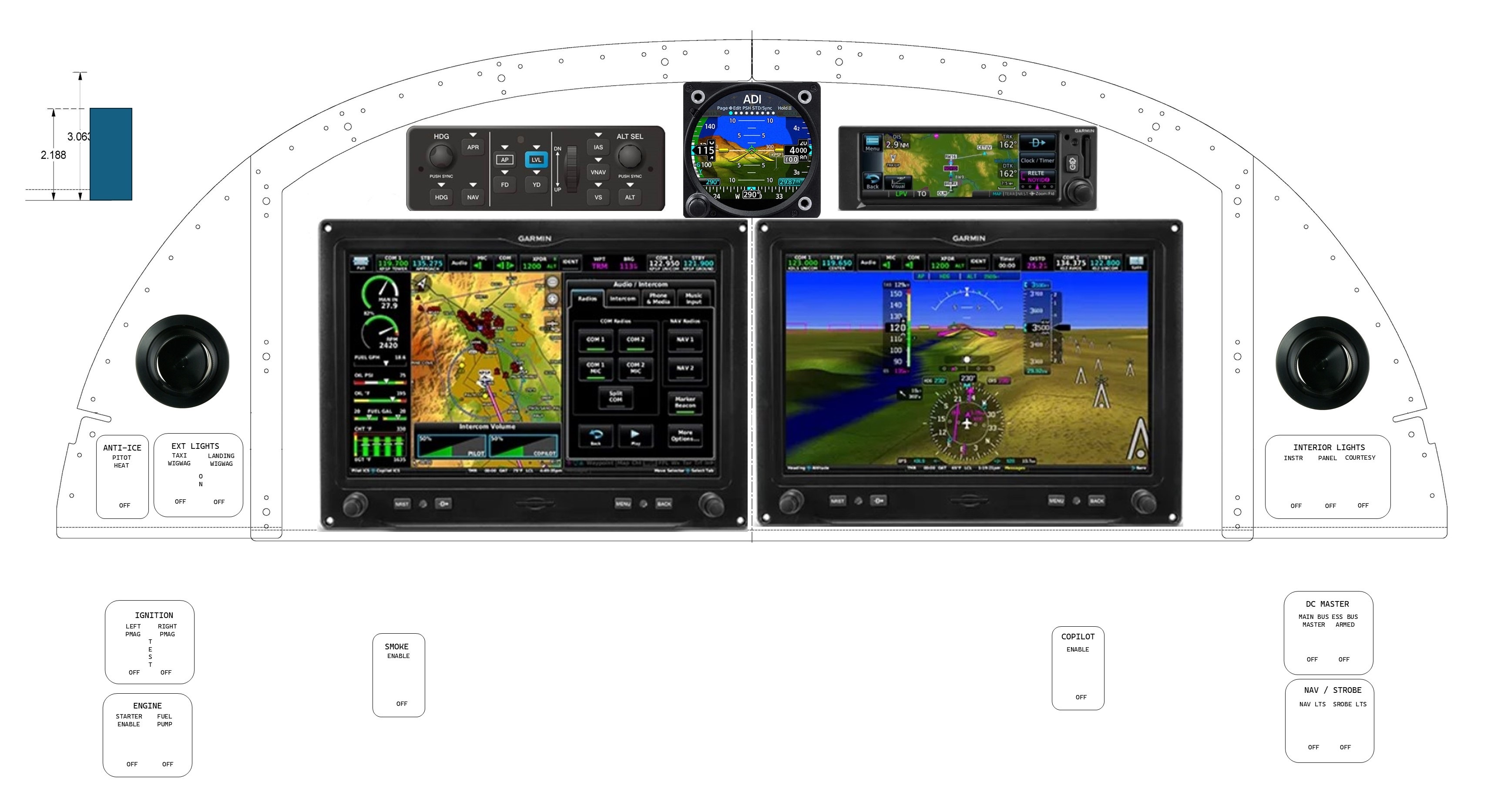
OBSOLETE, from MAR 11 2026
That looked cool, but recently I got to sit in an actual RV-8 while thinking about reachability and ergonomics.
The bottom line is that two big garmin screens is overkill. I should really do just one. Also, I think the switches at the bottom of the center instrument panel is going to be best, and also alleviates a alot of the right-hand left hand shenanigans.
So, I'm going to start over with the "philosophy essay" that I had saved in the cockpit design page, and then paste what I record here over onto that page again.
Here it goes:
So this post is about 15 years in the making (again). I spent a lot of time dreaming of how I was going to design the RV-7 panel while I was beginning its build, and when I restarted the RV-8 build, I decided to basically copy my previous thoughts and start from there.
To be honest, the copy-paste method works pretty well, my cockpit design philosophy hasn't changed much since I settled on a design back then, except I've noticed a lean towards simplicity.
Instrument Panel Philosophy
Glass panel
The first thing to point out is that I am going to have a glass panel airplane. I cannot find a reason to have vacuum powered steam gauges in my panel when the glass panel technology (and reliability) has advanced the way it has at the price point (approaching the same point as steam) it is reaching. You can get glass for the same price as steam. You can also get BIG GLASS for the price of a whole airplane.
After recently (May 2026) sitting in an actual RV-8, I am back to wanting to have a single PFD (configurable to display engine guages, a PFD, and a map). Also, I'm goign to need an IFR-capable GPS. Most of the “radio stack” boxes should now be built into the PFD suite. I’m currently looking at the Garmin g3x touch system, and the audio panel, NAV/COMs and Transponders are all remotely mounted. Well, shoot. It turns out that there is no remote NAV radio capability with the g3x, so I'd have to either have a separate NAVCOM radio, or use the GTN 650xi, which is almost $20k.)
My emphasis is going to be on a couple of general layout philosophies that will ultimately guide my design. Here they are.
First philosophy: Switches in Order of Use
Looking at my proposed before starting checklist, after I’ve done my preflight, briefed my passenger, gotten both of us squeezed into the seats, and I’m ready to start the engine, I’d like to start from one side of the panel, and make sure every switch is in the down position (there will be a few times when this isn’t appropriate but the “down” check should be standard).
Then, first turn on the battery (engine instrumentation, then set power controls, prime, strobes on (+Nav if it’s night), mags/PMAGS on, then engage the starter, Once the engine has started, check oil pressure, then turn the alternator on. Next, I’ll turn on any remaining equipment, get weather information, clearance, and taxi instructions, then it's time for the taxi light for visibility(night)/recognition(day) on the ground. Next, a runup, set flaps), then just before takeoff, I’ll flip on the landing lights (maybe wig wag, the name for alternating flashing lights), pitot heat (if IFR) and then the fuel pump for takeoff.
Send it!
In the RV-8 (tailwheel) it is prudent to hold the stick all the way back in your lap for start (although some point out this is unnecessary, why not do it?). So, any switch activations prior to start can be with your right hand on the right side of the panel, but any after start should be accessible with the left hand. Some, may need to be activated quickly with your hand on or near the throttle.
One possible switch layout based on that layout:
Before Start (Right (either) hand activation before stick-aft for start):
-Battery/Alternator
-Nav Lights
-Strobes
-Starter enable (assuming the starter is on stick grip)
-Magnetos
Post Start (left hand)
-Avionics
-Lights (Taxi, Landing, Wig-Wag)
-Pitot Heat
-Fuel Pump
I didn't forget about flaps...the flap switch is going to end up on the control stick.
If only it were that easy. This layout, and basic electrical system, has been used for many years on lots of certified airplanes, but why should I stick with a 50-year-old architecture (but Andrew, why change what works!?) when I am building a brand-new, high-tech, all-glass, airplane, right?
Bus Architecture
So, let’s come back to the “no vacuum pump” idea. With the IFR flying I’m going to be doing, I’d rather put a back-up alternator on the vacuum pad where the vacuum pump usually sits. These backup alternators are not belt-driven, but spline-driven, and come in a couple of different sizes. 8-Amp, 20-Amp, 30-Amp.
So how am I going to hook the backup alternator up electrically? Well, I’ve also read a lot about the endurance/essential/emergency bus idea.
The idea behind an e-bus is that when something bad happens to your main alternator (let’s assume for this discussion you only have one), then you can turn off your battery master (a fast way to “load shed”), and use an e-bus to leave on the items that are really required to continue the flight safely. Whether “continue” means “original destination” or “land when practicable” depends on how long your electrical system can support the load you need for continued safe flight and landing. If you have a good battery AND can load-shed enough (if you want this to be part of your emergency actions…some people frown on lots of load shedding actions during an emergency), a battery alone may provide enough power that fuel is now the limiting factor, and not electrons.
Now let’s introduce a backup alternator. With a backup alternator, you could conceivably load-shed below the alternator capacity and continue the flight indefinitely (well, until your fuel runs out).
The nice thing about an e-bus is that it allows quick load-shedding and a dual power path to some “can’t-live-without” goodies in your panel. If you recognize the alternator failure soon enough (annunciations, etc.) then you can load shed via switches. With a single bus, you have lots of load shedding to do. With two buses, you can load shed with a single "bus" switch.
So, let’s look at our options for bus architecture.
Option 1: Single Main Bus.
I can hook up the backup alternator with a regulator that only allows it to flow current if the bus falls below a certain voltage (aka, main alternator dies). All equipment is on the main bus (which means if there is a battery contactor failure, I’m “without paddle,” as they say).
Option 2: E-Bus
I could hook up the essential bus as a true endurance bus; only have the required equipment to continue the flight. The backup alternator could be fed field current from a hot battery bus (or the e-bus) and I could maybe isolate the two busses such that the main alternator is powering the main bus and the backup alternator is powering the essential bus all the time. A bus-tie contactor could be used to tie the two together so if I have a failure on one, I can save electrons until close to landing, then using bus-tie or the failed side’s master to re-energize that bus for all equipment. One of the AEC drawings has the main bus side always powering the endurance bus through a diode, and then an endurance bus alternate feed for when things start going badly. I really like this idea.
An older version of this essay introduced an Avionics Bus here, but I am no longer a fan of this. All my engine monitoring is needed for start. Let’s skip this one. Also, let's skip the two buses with an emergency bus for each of those buses. Too complicated.
WINNNER WINNER, CHICKEN EBUS!
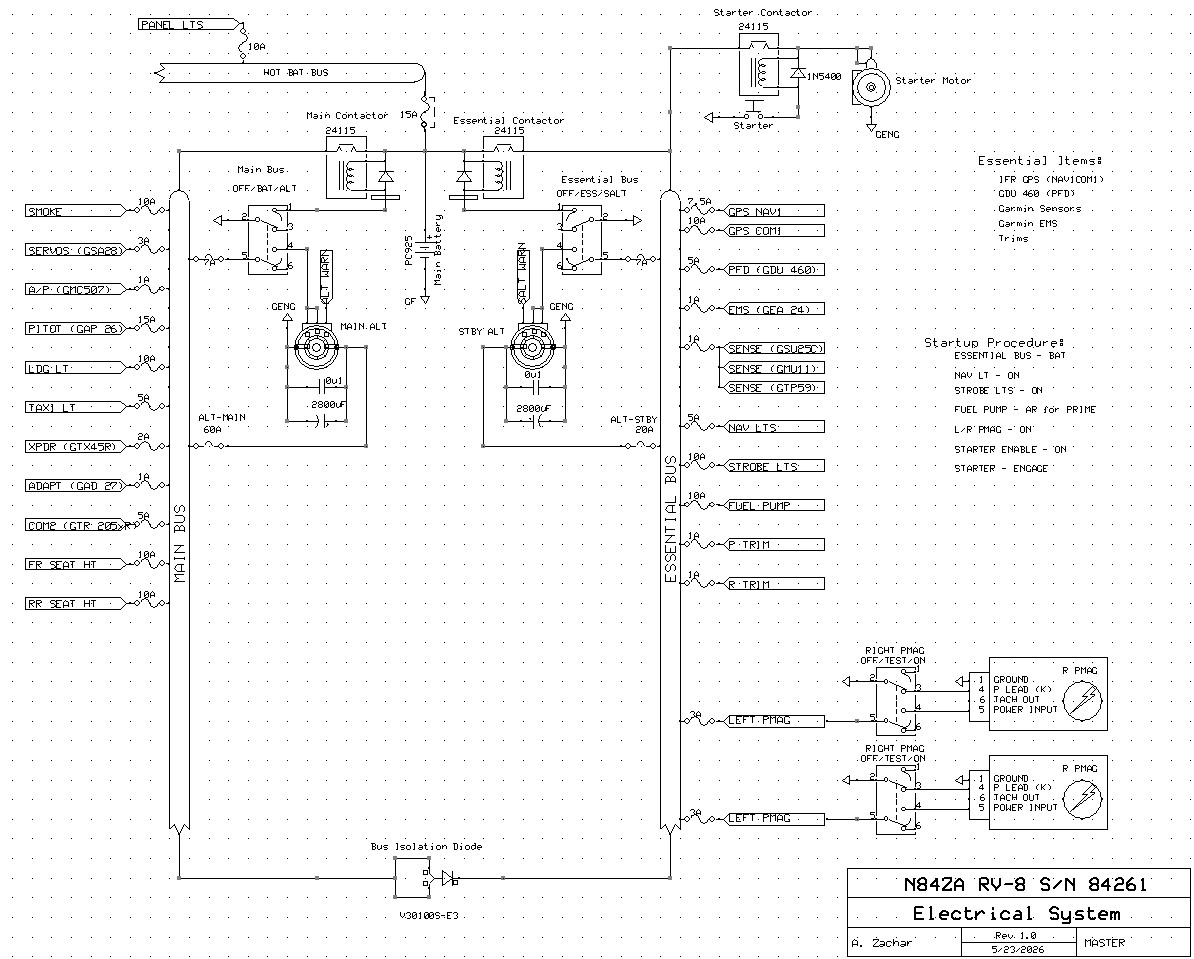
The latest, as of JUN 2026
So I have a cockpit design page (upper left of the nav bar) and I'm using it as a "what's my current plan" page.
I had an update from Sep 21, 2025 that had a panel with most of the switches by the right and left hands (off the panel). Actually, it seems this latest export of my sandbox is labelled 3/11/26.
OBSOLETE, from MAR 11 2026
That looked cool, but recently I got to sit in an actual RV-8 while thinking about reachability and ergonomics.
The bottom line is that two big garmin screens is overkill. I should really do just one. Also, I think the switches at the bottom of the center instrument panel is going to be best, and also alleviates a alot of the right-hand left hand shenanigans.
So, I'm going to start over with the "philosophy essay" that I had saved in the cockpit design page, and then paste what I record here over onto that page again.
Here it goes:
So this post is about 15 years in the making (again). I spent a lot of time dreaming of how I was going to design the RV-7 panel while I was beginning its build, and when I restarted the RV-8 build, I decided to basically copy my previous thoughts and start from there.
To be honest, the copy-paste method works pretty well, my cockpit design philosophy hasn't changed much since I settled on a design back then, except I've noticed a lean towards simplicity.
Instrument Panel Philosophy
Glass panel
The first thing to point out is that I am going to have a glass panel airplane. I cannot find a reason to have vacuum powered steam gauges in my panel when the glass panel technology (and reliability) has advanced the way it has at the price point (approaching the same point as steam) it is reaching. You can get glass for the same price as steam. You can also get BIG GLASS for the price of a whole airplane.
After recently (May 2026) sitting in an actual RV-8, I am back to wanting to have a single PFD (configurable to display engine guages, a PFD, and a map). Also, I'm goign to need an IFR-capable GPS. Most of the “radio stack” boxes should now be built into the PFD suite. I’m currently looking at the Garmin g3x touch system, and the audio panel, NAV/COMs and Transponders are all remotely mounted. Well, shoot. It turns out that there is no remote NAV radio capability with the g3x, so I'd have to either have a separate NAVCOM radio, or use the GTN 650xi, which is almost $20k.)
My emphasis is going to be on a couple of general layout philosophies that will ultimately guide my design. Here they are.
First philosophy: Switches in Order of Use
Looking at my proposed before starting checklist, after I’ve done my preflight, briefed my passenger, gotten both of us squeezed into the seats, and I’m ready to start the engine, I’d like to start from one side of the panel, and make sure every switch is in the down position (there will be a few times when this isn’t appropriate but the “down” check should be standard).
Then, first turn on the battery (engine instrumentation, then set power controls, prime, strobes on (+Nav if it’s night), mags/PMAGS on, then engage the starter, Once the engine has started, check oil pressure, then turn the alternator on. Next, I’ll turn on any remaining equipment, get weather information, clearance, and taxi instructions, then it's time for the taxi light for visibility(night)/recognition(day) on the ground. Next, a runup, set flaps), then just before takeoff, I’ll flip on the landing lights (maybe wig wag, the name for alternating flashing lights), pitot heat (if IFR) and then the fuel pump for takeoff.
Send it!
In the RV-8 (tailwheel) it is prudent to hold the stick all the way back in your lap for start (although some point out this is unnecessary, why not do it?). So, any switch activations prior to start can be with your right hand on the right side of the panel, but any after start should be accessible with the left hand. Some, may need to be activated quickly with your hand on or near the throttle.
One possible switch layout based on that layout:
Before Start (Right (either) hand activation before stick-aft for start):
-Battery/Alternator
-Nav Lights
-Strobes
-Starter enable (assuming the starter is on stick grip)
-Magnetos
Post Start (left hand)
-Avionics
-Lights (Taxi, Landing, Wig-Wag)
-Pitot Heat
-Fuel Pump
I didn't forget about flaps...the flap switch is going to end up on the control stick.
If only it were that easy. This layout, and basic electrical system, has been used for many years on lots of certified airplanes, but why should I stick with a 50-year-old architecture (but Andrew, why change what works!?) when I am building a brand-new, high-tech, all-glass, airplane, right?
Bus Architecture
So, let’s come back to the “no vacuum pump” idea. With the IFR flying I’m going to be doing, I’d rather put a back-up alternator on the vacuum pad where the vacuum pump usually sits. These backup alternators are not belt-driven, but spline-driven, and come in a couple of different sizes. 8-Amp, 20-Amp, 30-Amp.
So how am I going to hook the backup alternator up electrically? Well, I’ve also read a lot about the endurance/essential/emergency bus idea.
The idea behind an e-bus is that when something bad happens to your main alternator (let’s assume for this discussion you only have one), then you can turn off your battery master (a fast way to “load shed”), and use an e-bus to leave on the items that are really required to continue the flight safely. Whether “continue” means “original destination” or “land when practicable” depends on how long your electrical system can support the load you need for continued safe flight and landing. If you have a good battery AND can load-shed enough (if you want this to be part of your emergency actions…some people frown on lots of load shedding actions during an emergency), a battery alone may provide enough power that fuel is now the limiting factor, and not electrons.
Now let’s introduce a backup alternator. With a backup alternator, you could conceivably load-shed below the alternator capacity and continue the flight indefinitely (well, until your fuel runs out).
The nice thing about an e-bus is that it allows quick load-shedding and a dual power path to some “can’t-live-without” goodies in your panel. If you recognize the alternator failure soon enough (annunciations, etc.) then you can load shed via switches. With a single bus, you have lots of load shedding to do. With two buses, you can load shed with a single "bus" switch.
So, let’s look at our options for bus architecture.
Option 1: Single Main Bus.
I can hook up the backup alternator with a regulator that only allows it to flow current if the bus falls below a certain voltage (aka, main alternator dies). All equipment is on the main bus (which means if there is a battery contactor failure, I’m “without paddle,” as they say).
Option 2: E-Bus
I could hook up the essential bus as a true endurance bus; only have the required equipment to continue the flight. The backup alternator could be fed field current from a hot battery bus (or the e-bus) and I could maybe isolate the two busses such that the main alternator is powering the main bus and the backup alternator is powering the essential bus all the time. A bus-tie contactor could be used to tie the two together so if I have a failure on one, I can save electrons until close to landing, then using bus-tie or the failed side’s master to re-energize that bus for all equipment. One of the AEC drawings has the main bus side always powering the endurance bus through a diode, and then an endurance bus alternate feed for when things start going badly. I really like this idea.
An older version of this essay introduced an Avionics Bus here, but I am no longer a fan of this. All my engine monitoring is needed for start. Let’s skip this one. Also, let's skip the two buses with an emergency bus for each of those buses. Too complicated.
WINNNER WINNER, CHICKEN EBUS!
The latest, as of JUN 2026
Last edited: