Van's Air Force

The definitive Van's Aircraft support community! Buying, building or flying an RV? Join our exclusive family of mentors and enthusiasts!

Boeing Quick Change System - I’m Hooked!

Ironflight

VAF Moderator / Line Boy
Mentor
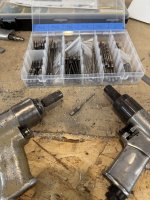
Many years ago, there was a great vendor at the SnF FlyMart hangar that sold drill bits. Many of them had this strange base - cylindrical, a little more than a quarter inch in diameter, with dimples in it. They chucked up fine in a regular drill, and I have used them that way for years (bigger drills, mostly), but I never really looked in to what they were. Well our friend David Howe showed me the system at his shop - the Boeing Quick Change chucks - but I held off converting because it seemed sort of an expensive way to go. I finally succumbed however, and now I am changing (almost) everything in the shop! Hint if you go this way - Ebay is your friend….. you can buy lots of #40, #30, #20, #10, and 1/4” bits, as well as the chucks for reasonable prices.

For years, I have kept one drill set up with a #40, and one with a #30 - and kept an electric drill with a friction chuck handy for all the other sizes. But with the Quick change, it is so fast and easy to swap bits that I’m change all the pneumatics to those.

I still have to convert my countersink cages and a few other specialized things - and you do still need to keep a regular chuck drill around for oddballs like #21, #27, #19…. But these will do for the acreage drilling!

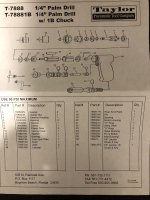
(Now if anyone can tell me how to get the regular chuck off of our Taylor palm drill…..)

Absolutely a “First world luxury item”, admittedly!!
IMG_7562.jpeg
 
(Now if anyone can tell me how to get the regular chuck off of our Taylor palm drill…..)

Open the chuck all the way and look for a screw in the middle. If there is one there it's probably left handed. Remove if present. Then use a set of drill chuck wedges to press off the chuck. They can be a real bear to get off..
 
Last edited:
Open the chuck all the way and look for a screw in the middle. If there is one there it's probably left handed. Remove if present. Then use a set of drill chuck wedges to press off the chuck. They can be a real bear to get off..
That’s exactly what I did (less the wedges….) on one of my other drills…the Taylor has no lock screw, and I can’t figure out how to stop the chuck from moving….because I don’t know what chuck wedges are? 🤣

Off to Google chuck wedges I guess……😉
 
I've done it a bunch....Put the drill in a vise with wood blocks. Chuck up the biggest allen wrench that fits (3/8" or so) with the short end in the chuck. Rotate so the long end is horizontal, Give the long end a fast "whack" with a medium ball peen hammer in CC direction. I have never had this procedure fail..let me kow your results!!
 
I've done it a bunch....Put the drill in a vise with wood blocks. Chuck up the biggest allen wrench that fits (3/8" or so) with the short end in the chuck. Rotate so the long end is horizontal, Give the long end a fast "whack" with a medium ball peen hammer in CC direction. I have never had this procedure fail..let me kow your results!!
Well I tried that….with the drill body in the vice, and the Allen wrench in the chuck, the Allen wrench just drops down to vertical - gravity gradient takes over….seems like I need to keep the drill spindle from turning for the “whack” to work. Yeah, I gave it a whack with the Allen hanging vertical, and it just spins merrily around a few times….

I have to be missing something obvious, because your instructions agree with many I have read!
 
Update!! Bill - your technique worked perfectly with my Souix drill! It might be that the Taylor Palm Drill is just so worn out (or small) that there isn’t enough resistance….

(And of course, working on tools keeps me from having to continue trimming baffles and fiberglassing the cowl details….. which I SHOULD be doing….)
 
That’s exactly what I did (less the wedges….) on one of my other drills…the Taylor has no lock screw, and I can’t figure out how to stop the chuck from moving….because I don’t know what chuck wedges are? 🤣

Off to Google chuck wedges I guess……😉
Yeah sorry I got a couple techniques mixed up. It's been a while..

Drill chucks can either be threaded on or press fit. If you have the screw it's probably a screw on and can be removed with the allen wrench trick. If it doesn't it's probably the press fit and needs the wedges.
 
Yeah sorry I got a couple techniques mixed up. It's been a while..

Drill chucks can either be threaded on or press fit. If you have the screw it's probably a screw on and can be removed with the allen wrench trick. If it doesn't it's probably the press fit and needs the wedges.
The Taylor's are 3/8 - 24 NF (ask me how I know). I am not familiar with any of the smaller hand drills generally used in our "business" that use a Morse Taper for a friction fit of chuck to quill - drill presses yes, drill motors no (I don't think, at least for smaller drills under 3/4").
 
You may also see them sold as "Magnavon" chucks and bits. I think they were the original manufacturers.

As well as drill bits, some places sell things like microstop cages with quick change shanks. Also, quick change adapters for jobber bits are widely available. I find the adapters useful for straight flute chucking reamers, and for some of the odder drill sizes.
 
Many years ago, there was a great vendor at the SnF FlyMart hangar that sold drill bits. Many of them had this strange base - cylindrical, a little more than a quarter inch in diameter, with dimples in it. They chucked up fine in a regular drill, and I have used them that way for years (bigger drills, mostly), but I never really looked in to what they were. Well our friend David Howe showed me the system at his shop - the Boeing Quick Change chucks - but I held off converting because it seemed sort of an expensive way to go. I finally succumbed however, and now I am changing (almost) everything in the shop! Hint if you go this way - Ebay is your friend….. you can buy lots of #40, #30, #20, #10, and 1/4” bits, as well as the chucks for reasonable prices.

For years, I have kept one drill set up with a #40, and one with a #30 - and kept an electric drill with a friction chuck handy for all the other sizes. But with the Quick change, it is so fast and easy to swap bits that I’m change all the pneumatics to those.

I still have to convert my countersink cages and a few other specialized things - and you do still need to keep a regular chuck drill around for oddballs like #21, #27, #19…. But these will do for the acreage drilling!

(Now if anyone can tell me how to get the regular chuck off of our Taylor palm drill…..)

Absolutely a “First world luxury item”, admittedly!!


They look amazing !

Darn Paul,
That is such a cruel post for all the "Tool Freaks" on this site! ( I am one of them)

I immediately searched Ebay, nothing but stray drill bits and reamers.

I need better "friends" that can feed my habit! 😀
 
The Taylor's are 3/8 - 24 NF (ask me how I know). I am not familiar with any of the smaller hand drills generally used in our "business" that use a Morse Taper for a friction fit of chuck to quill - drill presses yes, drill motors no (I don't think, at least for smaller drills under 3/4").
Ahh thanks for the info. I have to admit the last drill chuck I changed was on a drill press.
 
I've done it a bunch....Put the drill in a vise with wood blocks. Chuck up the biggest allen wrench that fits (3/8" or so) with the short end in the chuck. Rotate so the long end is horizontal, Give the long end a fast "whack" with a medium ball peen hammer in CC direction. I have never had this procedure fail..let me kow your results!!
Bill - great example of using Impulse in the true Physics sense of the term, which I am sure Paul knows from his Orbital Mechanics driving space shuttles around.

Great example of a Real World™ application of what we learn in school that magically actually works. Despite all my schooling, my farmer brother in law (shout out to Uncle Rex) schooled me in impulse years ago when I couldn't get a nut off and he put a crescent wrench on it and pinged it once with a hammer - BAM it was loose!

Once you see it in action you never forget. You can teach your kids all day from the books but the light goes on (for me included) when you finally see the trick put to practical use.
 
I was lucky enough to live near Boeing and their surplus outlet where they sold all manner of used aviation tools and supplies. Sadly it's closed now, but they do have some online stores. Not the same as being able to put your hands on used equipment before buying it.
 
I was lucky enough to live near Boeing and their surplus outlet where they sold all manner of used aviation tools and supplies. Sadly it's closed now, but they do have some online stores. Not the same as being able to put your hands on used equipment before buying it.
eBay is still listing two suppliers for the Magnavon QC coupler ...
 
I have one primary drill and I have used the Boeing quick change system on that drill. I used to have an adapter that could be screwed into a standard chuck. I have adapters for the standard #40 & #30 drills, but for non-standard size drills I just snapped in my regular chuck. Unfortunately the adapter wore out and even after searching far and wide I couldn't find a replacement. Now I have to use my backup Taylor drill which still has a regular chuck.
 
I have one primary drill and I have used the Boeing quick change system on that drill. I used to have an adapter that could be screwed into a standard chuck. I have adapters for the standard #40 & #30 drills, but for non-standard size drills I just snapped in my regular chuck. Unfortunately the adapter wore out and even after searching far and wide I couldn't find a replacement. Now I have to use my backup Taylor drill which still has a regular chuck.
It's real easy to make an adapter from the QC style x 3/8 - 24 NF of the removed chuck, so when the chuck is needed for oddball sized drills you just install it like all the other drill bits with QC shanks ...
 

Attachments

  • QC Adapter For Drill Chuck.jpg
    QC Adapter For Drill Chuck.jpg
    1.2 MB · Views: 22
It's really mostly about convenience and not having such a big keyed chuck in the way, and having to use the key all the time ...
Yes, when drilling flanges near webs the smaller diameter makes a big difference
 
I have one primary drill and I have used the Boeing quick change system on that drill. I used to have an adapter that could be screwed into a standard chuck. I have adapters for the standard #40 & #30 drills, but for non-standard size drills I just snapped in my regular chuck. Unfortunately the adapter wore out and even after searching far and wide I couldn't find a replacement. Now I have to use my backup Taylor drill which still has a regular chuck.
Re/“non-standard” drill sizes, I make my own Magnavon type QC blanks, then counterbore them to the desired size, align them in a fixture (DIY) and silver braze the drill shank into the QC socket - then mark & color code them to insure segregation from their more mundane “brothers”.

I probably have 20 or more of the specialty sizes …

HFS
 
back in the day, before boeing closed the surplus store, you use to be able to buy the drills and chucks for pennies on the dollar there. i still have a bunch of them I bought there.
 
Hello, I have been using the quick change tooling since I started. Love them. I went a little different way. Yard Store sells Boeing quick change Collets. For example, the standard countersinks use a 1/4 collet. Yard Store sells them for $5.00 https://www.yardstore.com/collet-1-4-with-quick-change-shaft-used or a 5 pack https://www.yardstore.com/5-piece-collet-1-4-with-5-16-quick-change-shaft-used. These 1/4 inch Quick Change and use the OW collet to fit all various sizes of bits. I bought the collets in the popular sizes from

For example I purchased the following to fit into the 1/4 inch quick change collet from Yard Store

Collet, Double Taper OW #19 for 1/4 Quick change
Collet, Double Taper OW #27 for 1/4 Quick change
Collet, Double Taper OW #10 for 1/4 Quick change
Collet, Double Taper OW #12 for 1/4 Quick change
Collet, Double Taper OW #21 for 1/4 Quick change
Collet, Double Taper OW #30 for 1/4 Quick change
Collet, Double Taper OW #40 for 1/4 Quick change
Collet, Double Taper OW #12 for 1/4 Quick change

Each different sized drill just uses a different sized collet. This allows me to use standard drill bits and just installe them in the properly sized collet. when that bit dulls, just replace the bit.

Ebay has them. https://ebay.us/m/APC8bD this is one example.

Enjoy.
 
Back
Top