Van's Air Force

The definitive Van's Aircraft support community! Buying, building or flying an RV? Join our exclusive family of mentors and enthusiasts!

Benchmarking oil temperature on RV-14A with Lycoming 390 EXP

Estevanb

Well Known Member
Sponsor
Hi all,

I'm on my second flight, getting used to my airplane temperatures, and trying to understand what will be its "normal" temperatures. Would like to ask other RV-14/EXP390 owners to share what are the average CHT and oil temperatures you are observing with cowl flaps open and closed. Mine are in the range of 320-360 CHT and 190-215 oil temp (cowl flap open-close).

I am unsure if my oil temp is high because the engine is still breaking in or if I have to troubleshoot something else.

Thanks!
 
This will largely will be dependent on the OAT. Your numbers are pretty much about average for a RV14, maybe a little on the higher side due to being not completely broken in.
My CHTs run about 300-320 and 180-185F in cruise at OAT of a 45-50F and 345-355, 200 oil at 75-80F OAT
 
I hardly close my cowl door in cruise, and it is open at all times in the summer here in the ATL area. But then again this will be my first winter of flying my -14. I have 130 hours on my new 390 and your numbers look pretty close to mine. Flying PNS-ATL yesterday at 9500, WOT / 2400 rpm / MP21.8, my oil temp was 185, CHTs in the 300-320 range. OAT was 45F. TAS 178kts
 
This will largely will be dependent on the OAT. Your numbers are pretty much about average for a RV14, maybe a little on the higher side due to being not completely broken in.
My CHTs run about 300-320 and 180-185F in cruise at OAT of a 45-50F and 345-355, 200 oil at 75-80F OAT
Thanks! This is really helpful. I could see that variation due to OAT as well. Unfortunately to me, Florida weather, doesn't help much. :)
 
I hardly close my cowl door in cruise, and it is open at all times in the summer here in the ATL area. But then again this will be my first winter of flying my -14. I have 130 hours on my new 390 and your numbers look pretty close to mine. Flying PNS-ATL yesterday at 9500, WOT / 2400 rpm / MP21.8, my oil temp was 185, CHTs in the 300-320 range. OAT was 45F. TAS 178kts
I am currently flying with cowl flap open all the time. But I was kind of unhappy with CHT temps dropping because of that. I wish I could make CHT temps higher and Oil temp lower. (Thinking about CHT temp being ideal at 380F)
 
I am currently flying with cowl flap open all the time. But I was kind of unhappy with CHT temps dropping because of that. I wish I could make CHT temps higher and Oil temp lower. (Thinking about CHT temp being ideal at 380F)
There are ways to improve and accomplish what you want but at this point, I suggest to keep things as they are since it is not an issue the engine is well broken in and temps have stabilized. As far as I am concerned, CHT of 300-350 range is of no issues but opinions vary on that. With the 14A, the challenge is the oil temp on specially on hot day.
 
Hi all,

I'm on my second flight, getting used to my airplane temperatures, and trying to understand what will be its "normal" temperatures. Would like to ask other RV-14/EXP390 owners to share what are the average CHT and oil temperatures you are observing with cowl flaps open and closed. Mine are in the range of 320-360 CHT and 190-215 oil temp (cowl flap open-close).

I am unsure if my oil temp is high because the engine is still breaking in or if I have to troubleshoot something else.

Thanks!
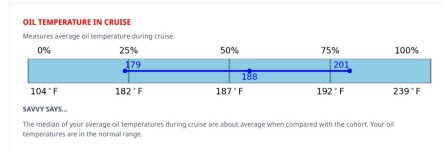
My oil temps did not change much after the third flight (Was lucky to break in Fall in Ohio) Below now temps in Florida compared to fleet averages. Mine 188 F (Florida now, last 300 hrs.), fleet average 187 F. CHT's came down first 20 hrs. but OT about the same.


Screenshot 2024-11-25 185928.jpg
 
Not an RV14, but I have a IO-390 in my RV7 with a 13 row oil cooler on the firewall fed by a length of 4" skeet coming off the baffle behind #4. No cowl flaps, air flow is what it is.

My first few flights were in the summer here in KS. At 75% power (25/25) and mixture slobbering rich, the oil temp in cruise was always almost exactly 140*f more than whatever ambient was. Example; OAT 70*f = OT 210, OAT 80*f = OT 220*f,

I've now got about 25 hours on it. The fall temps have dropped which obviously helps, but the OT no longer seems as married to OAT as when I started flying. At this point I can lean to 12.5 gph and in cruise it has settled down to OT of 195 with OAT anywhere between 40-70*f . I suspect it will come down a bit more once it's fully broken in.

You probably already know this, but Lycoming says that break in on the 390 may take as much as 50 hours. CHT's have never been high on my engine and are currently about 300-325*f at 75% power, but it's still burning about a quart every 2-3 hours. That seems to indicate that there's probably still quite a bit of friction heat being generated in the cylinders as the rings and cylinder walls continue to try to find their happy place, and that heat is being carried away in the oil.

I suggest the same advice that was given to me; Keep running it. You don't know if you have a problem until everything stabilizes and on this engine it will take a while.
 
Thanks! Makes a lot of sense. I will keep breaking it in and now I am less worried about it because looks like I am not an odd case. Why I am reading on the posts seems similar to what I am experiencing.

Thanks guys
 
Hi all,

I'm on my second flight, getting used to my airplane temperatures, and trying to understand what will be its "normal" temperatures. Would like to ask other RV-14/EXP390 owners to share what are the average CHT and oil temperatures you are observing with cowl flaps open and closed. Mine are in the range of 320-360 CHT and 190-215 oil temp (cowl flap open-close).

I am unsure if my oil temp is high because the engine is still breaking in or if I have to troubleshoot something else.

Thanks!
I'm just now out of phase 1 and have a bit over 50 hours on my EXP. My cylinder head temperatures never got over 400, even in August here in New Mexico, and came down very quickly after only about 2 hours or so. Now they typically run anywhere around 340-370, which I think is about right for scavenging lead out of the fuel. Personally I wouldn't want to run in the low 300's for that reason.
My problem, like many others has been high oil temperatures, not CHT. My early flights were just under redline, ~225F, but slowly came down during phase 1. After more than 45 hours it was just hovering over 190F on most flights. That's at about 23" MAP because I was running it as hard as I could for break-in. That's REALLY hard to do (not possible, actually) when your home field elevation is 6200 feet. I was having to fly at pattern altitude everywhere inside my test area, and even then the best MAP was only about 23". Also, I alternated between running flat out at 2700 and cruise rpm of 2450.
I switched from mineral oil to Phillips XC 20W-50 at 50 hours and that brought the temps down another few degrees so I'm finally running in the green (180-190F) when in level flight.
I've found that the oil temps rise quickly, and above the green range while in climb, but drop slowly after leveling off. I've also found that the oil temps are sensitive to rpm, and runs cooler at cruise RPM (2450) compared to 2700. I've never been able to fly with the cowl flap completely closed yet, but in recent flights I'm able to close it about halfway and still stay in the green.
Bottom line is that high oil temperatures anecdotally appear common during break-in on these engines. Don't be too eager to switch from mineral oil to a synthetic either because continuing the break-in is the only thing that will eventually bring the temperatures down. At least that is what I experienced. Perhaps those closer to sea level will have a different experience.
 
I'm just now out of phase 1 and have a bit over 50 hours on my EXP. My cylinder head temperatures never got over 400, even in August here in New Mexico, and came down very quickly after only about 2 hours or so. Now they typically run anywhere around 340-370, which I think is about right for scavenging lead out of the fuel. Personally I wouldn't want to run in the low 300's for that reason.
My problem, like many others has been high oil temperatures, not CHT. My early flights were just under redline, ~225F, but slowly came down during phase 1. After more than 45 hours it was just hovering over 190F on most flights. That's at about 23" MAP because I was running it as hard as I could for break-in. That's REALLY hard to do (not possible, actually) when your home field elevation is 6200 feet. I was having to fly at pattern altitude everywhere inside my test area, and even then the best MAP was only about 23". Also, I alternated between running flat out at 2700 and cruise rpm of 2450.
I switched from mineral oil to Phillips XC 20W-50 at 50 hours and that brought the temps down another few degrees so I'm finally running in the green (180-190F) when in level flight.
I've found that the oil temps rise quickly, and above the green range while in climb, but drop slowly after leveling off. I've also found that the oil temps are sensitive to rpm, and runs cooler at cruise RPM (2450) compared to 2700. I've never been able to fly with the cowl flap completely closed yet, but in recent flights I'm able to close it about halfway and still stay in the green.
Bottom line is that high oil temperatures anecdotally appear common during break-in on these engines. Don't be too eager to switch from mineral oil to a synthetic either because continuing the break-in is the only thing that will eventually bring the temperatures down. At least that is what I experienced. Perhaps those closer to sea level will have a different experience.
Thanks for sharing your experience @asw20c ! You are describing exactly what is going on with me. Looks like it is pretty much standard behavior for this initial break in. I have just completed 6 hours and I already have oil temp below 200 and "cool CHTs". I also can't close cowling flap yet. Oil temp quickly increases to 200+.
 
Thanks for sharing your experience @asw20c ! You are describing exactly what is going on with me. Looks like it is pretty much standard behavior for this initial break in. I have just completed 6 hours and I already have oil temp below 200 and "cool CHTs". I also can't close cowling flap yet. Oil temp quickly increases to 200+.
Yup. And you may also find that oil temps start to rise again when doing a long RNAV approach. Here, one of the approaches to my home field has a hold in lieu of a procedure turn so if you fly that, plus the approach while slowed to about 90 kts, the temps start to rise again even though you are at a much lower power setting. Getting that ram air into the cowling makes a difference.
 
George, a bit off topic, but I noticed on this flight you don't quite hit full governed RPM (max was 2680). Is that with the pitch stop RPM set at 2650?
I probably didn't have the prop fully in. We're setup for static RPM at 2650 or so, and by liftoff we're at 2700 even.
 
Interesting thread. Like others above, I too am wondering about break-in temps, fuel flow, oil, usage, etc. I thought I'd add another data point(s).

In my case, my engine really never has used much oil....at least not what I expected. I added 1/2 quart after about 3 hours. After 6 hours I wasn't really sure if I needed to add, but added 8 oz.

It appears that my CHT's are OK, but like some others, I never saw high temps. I have several questions:

1) I wonder what IS peak CHT on this engine?
2) When the engine is broken in (maybe at this point it is....or at least close), what should I be running for fuel flow since I don't know peak?
3) I ran at 11.9 gph at 76% yesterday for 9 minutes got the highest temps I've seen in cruise(of course), not sure if this is OK?

Engine: IO-390 EXP 210 HP (not the 215 HP EXP 119)

Note: Highest CHT I've seen is on #1 on the first flight 377 degrees at 16 gph for less than 1 minute then started to come down after that. By the end of the flight (in cruise), CHT on the #1 was in the 340's with 24.2" MP, 2550 RPM, 13.2 fuel flow. Not much has changed since.

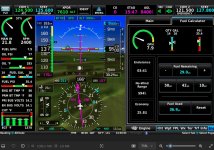
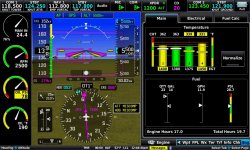
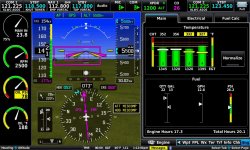
Screen shots below and wondering if anything stands out to anybody:

Screen Shot of Second Flight Below (forgot to take shots on first flight):

Second Flight.jpg

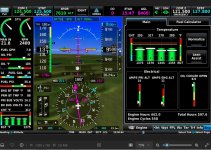
A couple of shots from yesterday. First one is when I leaned to 11.9 for 9 minutes.

11.9 GPH.jpg

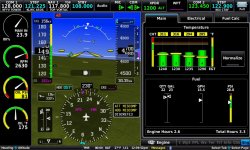
Screen shot below is where I spent most of the day in cruise 12.5 - 13 gph:

12.8 gph.jpg
 
Last edited:
Your data looks good to me. Those CHTs are very good. Consider redline 420 or so, and actionable at around 400.
 
I suggest to a few GAMI spread runs. I’d guess your spread is over a gallon per hour right now. A couple of injector changes and you should be in the ball park. Send the EMS data to Don Rivera at AirFlow performance and he can recommend the replacement nozzle sizes (he sells them for a very reasonable price).

Carl
 
Just stating the obvious but needs to be said. We built an RV14A with the 390 210 and installed per spec. At first it ran pretty hot. We are at altitude (KFLY). After researching a bit to figure what was normal Van's came out with an change in the oil cooler tube design. We bought it, installed it and and it has worked fantastic for over 4 years now. So I would ask how old your RV is and compare to what is available. We were about #186
 
Back
Top