Van's Air Force

The definitive Van's Aircraft support community! Buying, building or flying an RV? Join our exclusive family of mentors and enthusiasts!

Bench Power Supply or spare 12V battery for panel testing

the electronics start shutting down, but the voltage is still 13+. Why?
The is too much resistance in the circuit, either in the positive or negative side, or in the ACM.
The vast majority of electrical problems are due to bad connections which add resistance to the circuit.
 
The is too much resistance in the circuit, either in the positive or negative side, or in the ACM.
The vast majority of electrical problems are due to bad connections which add resistance to the circuit.
I will investigate. Auto Parts store did say the battery was bad.
 
Reflex - are you attaching this PS right onto the positive and negative battery terminals, or straight to the main bus ? Trying to educate myself reading this thread. Thanks

BAR,

You don't want to connect the power supply to the battery. Early on, I disconnected the battery leads from the battery and connected the power supply to those leads. In other words, the power supply takes the place of the battery. Later, I used my charging jack with the battery disconnected. This allows me to connect the power supply in seconds instead of having to wire up the leads.

To answer your question specifically, my leads ultimately run to the main bus. So you could say that I connected to the main buss.

Why did I use a power supply rather than the battery?

1) Batteries run out of power - If you're one of the experienced folks on this form, you can probably run though all the avionics set-up in a charge or two. If you're somebody like me, it's going to take a while (and it has). The calibration of the fuel tanks alone would probably eat up at least one charge cycle depending on your battery capacity.

2) How low can you run the battery without damaging it? How low can the voltage be to the avionics and still have them work properly? What happens if you lose battery power (low voltage) during programming of your avionics system? While I absolutely love this forum and it would have been extremely more difficult to finish my build without it; if these questions were asked here it would likely result in several pages of different answers and thread drift. I decided that having the ability to provide a constant 14.3V to my system would eliminate these questions.

3) Spending time working with the avionics takes a lot of battery power. I don't have a lot of experience with "glass" so it's been nice to able to work with/learn the system without worrying about battery power and charging.

There are probably a number of reasons not to use a power supply, but for me it was the right choice based on the reasons above. Isn't experimental great? !!

Fred
 
wirejock, I neglected to mention that a circuit should be loaded when measuring voltage. A battery voltage of 13+ doesn't mean much without a load. A 55 Watt Headlight Bulb makes a good load. To check a battery capacity, the headlight should stay on for a couple of hours without the voltage falling below 11VDC. Letting loaded battery voltage drop below 11 volts can ruin a battery.
 
I think this post went 2 directions, bench testing and system testing after installation.
For simple bench testing just to see if everything works a battery works fine.
For in aircraft system testing, setup, updates etc. some type of GPU attach to the battery works good.
I still caution folks about using ground power units with no over voltage/current protection.
 
I have a 50 Amp Diamond bench power supply that has very stable output voltage and good circuit protection - bought it over twenty years ago from an electronics shop - no idea what a similar box would cost today. I use that wired in to teh ship’s electrical system, and sometimes flip it on and leave it that way (and the ship powered up) for hours when I am out working on things. It certainly rules out infant mortality on first flights because the avionics will probably have a hundred or more hours before I get there….and when you’re working on configuration and such, there is no rush at all - you take your time and learn the systems.
Maybe we talk you into doing a video on setting up and using the bench power supply? This is the only part of the build I am not super comfortable with.
 
I have a dedicated circuit breaker on the panel for my bench power supply. I plug in my bench power supply to a set of banana jacks. Turn on the bench supply adjust the voltage to like, 15v, then push the breaker in to power up the panel. I also have a full diode bridge between the banana jacks and the panel power wires. This way, I can not power up the panel with the voltage reversed. But there is a few volt drop thru the bridge. I have changed the diode bridge to a relay bridge to reduce the drop thru the bridge from 2 volts to 1 volts. I leave the master switch off so as not to introduce the battery into the circuit.
 
Maybe we talk you into doing a video on setting up and using the bench power supply? This is the only part of the build I am not super comfortable with.
Not really worth a video….I just hook up large wires (I cut the ends off a 12 gauge extension cord, to be honest) to the positive and negative battery cables, then over to the power supply. Wrap all connections in electrical tape just to make sure nothing shorts to ground (well…the GROUND can short to ground….😉), and power up the power supply. To the ship, it looks like a battery.
 
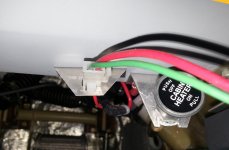
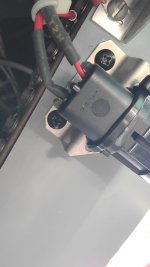
I have a connector at the bottom right of my panel into which an external switching power supply gets plugged. The connection goes directly to the avionics bus. So, when I plug in the power supply, the avionics come up. In that mode I usually do the software and data base updates. Then, if I want to power up the rest of the plane electrical, I simply turn on the avionics switch, which then causes the avionics bus to back feed the rest of the electrical system, which is useful for such things as testing flaps and trim and lights. If you have a relay for the avionics switching, then you have to just momentarily energize the master to latch the relay. The connector is polarized, so you can't make a polarity mistake. Picture shows the original connector and its placement, second is of a newer automotive style connector I have there now. Link is to the power supply, which nominally is 12V 29A, but you can adjust it up to 13 or a bit more if you insist on realistic operating voltages.

No fuses, extra breakers - connection from the connector is real short to bus and ground. On the load side, you have all the device breakers anyway, and on the supply side if you were to show up with a short, it wouldn't matter because there is no battery power there without the master. Yes, with the master on, the connector is hot, but so is the bus also, which presumably is protected upstream, like fuseable link, etc.


Attachments

  • Aux Power Connector.jpg
    Aux Power Connector.jpg
    385.9 KB · Views: 33
  • Connector.jpg
    Connector.jpg
    142.8 KB · Views: 32
The White Lightning manual has a good diagram of installation options if you're looking for a high level idea of how to add in bench power. Page 5.

https://cdn.shopify.com/s/files/1/0626/5372/6871/files/752-790_M1435-EXP_20220915.pdf?v=1703003138
White Lightning's approach doesn't allow you to bring up the avionics without also powering everything on the main bus, some of which of course can be turned off. I preferred to be able to isolate and separately power avionics, for example for firmware and data base updates, which is why I connected my external connector to the avionics bus, and feed the main via the avionics switch, which typically includes a relay, which then needs to be able to handle the current that any main bus items you turn on may draw.
 
MFJ made a linear 30 amp power supply that I used during the build, and continue to use today with a quick disconnect for when I’m either hangar flying or doing firmware/db updates. Looks like their catalogue has changed and only have switching power supplies now.
The reason their catalog is different is because they're closing :

MFJ Ceasing On-Site Production​


04/26/2024
Updated 4:26:24 8:00 pm EDT with additional statement from Martin F. Jue, K5FLU.

MFJ Enterprises, Inc founder Martin F. Jue, K5FLU, announced that as of May 17, 2024, the company will cease on-site production at their Starkville, Mississippi, facility. Ameritron, Hy-Gain, Cushcraft, Mirage, and Vectronics brand products will be affected by the shutdown.

In a letter posted to social media, Jue said he is looking forward to retiring.

Times have changed since I started this business 52 years ago. Our product line grew and grew and prospered. Covid changed everything [for] businesses, including ours. It was the hardest hit that we have ever had, and we never fully recovered.

I turned 80 this year. I had never really considered retirement, but life is so short, and my time with my family is so precious.


Jue founded MFJ Enterprises in 1972, after building a CW filter kit that sold for less than $10. Since 1990, the company has acquired several other legacy brands within the amateur radio market. Jue shared that the company will remain open to sell existing inventory because they have “a lot of stock on hand.” They will also continue to offer repair services for the foreseeable future.

Jue expressed gratitude to the many longtime employees of MFJ, some of whom have been with the company for 40 years. He also thanked MFJ dealers and radio amateurs for their patronage over the decades.

He also sent a special message to ARRL Members, and loyal QST readers:

"I give my deepest heartfelt thank you to my fellow hams all over the world and especially to ARRL members and QST readers. In my youth, I was given a second-hand set of 1958 QSTs. I read them over and over until I practically memorized every word. This gave seed to MFJ.

MFJ became a worldwide ham radio leader only because of you. As I turned 80, I cannot thank you all enough for 52 wonderful ham radio years. Thank you, 73s . . . Martin F. Jue, k5flu"


 
White Lightning's approach doesn't allow you to bring up the avionics without also powering everything on the main bus, some of which of course can be turned off. I preferred to be able to isolate and separately power avionics, for example for firmware and data base updates, which is why I connected my external connector to the avionics bus, and feed the main via the avionics switch, which typically includes a relay, which then needs to be able to handle the current that any main bus items you turn on may draw.
I have a rather expensive GPU which I use for my own aircraft and in the repair station, but I still prefer to attach it to the battery so that it can act as a 'safety valve' just in case something goes haywire. I just don't trust a mega $$ panel to it no matter how good it is.
(so in the Lightning diagrams fig 2 is my preference)
 
I have the 30 amp MFJ switching power supply that was in the catalog as of 2 years ago. I've been using it on the bench and I've hooked it up directly to the aircraft via the VPX DC input. It works very well. Since the backbone is VP-X, I can easily isolate non-avionics stuff with the configurator.

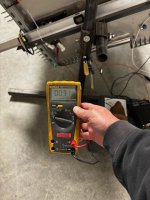
I don't have an o-scope to see what peak-to-peak ripple is really present. But an AC voltmeter shows the effective RMS ripple of about 3.1mv. If I remember how to approximate, I think thats equivalent to less than 10mv peak-to-peak, which I believe is well within the acceptable limits for avionics.
 

Attachments

  • IMG_0653.jpg
    IMG_0653.jpg
    54.4 KB · Views: 18
I have a rather expensive GPU which I use for my own aircraft and in the repair station, but I still prefer to attach it to the battery so that it can act as a 'safety valve' just in case something goes haywire. I just don't trust a mega $$ panel to it no matter how good it is.
(so in the Lightning diagrams fig 2 is my preference)
Point taken. But if you are that concerned, I'd add a 15V SCR crowbar to OC shut down the GPU. Connected to the battery you'll be in an indeterminate condition in regard to how much you are charging the battery or actually powering the plane from the battery with the GPU loafing, unless you carefully set the GPU to a charging voltage with enough margin to also power the plane.
 
Point taken. But if you are that concerned, I'd add a 15V SCR crowbar to OC shut down the GPU. Connected to the battery you'll be in an indeterminate condition in regard to how much you are charging the battery or actually powering the plane from the battery with the GPU loafing, unless you carefully set the GPU to a charging voltage with enough margin to also power the plane.
My 75-amp GPU runs at 14/28V and has both overcurrent and OV protections of course.
 
Last edited:
Back
Top