Van's Air Force

The definitive Van's Aircraft support community! Buying, building or flying an RV? Join our exclusive family of mentors and enthusiasts!

Baffle tie rods rust plan?

mr_matt

Active Member
Patron
Hi thanks in advance for any help you can provide.

I have been putting off figuring out how I am going to tie the lower baffles together (titan 340 with tapered barrel fins). I decided to try rods as this is my first engine install and safety wire seemed a bridge too far for me.

Anyway, I planned on making them out of stainless rod, and I would have to turn the ends on the stainless stock to thread 6-32. However, I did find some O1 tool steel rod right on dimension so I grabbed that too and did a fit up. THe stuff bent and threaded easily.

So the question is, how bad will these corrode? I really dont want to remake these in stainless (303 I think it what I got) if these O1 rods will work (lazy is all)

If I have to do something for the corrosion, I suppose I could go ahead and heat treat them and anneal them, if memory serves they will be pretty robust after that process but I dont want to do that either if I can get out of it.

Thanks

Matt
 

Attachments

Just a data point. My RV has lived in a hot, humid, salt-air environment for the past 8 years. The stock rods, which I have done nothing to, show zero signs of corrosion.
 
Methinks you're thinking too much about this. My hangar mate used safety wire with a drilled out pop rivet in the baffle hole attach points to prevent tear-through. I used the stock rods that came with Van's baffle kits; I have no idea what they're made of. Both of these approaches have held up well for years. No rust, no wear, no problems. And like Todd, I live in a hot, humid, salt-air environment as well.

Since you don't have to worry about that issue now, it's a good time to look into sealing up the baffles while they're clean and easier to get to. Do a search for high CHTs, the washer trick on #3 (and #2 to a lesser extent), and sealing up the inter cylinder baffles. Get you a cup of coffee first, as there's lots of reading material. Lots.
 
I like the rods, but you need more of a bend on the inner rods. It’s contacting the inter cylinder baffle. Also, double nut the ends or better yet, an all metal locking nut. I put a short section of Tygon line on the center of mine so it cant abrade anything it touches.
 
I like the idea of safety wire. For rods, they get bent to clear some of the engine bits and pieces. Do you just run safety wire through some plastic housing and let it all press up against some of the metal tubing on the engine since you can't do the same routing as with a rod?
 
I use the steel rods you can buy for remote control model aeroplanes, normally used as push-pull rods for controls. Like piano wire it's very stiff but it comes with the ends threaded and once cut and bent for our application, you only have to thread one end. Doesn't seem to rust at all.
 
I like the idea of safety wire. For rods, they get bent to clear some of the engine bits and pieces. Do you just run safety wire through some plastic housing and let it all press up against some of the metal tubing on the engine since you can't do the same routing as with a rod?
Yes, you can get some small ID plastic/poly tubing and slide it over the twisted safety wire. It'll last a long, long time and prevent metal on metal contact. You don't want it sawing through the oil drain-back tubes. That would just be embarrassing.
 
I like the idea of safety wire. Do you just run safety wire through some plastic housing and let it all press up against some of the metal tubing on the engine since you can't do the same routing as with a rod?

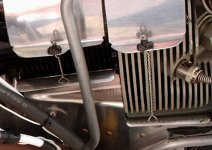
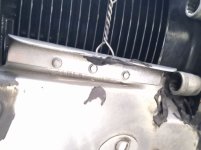
Wire individual cylinders. And use 0.040 wire, not 0.032.

Baffle Ties.jpg

Add the curved outlet to the inter-cylinder baffle. Nested dimples, solid rivets...

Extension.jpg
 
Last edited:
Wire individual cylinders. And use 0.040 wire, not 0.032.

View attachment 121286

Add the curved outlet to the inter-cylinder baffle. Nested dimples, solid rivets...
Dumb question, but do thet inter-cylinder baffles come out relatively easily? I'm looking at my Titan and they appear to be held in from the top with some sort of tension clip (?) and are RTV'd fairly heavily. Wiring individual cylinders makes a lot of sense to me since cylinders will move separately.
 
Yes, the inter-cylinder baffles come out relatively easily. But why would you want to remove them? Everything else goes in around them. And you may spend a lot of time trying to come up with a better mousetrap, only to realize there are thousands of aircraft with the baffles set up as described here. All of them are proven and working well.

You didn't say if this is a new aircraft or if it's new to you [there are several posts asking somewhat related questions within this thread]. There should be some RTV around the inter cylinder baffles, especially on the side closer to the engine case. There are typically huge gaps around where the tabs of the inter cylinder baffles are bent toward the cylinder barrel, and those need to be sealed up with RTV. If they're already sealed, let that sleeping dog lie. The idea is to seal all the gaps that aren't moving air past a cooling fin, as even a small crack is detrimental. And that's a double whammy because not only is the wasted air not removing heat, it lowers the pressure differential between the top and bottom sides of the engine. That in turn lowers the overall cooling efficiency. This has been written about extensively in this forum if you want to do a deep dive into that. Or maybe even a shallow dive.
 
Yes, the inter-cylinder baffles come out relatively easily. But why would you want to remove them? Everything else goes in around them. And you may spend a lot of time trying to come up with a better mousetrap, only to realize there are thousands of aircraft with the baffles set up as described here. All of them are proven and working well.
My comment was in response to Dan's approach of not tying cylinders to each other, but instead each baffle connects to the inter-cylinder baffle. On my new Titan, I'd have to take that center baffle out to add on a flange to attach the safety wire to. I thought that sounded pretty ideal if removing the baffle was not a big deal, but otherwise I'll likely just stretch the safety wire from one cylinder to the other as others have done.
 
Thanks everyone for the input.

I should have mentioned that the photo was taken mid-installation. I know it looks odd, and one of the rods is folded over only because I was in the middle of tightening it. Nothing comes close to touching, and the innermost rod has a double Z-bend specifically to provide clearance. For final install I will use proper nuts and some sort it hear shrink to avoid chafing

The main reason I didn't use safety wire initially is that I wanted to be able to install the baffles, check the fit, remove them, make adjustments, and repeat the process. The tie rod made that much easier (I'm a longtime RC modeler, so threading tie rods like this is pretty natural for me). Now that the fitting work is essentially done, I may still replace it with safety wire if I can make it nice.

The best news from this discussion is learning that corrosion isn't a concern here. In that case, I think this part is finished.

Next up, I'm going to impregnate the fiberglass as Dan H described and then make his upper and lower "cooling fin" seals. I wanted to get the baffles fitting up against the fins as well as possible before moving on to that step.

Thanks again for all the feedback.
 
My comment was in response to Dan's approach of not tying cylinders to each other, but instead each baffle connects to the inter-cylinder baffle. On my new Titan, I'd have to take that center baffle out to add on a flange to attach the safety wire to. I thought that sounded pretty ideal if removing the baffle was not a big deal, but otherwise I'll likely just stretch the safety wire from one cylinder to the other as others have done.
Oh, I get it now. Dan H has done some pretty slick work impregnating fiberglass fabric with a Permatex or RTV sealant (I really don't remember the details) to optimize cooling from between the cylinders to the underside of the cylinder fins. It prevents the air between the cylinder head fins from just dumping straight down. From his pic, it's hard to tell if that's what the safety wire is grabbing or if it's something else. You might do a search here for the process he took, as he documented it pretty well. And he 'splains it a lot better than I could.
 
Dumb question, but do thet inter-cylinder baffles come out relatively easily? I'm looking at my Titan and they appear to be held in from the top with some sort of tension clip (?) and are RTV'd fairly heavily. Wiring individual cylinders makes a lot of sense to me since cylinders will move separately.
Not if they are sealed with rtv. You will need to get in there with a blade and cut a good portion of it to remove them, assuming good prep was done before the rtv was applied.
 
The rods as supplied in the FWF kits/plans have always been stainless steel. They are a pita to thread, but dont corrode.

Second and third times around though I used safety wire.
 
Back
Top