Van's Air Force

The definitive Van's Aircraft support community! Buying, building or flying an RV? Join our exclusive family of mentors and enthusiasts!

Backfires at/near idle in pattern - should I be concerned?

GyroF-16

Well Known Member
Patron
I have a new-to-me F1 Rocket. Took it up for my first real test flight yesterday. As a result, I have several questions for the smart people here - I’ll start with this one:
I’m experiencing some backfiring at low power settings. They seemed like somewhat minor “pops” when reducing power to idle at 9,500 MSL for some stalls. I operate from a pretty high home field (KFLY), and the density altitude at the field yesterday was about 9,500 feet. I leaned to max RPM during runup, then a touch towards rich.
For the low-power operations (stalls), I had the boost pump on, and moved the mixture lever maybe an inch further forward. As I said above, I got some “pops” most times I pulled the throttle to idle for stalls.
Then, back in the pattern, the “pops” at low power got more frequent and maybe more pronounced. It was especially noticeable when I pulled the throttle to idle, and it continued as long as the power was back, even if I added a little power. I flew several patterns where I pulled the power to idle at the turn to base, and kept it at idle until touchdown (practice engine-out approaches). Apparently the backfiring was pretty noticeable from the ground, because a got a call on CTAF from someone on the ground saying I was backfiring pretty loudly and consistently in the pattern. I gradually increased the mixture to “full rich” over the course of several patterns to try to reduce the backfiring, but to no avail.
Other info which may be helpful: it’s an IO-540 D4A5 with Airflow Performance fuel injection, one Slick mag and one Lightspeed mag. I have a 3-blade MT prop.
Any thoughts or recommendations?
I’m pretty sure that the “pops” weren’t due to a “too-lean” condition (since they were eventually happening with “full rich” selected).
Possibly “afterfiring” because I was too rich?
The MT prop was full forward (fine pitch) and boost pump was on every time I heard the pops - could it be the prop driving the engine and pulling in more fuel then could be burned at idle?
I was moving the throttle to idle pretty briskly in the pattern - would it help to move it to idle more smoothly (3-4 seconds)?
I haven’t had a chance to check for leaks in the intake or exhaust yet…

I’m open to your suggestions.
Also - is this popping potentially causing damage to the engine, or is it just sub-optimal?
 
Last edited:
I’m pretty sure that the “pops” weren’t due to a “too-lean” condition (since they were eventually happening with “full rich” selected.
Possibly “afterfiring” because I was too rich?
I had this issue with a new-to-me 8A before I got a feel for the mixture control. I can't prove it, but I think it was mixture knob too rich. Scared the hell out of me on downwind to my 2nd (ever) landing at Spaceport at the end of the ferry flight. I figured out what the sound was quickly (backfire), then messed with a bunch of stuff, then ended up with GAMI injectors. At some point along the way I noticed it wasn't happening anymore and I concluded it was a problem in the seat-to-throttle interface.

Some people here have opined that this is a leak in the intake system, which I believe might also cause it, but I don't think that was my problem.

EDIT: at the time, there was some debate between myself and an experienced GA pro pilot friend. I called it "backfiring" which he understood to be firing into the intake. I always understood that to be firing into the exhaust (I have referred to fuel injection intake fires in the automotive world to be a "sneeze"). "Afterfiring" may be the more preferred term in airplane maintenance - unburned fuel in the exhaust.

Mike Busch has said "full rich is horrendously rich" which I agree with, but we've got the added wrinkle of high altitude in CO. It would be easy to be way too rich.
 
Last edited:
Lots of things to look at, but timing is one suspect. I'm sure those with better knowledge will chime in.
Good to know. I’ve been wondering about the timing on the Slick mag, because the RPM drop is significantly more than the Lightspeed mag during the mag check. I’m wondering if it’s a bit too retarded. Another thing on my “to check” list.
 
Good to know. I’ve been wondering about the timing on the Slick mag, because the RPM drop is significantly more than the Lightspeed mag during the mag check. I’m wondering if it’s a bit too retarded. Another thing on my “to check” list.
Huge RPM drop is also sometimes too rich. I had some concerns about out of spec mag drops and, in the end, it was the red lever.
 
Induction leak, sniffle valve leak (stuck)
Absolutely nothing leaking after shutdown, so I’m thinking that rules out the sniffle valve.

(EDITED TO ADD: Oh - I guess maybe you mean that it isn’t closing and sealing properly when the engine is running. Idle on the ground it pretty smooth, though…)

Induction leak is on the agenda to check after another flight to try leaner mixture in the pattern and slower power reductions.

Is this popping likely an annoyance, or am I risking damaging the engine by letting it continue while experimenting?
 
The MT prop was full forward (fine pitch) and boost pump was on every time I heard the pops - could it be the prop driving the engine and pulling in more fuel then could be burned at idle?

All the RVs I've flown with Lycoming engines and CS props have done this to some extent, always when you pull the throttle to idle on the downwind. At my airpark I hear lots of other RVs overhead doing the exact same thing. I've always assumed it was for the reason above - extra fuel going out the exhaust as the engine spools down.

I've always chalked this up as being a "normal RV thing". However, for me this has been a transient event that only lasts a few seconds, not continuously. And on my current airplane, it doesn't seem to happen every time either.

All that to say - In my experience this can be normal, but the way you describe it sounds like it could potentially be more pronounced than what I'm used to. Maybe see if you can get some cockpit video with audio so we can hear what you're hearing!
 
I have a new-to-me F1 Rocket. Took it up for my first real test flight yesterday. As a result, I have several questions for the smart people here - I’ll start with this one:
I’m experiencing some backfiring at low power settings. They seemed like somewhat minor “pops” when reducing power to idle at 9,500 MSL for some stalls. I operate from a pretty high home field (KFLY), and the density altitude at the field yesterday was about 9,500 feet. I leaned to max RPM during runup, then a touch towards rich.
For the low-power operations (stalls), I had the boost pump on, and moved the mixture lever maybe an inch further forward. As I said above, I got some “pops” most times I pulled the throttle to idle for stalls.
Then, back in the pattern, the “pops” at low power got more frequent and maybe more pronounced. It was especially noticeable when I pulled the throttle to idle, and it continued as long as the power was back, even if I added a little power. I flew several patterns where I pulled the power to idle at the turn to base, and kept it at idle until touchdown (practice engine-out approaches). Apparently the backfiring was pretty noticeable from the ground, because a got a call on CTAF from someone on the ground saying I was backfiring pretty loudly and consistently in the pattern. I gradually increased the mixture to “full rich” over the course of several patterns to try to reduce the backfiring, but to no avail.
Other info which may be helpful: it’s an IO-540 D4A5 with Airflow Performance fuel injection, one Slick mag and one Lightspeed mag. I have a 3-blade MT prop.
Any thoughts or recommendations?
I’m pretty sure that the “pops” weren’t due to a “too-lean” condition (since they were eventually happening with “full rich” selected).
Possibly “afterfiring” because I was too rich?
The MT prop was full forward (fine pitch) and boost pump was on every time I heard the pops - could it be the prop driving the engine and pulling in more fuel then could be burned at idle?
I was moving the throttle to idle pretty briskly in the pattern - would it help to move it to idle more smoothly (3-4 seconds)?
I haven’t had a chance to check for leaks in the intake or exhaust yet…

I’m open to your suggestions.
Also - is this popping potentially causing damage to the engine, or is it just sub-optimal?
Not a timing issue.

The pops are likely afterfires. You have a separate idle mixture setting. As you pul back to idle, your mixture moves from the main circuit to the idle circuit. If the idle mixture is too rich or too lean, it can cause occasional, random misfires. Once mixture is too lean or rich it can no longer be ignited by the sparks. When this happens, the incombusted fuel air mixture goes out the exhaust pipe. Once the cyl fires again, the heat of that exh pulse ignites that mixture in the pipe and you get an explosion, the pop you are hearing.

You need to properly set your idle mixture. Given that it is worse at low altitudes and the fact that it is much easier to get misfires on the lean side, i am guessing it is too lean, but could also be too rich. This should be your first next step.

Once you are on the idle circuit, the position of the red knob is irrelevant. Idle mixture is only controlled via the star wheel on the square arm on the starboard side of the servo. With the red knob full in, you can be plenty rich on the main circuit(part or full throttle ), but once you pull to idle, you are at the mercy of the idle mixture, which if lean can cause your symptoms even with the red knob in.
 
Last edited:
All the RVs I've flown with Lycoming engines and CS props have done this to some extent, always when you pull the throttle to idle on the downwind. At my airpark I hear lots of other RVs overhead doing the exact same thing. I've always assumed it was for the reason above - extra fuel going out the exhaust as the engine spools down.

I've always chalked this up as being a "normal RV thing". However, for me this has been a transient event that only lasts a few seconds, not continuously. And on my current airplane, it doesn't seem to happen every time either.

All that to say - In my experience this can be normal, but the way you describe it sounds like it could potentially be more pronounced than what I'm used to. Maybe see if you can get some cockpit video with audio so we can hear what you're hearing!
Not normal with a properly set idle mixture, which is sadly rare in aviation, so therefore somewhat common. I have 2000 hours across my 2 planes and have NEVER had a pop on decel to idle.
 
Good to know. I’ve been wondering about the timing on the Slick mag, because the RPM drop is significantly more than the Lightspeed mag during the mag check. I’m wondering if it’s a bit too retarded. Another thing on my “to check” list.
The Lightspeed is advanced at low MAP so even at 1700-1800 RPM for mag check it's spark is way before the Mag. Shut the mag off and much of the combustion event has already happened before the mag would have fired so very small RPM drop. Sure, check the mag timing, but that's not why it doesn't have a lot of drop.

Ed
 
Frankly, I’ve never owned a Lycoming airplane that DID NOT afterfire on downwind to some extent. The stacks on a Rocket are quite short and that may be a contributor, but even with EFI my Rocket does this. Hell, my 2008 Corvette does too, and has done so since the day I took it home from the dealership as a new car.
 
Not normal with a properly set idle mixture, which is sadly rare in aviation, so therefore somewhat common. I have 2000 hours across my 2 planes and have NEVER had a pop on decel to idle.
Mine is set properly (less than 50 RPM rise when leaning to ICO) so I don't know what to tell you.
 
Once you are on the idle circuit, the position of the red knob is irrelevant. Idle mixture is only controlled via the star wheel on the square arm on the starboard side of the servo. With the red knob full in, you can be plenty rich on the main circuit(part or full throttle ), but once you pull to idle, you are at the mercy of the idle mixture, which if lean can cause your symptoms even with the red knob in.
This. I did adjust this at some point and that may have been what helped.
 
Not a timing issue.

The pops are likely afterfires. You have a separate idle mixture setting. As you pul back to idle, your mixture moves from the main circuit to the idle circuit. If the idle mixture is too rich or too lean, it can cause occasional, random misfires. Once mixture is too lean or rich it can no longer be ignited by the sparks. When this happens, the incombusted fuel air mixture goes out the exhaust pipe. Once the cyl fires again, the heat of that exh pulse ignites that mixture in the pipe and you get an explosion, the pop you are hearing.

You need to properly set your idle mixture. Given that it is worse at low altitudes and the fact that it is much easier to get misfires on the lean side, i am guessing it is too lean, but could also be too rich. This should be your first next step.

Once you are on the idle circuit, the position of the red knob is irrelevant. Idle mixture is only controlled via the star wheel on the square arm on the starboard side of the servo. With the red knob full in, you can be plenty rich on the main circuit(part or full throttle ), but once you pull to idle, you are at the mercy of the idle mixture, which if lean can cause your symptoms even with the red knob in.
Great stuff - thank you.
Just to be clear, you mentioned “given that it is worse at low altitudes…”. This was happening at 8,000-9,500 MSL, and close to 10,000 DA - so I don’t think it qualifies as traditional “low altitudes”, even though it was in the traffic pattern.
I only point this out to ask if that makes a lean or rich setting in the idle mixture more likely?
And, given that I operate from a 6,900 MSL home field, how would you recommend that I set it so that the idle mixture won’t be unacceptably lean when I go to sea level (or near it) when traveling?
Thanks again - I’m soaking this up like a sponge.
 
Last edited:
This. I did adjust this at some point and that may have been what helped.
Coming from a (presumably) lower altitude to Colorado, did you need to adjust the idle mixture to be leaner, or richer?
I’d guess leaner, but I’d like to know if my rationale is off on this…
 
Last edited:
Coming from a (presumably) lower altitude to Colorado, did you need to adjust the idle mixture to be leaner, or richer?
I'm at BJC now so, yes lower. I adjusted leaner, but I wasn't terribly exacting about it - just a few clicks and tried it. Didn't keep messing with it. I don't remember when the popping stopped but it was all a bit of a process. The largest parts were injectors and learning to lean the engine for the altitude.
 
Do you have a modern engine monitor that shows (and records) data from all cylinders?
Twice I've had something similar. Once it was easy to diagnose with an engine monitor.
Once it wasn't easy (because I didn't have an engine monitor).
 
Great stuff - thank you.
Just to be clear, you mentioned “given that it is worse at low altitudes…”. This was happening at 8,000-9,500 MSL, and close to 10,000 PA - so I don’t think it qualifies as traditional “low altitudes”, even though it was in the traffic pattern.
I only point this out to ask if that makes a lean or rich setting in the idle mixture more likely?
And, given that I operate from a 6,900 MSL home field, how would you recommend that I set it so that the idle mixture won’t be unacceptably lean when I go to sea level (or near it) when traveling?
Thanks again - I’m soaking this up like a sponge.
You said it popped a bit doing stalls at 9000 and then it popped worse in the pattern at 6000. My math may be fuzzy, but always thought 6000 was lower than 9000. I was not referring to traditional altitudes, just the ones you referenced.

Mixture is relative to PA. The higher you go, the leaner you need to be to maintain the same air fuel ratio. So 6000 wants a richer mixture than 9000. Therefore as popping gets worse at lower altitudes, we can speculate you are on the lean side of optimum.
 
Mine is set properly (less than 50 RPM rise when leaning to ICO) so I don't know what to tell you.
There are more effective ways to set idle mixture. I use a lowest map method and get no popping. You may want to try it and see if you get better results. I am not a fan of the accepted aviation method you mentioned, as it doesn’t usually give great results. It is usually good enough, just not optimal.
 
Coming from a (presumably) lower altitude to Colorado, did you need to adjust the idle mixture to be leaner, or richer?
I’d guess leaner, but I’d like to know if my rationale is off on this…
It depends how far from optimal you were before going to Co. i would adjust mixture to optimal at home airport and go a couple clicks richer. I set my idle at 800 msl. I have no issues running at 6000’ airports. However, it is not as easy going in the other direction, so better to be a bit richer than optimal to no have issues when going to lower airports. Its a compromise you need to make when living up there.
 
Frankly, I’ve never owned a Lycoming airplane that DID NOT afterfire on downwind to some extent. The stacks on a Rocket are quite short and that may be a contributor, but even with EFI my Rocket does this. Hell, my 2008 Corvette does too, and has done so since the day I took it home from the dealership as a new car.
neither of my two lycs (one is a 540 just like yours) ever has, so we must be doing something different.
 
I had something similar, turned out to be an intake gasket on one of the cylinders beginning to break up. Difficult to find as it was hidden out of easy sight.

Gasket was $1.
 
I experienced similar popping in the pattern just after reducing power 2 years ago Traced it to a sizeable exhaust leak at the exhaust mount flange. The proof was in the EGT data too. That cylinder EGT rose when all others fell indicating something unusual was going on.
 
The three planes I flew a bunch I could "lean pop" in the flare every time were Bendix RSA IO 360 and 540s in "certifed" Pitts, crossover 4s, 3 into 1s and 6 into 1s.

It came from throttle reduction rate. Mixture full rich position. Midwest, low pressure altitude.

They were not mine, so I babied them in the pattern power wise and while flying acro sequences, but if the need was there to chop power to get a spin entry at the right spot in the acro box, they would also "lean pop".

Always liked the sound, in or out of the cockpit. Seemed common in that arena. A bit Merlinesque. Might have been groupthink as they all went to the same local college, but the IAs/A&Ps of the group all called it "lean pops".
 
Last edited:
The three planes I flew a bunch I could "lean pop" in the flare every time were Bendix RSA IO 360 and 540s in "certifed" Pitts, crossover 4s, 3 into 1s and 6 into 1s.

It came from throttle reduction rate. Mixture full rich position. Midwest, low pressure altitude.

They were not mine, so I babied them in the pattern power wise and while flying acro sequences, but if the need was there to chop power to get a spin entry at the right spot in the acro box, they would also "lean pop".

Always liked the sound, in or out of the cockpit. Seemed common in that arena. A bit Merlinesque. Might have been groupthink as they all went to the same local college, but the IAs/A&Ps of the group all called it "lean pops".
To be clear on my comments above, I was not referring to very quick pulls to idle from high power when I said that I don't get them. It is usually from mid RPMs for me. I agree with moose that lean pops are more to be expected in that scenario - rapid pull to idle from high power. That is a pretty well known side effect of the mechanical fuel metering in high perf engines; The carb / servo chops the mixture rate before the engine can decelerate and you get the lean pops briefly in the transition. I should also note that a similar symptom (popping on decel to idle) can also occur with leaking exhaust gaskets.
 
Last edited:
You have a separate idle mixture setting. As you pull back to idle, your mixture moves from the main circuit to the idle circuit.

There is no separate "idle circuit".

Once you are on the idle circuit, the position of the red knob is irrelevant. Idle mixture is only controlled via the star wheel on the square arm on the starboard side of the servo. With the red knob full in, you can be plenty rich on the main circuit(part or full throttle ), but once you pull to idle, you are at the mercy of the idle mixture, which if lean can cause your symptoms even with the red knob in.

Mixture valve and a supplemental idle valve are in series. The idle valve effectively modifies the area of the main jet. The only transition is fuel flow control at idle is no longer dependent on venturi airflow. And yes, the mixture valve connected to the red knob does have an effect on flow at idle...consider mixture cutoff.

We return you to your regular programming.
 
Lots of interesting information coming out in this thread! The “RV Pop” has been part of our world for longer than I have been around, and to date I have always found that the best way to prevent it is gradual throttle reductions in the pattern. You hear it and go “someone wasn’t planning their pattern entry properly”….kind of like when you hear an RPM surge as someone pushes their prop control full forward without the throttle pulled back a bit….

Going back to the title o the thread, this has been happening to pilots in RV’s forever, so no, I wouldn’t be concerned about it. No one that I have ever heard of has blown their exhaust off because of it. But maybe some of the things brought out here might reduce it.
 
I have always found that the best way to prevent it is gradual throttle reductions in the pattern. You hear it and go “someone wasn’t planning their pattern entry properly”….kind of like when you hear an RPM surge as someone pushes their prop control full forward without the throttle pulled back a bit….
This is a good insight - maybe the disappearance of my popping was just better throttle use. Problem with the seat-to-throttle interface.
 
There is no separate "idle circuit".


Mixture valve and a supplemental idle valve are in series. The idle valve effectively modifies the area of the main jet. The only transition is fuel flow control at idle is no longer dependent on venturi airflow. And yes, the mixture valve connected to the red knob does have an effect on flow at idle...consider mixture cutoff.

We return you to your regular programming.
Now I'm really confused. Up here it's verboten to taxi and airplane with the red knob fully forward.
Does the red knob do anything at idle?
If I understand, the idle mixture needs to be tweaked. The star rotated to correct idle mixture.
Here's where I get brain fog. What happened when I fly down to sea level? Do I have to adjust again?
Do I adjust it slightly rich?
But then it's too rich at home.
My head hurts.
 
My experience, IO 360 RSA 5. Mag/Pmag 5 ATDC, Big fat low mass Hartzell prop. It would pop slowing in the pattern or doing spins at altitude. Initially set idle mixture for 40 rpm increase. I noticed it would pop at rapid throttle reduction when manifold pressure went below 7 inches. My perception was it was an after fire. I could smell fuel. Over a period of a time I leaned the mixture setting 1 click at a time until there was maybe 10 rpm increase and the manifold pressure at idle is near minimum. The engine still accelerates instantly on throttle up at sea level.

The other observation was that the pop did not stop by leaning the mixture lever except near ICO

It doesn’t do it anymore. I can chop the throttle until the manifold pressure goes under range and it just hums. I can’t say it was the root cause because I did it over a long period and was making other changes to the engine. Maybe 4 clicks total and it went from popping slightly to not in one click. Dunno.
 
Last edited:
Now I'm really confused. Up here it's verboten to taxi and airplane with the red knob fully forward.
Does the red knob do anything at idle?
If I understand, the idle mixture needs to be tweaked. The star rotated to correct idle mixture.
Here's where I get brain fog. What happened when I fly down to sea level? Do I have to adjust again?
Do I adjust it slightly rich?
But then it's too rich at home.
My head hurts.
The equation for the amount of information vs misinformation on VAF still hasn’t been figured out.
I’ll second the brain fog.

I do not believe there is a magic density altitude adjuster in our fuel systems. But- I could be wrong!
 
Now I'm really confused. Up here it's verboten to taxi and airplane with the red knob fully forward.
Does the red knob do anything at idle?
If I understand, the idle mixture needs to be tweaked. The star rotated to correct idle mixture.
Here's where I get brain fog. What happened when I fly down to sea level? Do I have to adjust again?
Do I adjust it slightly rich?
But then it's too rich at home.
My head hurts.
You’re channeling my thoughts, wirejock. I’m up for adjusting my idle mixture (and I’ve been reading up on the procedure).
But I certainly want reliable operation at Sea Level, even after adjusting for my high DA environment.
 
And yes, the mixture valve connected to the red knob does have an effect on flow at idle...consider mixture cutoff.
Yes, I understand that, but trying to simplify. If the red knob is in a position to flow properly at mid power, it can't realistically be manipulated to affect a mixture change at idle in the second it takes to pull power back. So for the purposes of this particular scenario it is not relevant. OP was at full rich, so the idle mixture as set by the idle mixture bar, with no effect from the red knob.
 
Last edited:
Now I'm really confused. Up here it's verboten to taxi and airplane with the red knob fully forward.
Does the red knob do anything at idle?
If I understand, the idle mixture needs to be tweaked. The star rotated to correct idle mixture.
Here's where I get brain fog. What happened when I fly down to sea level? Do I have to adjust again?
Do I adjust it slightly rich?
But then it's too rich at home.
My head hurts.
The red knob can affect mixture, but it has to go WAY out to do so and if you go far enough to actually lean the mixture at idle it will now be close to too lean for mid power taxi operations. Better to properly adjust idle mixture and then there is no need to use the red knob. On my 6, I have never leaned on the ground in 1500 hours. Cylinders have very little carbon deposits and have NEVER fouled a plug.

If you live at 5500 PA, you should be setting the mixture a bit richer than optimal to deal with lower alt operations. I have no experience dealing with that scenario, so can't really help. I just can't tell you how much further rich you need to be as I have no experience. You have a lot of lattitude on the rich side, but much less on the lean side. I can easilly go from 800 - 6000' and not be too rich at idle, but the case is different going in the opposite direction. Probably best to stick with local wisdom.

Do an experiment. At idle, pull the red knob back until you get a rise in RPM, indicating you have leaned the mixture a bit. Then push in the throttle and see how far youcan go before it dies.
 
Last edited:
There is no separate "idle circuit".


Mixture valve and a supplemental idle valve are in series.
Yes, seperate circuit is carb lingo but was trying to keep it simple. There is a seperate idle mixture control that is designed to be used for metering fuel at RPMs up to 1000-1200 RPM. Was trying to make that point without a lot of detail so laymen could understand.
 
My experience, IO 360 RSA 5. Big fat low mass Hartzell prop. It would pop slowing in the pattern or doing spins at altitude. Initially set idle mixture for 40 rpm drop. I noticed it would pop at rapid throttle reduction when manifold pressure went below 7 inches. Over the period of a time I leaned mixture setting 1 click at a time until there was maybe 10 rpm drop and the manifold pressure at idle is near minimum. The engine still accelerates instantly on throttle up at sea level.

The other important observation was that the pop could not be stopped by moving the mixture lever except at ICO.

It doesn’t do it anymore. I can chop the throttle until the manifold pressure goes under range and it just hums. I can’t say it was the root cause because I did it over a long period. Maybe 4 clicks total and it went from popping slightly to not in one click. Dunno
Yes, setting idle mixture to lowest MAP instead of the flawed 50 RPM drop will greatly reduce this symptom. Was trying to make that point and guess I didn't do so well.
 
Thie above technique settling idle mixture was not taught to me by the bunch of I.A./A&Ps that taught me acro and I helped on with maintenance, they were more in the rpm rise at cut, as I recall.

Logic says "lean pops" being normal to them says the lowest MAP is better. Any "lean pops" then mean look for a new leak!

Bias- mid 1990s acro, 2010s on following VAF, thanks for tying a few current posts to old, to you, threads.
 
I have experienced the same pops with throttle pulled back in descent. My observation is it occurs when the prop is driving the motor. In my carb'd x-340 with MT electric prop it does not occur unless I pitch the prop toward takeoff pitch with the power pulled back. If I pull the power back and leave the prop pitched for cruise, the popping does not occur. In my IO360 with Hartzell CS prop I get popping unless I limit power reduction and descent rate. I have noticed if I pull the prop back while pulling the power back the incidence of popping is significantly reduced. Thus, it appears, the prop is driving the motor causes the popping. I presume that is after fire with fuel in exhaust. Is there a way to stop it operationally? So far only the methods described above work for me.
 
There is no separate "idle circuit".


Mixture valve and a supplemental idle valve are in series. The idle valve effectively modifies the area of the main jet. The only transition is fuel flow control at idle is no longer dependent on venturi airflow. And yes, the mixture valve connected to the red knob does have an effect on flow at idle...consider mixture cutoff.

We return you to your regular programming.
Why should I read the books when I can ask you. The deceleration mode is a special case. The manifold pressure is below the idle setting. The air mass flow is at minimum, the temperature of the combustion chamber is at a minimum. Doesn’t that mean I haven’t burnt all the fuel?
 
Why should I read the books when I can ask you. The deceleration mode is a special case. The manifold pressure is below the idle setting. The air mass flow is at minimum, the temperature of the combustion chamber is at a minimum. Doesn’t that mean I haven’t burnt all the fuel?
I always thought that idle fuel flow is metered purely by idle mixture lever position, which is linked to throttle arm, with some overriding influence from the main mixture arm. No influence from MAP or airflow. I am sure Dan will correct that if necessary.
 
I do not believe there is a magic density altitude adjuster in our fuel systems.

Not as typically delivered today. However, Elmer Haase did design and patent an external device for altitude compensation. Kinda looks like a big bullet plumbed to the Bendix servo.

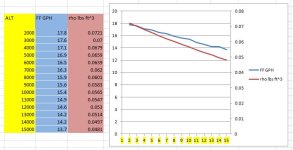
The device is not common because Bendix-type injection already does a reasonable job of matching fuel delivery to air density. Some time ago I flew a quick test, WOT at full rich from 200 feet to 15,000 feet. Here is fuel flow plotted against standard air density:

Fuel Flow vs Density.JPG

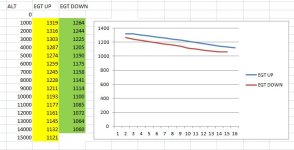
EGT change was about 200F, a change in fuel-air ratio of roughly 0.02. Although there is a loss of power, it's not huge, because the mixture sweep power curve is rather flat on the rich side of peak.

EGT Change.JPG

Why should I read the books when I can ask you.

In the case of popping exhaust, I don't recall ever reading a published explanation, in a reference or a manual. My personal experience is the same as others report above. If I rapidly reduce power at speed, I get lots of popping. If I bleed off speed with gradual reductions, I get none.

Yes, seperate circuit is carb lingo but was trying to keep it simple. There is a seperate idle mixture control that is designed to be used for metering fuel at RPMs up to 1000-1200 RPM. Was trying to make that point without a lot of detail so laymen could understand.

The transition is linked to air density, not RPM. The idle mixture valve becomes the primary fuel flow control when venturi and ram pressures are too low to meter with diaphragm control of the ball valve.
 
Last edited:
You said it popped a bit doing stalls at 9000 and then it popped worse in the pattern at 6000. My math may be fuzzy, but always thought 6000 was lower than 9000. I was not referring to traditional altitudes, just the ones you referenced.

Mixture is relative to PA. The higher you go, the leaner you need to be to maintain the same air fuel ratio. So 6000 wants a richer mixture than 9000. Therefore as popping gets worse at lower altitudes, we can speculate you are on the lean side of optimum.
Well, I was actually having popping when reducing power for stalls at 9500 MSL (which was about 12,000 DA), then more popping between pattern altitude of 7,900 MSL and touchdown at 6,900 MSL field elevation (with a calculated 9,400 density altitude).
So all pretty high.
But good point that a leaner mixture might help. And/or an adjustment to Idle mixture.
 
Last edited:
Bendix-type injection already does a reasonable job of matching fuel delivery to air density
I assume this is because the fuel servo is reasonably good at measuring air mass flow through a pitot-static mechanism, with some error factor for temperature... I guess like volume airflow measurement compensated for pressure but not temperature?
 
You got it.

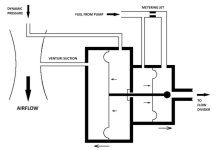
Air diaphragm and fuel diaphragm, greatly simplified. Linked together, they move a ball valve. There are details, but vacuum and dynamic pressure combined apply a variable force to the air diaphragm. Less density = less force, thus less ball valve opening.

Bendix Operating Principle.jpg
 
.
But good point that a leaner mixture might help. And/or an adjustment to Idle mixture.
I said you were on the lean side of optimum on your idle mixture. That means you are too lean and need to richen. This was all in reference to your idle mixture NOT the red knob. I also said this was just an educated guess. You really need to perform a proper idle mixture setting process, which will take idle mixture out of the equation. If you still have issues, can diagnose further.
 
Last edited:
Back
Top