Van's Air Force

The definitive Van's Aircraft support community! Buying, building or flying an RV? Join our exclusive family of mentors and enthusiasts!

Alternator Issue - Voltage Regulator?

WingnutWick

Well Known Member
Hello all,

Recently noticed my internally regulated plan power alternator on my 8 was putting out higher than normal Voltages on startup. It then tripped the alt field breaker (not the alternator breaker). Is this a sign of a failing/failed regulator?

Of note I do not have and alternator field switch, should I? I believe it’s recommended to start and shut down with the alternator off, but how critical is this?

Thanks!
 
Hello all,

Recently noticed my internally regulated plan power alternator on my 8 was putting out higher than normal Voltages on startup. It then tripped the alt field breaker (not the alternator breaker). Is this a sign of a failing/failed regulator?

Of note I do not have and alternator field switch, should I? I believe it’s recommended to start and shut down with the alternator off, but how critical is this?

Thanks!
I believe the way this works is the voltage regulator monitors the alternator output by using a voltage sense line. If the voltage is low then the field current is increased. If you had a bad connection (or no connection) for the sense to the voltage regulator then the circuit monitoring the sense might think the voltage is low and provide more and more field current causing the alternator voltage to get higher. At certain point it might trip the field current breaker. I'm not sure how your alternator / regulator are wired, but explanation does match your symptoms.
 
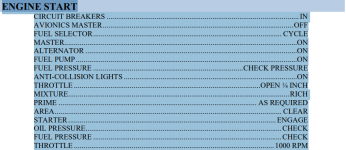
In every single-engine type certified aircraft I have flow (many), it's common practice to turn ON the Alternator Field switch unless external power has been applied -- typical Normal Procedures "Engine Start" shown below (same for Cessna, Piper Beechcraft). I'm guessing the reason is so the pilot don't start the engine and then forget to throw the Alternator switch. The alternator doesn't generate much if any current during engine start. Over charging -- sounds like your internal regulator is bad.

1769305203035.png
 
Last edited:
Check for inexpensive problems first like loose wires and crimped connectors.
The regulator voltage sense circuit should NOT have another load on it like an indicator lamp.
There are different opinions about starting the engine with the alternator field off.
My opinion is that it doesn't matter.
In case of smoke in the cockpit or imminent forced landing, the pilot shall have the ability to shut off all electrical power as close to the source(s) as possible. The battery master switch might not disable the alternator. Once running, an alternator field gets powered by the alternator itself, not the battery.
 
Hello all,

Recently noticed my internally regulated plan power alternator on my 8 was putting out higher than normal Voltages on startup. It then tripped the alt field breaker (not the alternator breaker). Is this a sign of a failing/failed regulator?

Of note I do not have and alternator field switch, should I? I believe it’s recommended to start and shut down with the alternator off, but how critical is this?

Thanks!
Talk to the techs at B&C. They will tell you makes zero difference and a waste of time debating the issue.
 
Imo there is a decent likelihood that there are problems inside your pp. so many flaws in that alternator, it is hard to say which one it may be. Strongly recommend you replace it with something other than pp. the connectors they use are junk, so start there, as it is an easy fix. Tug on the wires to see if they pull out.

I recommend an alt field switch. Normally not need, but when problems arise or testing is needed they come in handy.
 
I recommend an alt field switch. Normally not need, but when problems arise or testing is needed they come in handy.
Since the switch is normally not needed, I eliminate it - and for the occasions where I want to turn the field off, I pull the circuit breaker (which I always install). Let me caveat that with the fact I am talking about internally regulated (automotive) alternators. For externally regulated units, wire it - and operate it - the way your regulator manufacturer recommends.

Too often, we don’t differentiate between internal and external regulators in these recommendations.
 
Paul,
If you don't mind me asking......do you own/run both PP and B&C? I'm a B&C guy thru and thru. I don't mind the external Voltage Regulator. Seems fairly bullet proof, but I don't wish to discount the Plane Power unit at all.
 
Paul,
If you don't mind me asking......do you own/run both PP and B&C? I'm a B&C guy thru and thru. I don't mind the external Voltage Regulator. Seems fairly bullet proof, but I don't wish to discount the Plane Power unit at all.
I run B&C in our Tundra - flawless in 450 hours and seven years. All the rest of our Lycomings have automotive ND’s and I think I’ve replaced two alternators in about 4,000 hours among them. Haven’t had the need to try a PP, so have no experience with them.
 
Since the switch is normally not needed, I eliminate it - and for the occasions where I want to turn the field off, I pull the circuit breaker (which I always install). Let me caveat that with the fact I am talking about internally regulated (automotive) alternators. For externally regulated units, wire it - and operate it - the way your regulator manufacturer recommends.

Too often, we don’t differentiate between internal and external regulators in these recommendations.
Agreed. My rec was more biased to ER. However, your solution of a pullabe breaker meets my general recommendation for having the ability to kill power to the Alt for testing or anamolies. That is a switch in my mind. You also must factor in OV protection. Without it, you must have a means to kill the Alt IMHO.
 
Agreed. My rec was more biased to ER. However, your solution of a pullabe breaker meets my general recommendation for having the ability to kill power to the Alt for testing or anamolies. That is a switch in my mind. You also must factor in OV protection. Without it, you must have a means to kill the Alt IMHO.
I used a Potter Brumfield breaker/switch on that and other circuits that require both switch and breaker. However, the lower amperage rated PB breaker/switches can be susceptible to extreme cockpit temperatures, especially while sitting on the ground on a very hot day. It would be nice if they made a magnetic version, but these do save considerable panel space.

 
Hello all,

Recently noticed my internally regulated plan power alternator on my 8 was putting out higher than normal Voltages on startup. It then tripped the alt field breaker (not the alternator breaker). Is this a sign of a failing/failed regulator?

Of note I do not have and alternator field switch, should I? I believe it’s recommended to start and shut down with the alternator off, but how critical is this?

Thanks!
1. Check the connector - grey or black 3 pin affair on the back of the Alternator -- is the IG & Sense "loop" intact? will it survive a pull test?

As stated elsewhere, the internal regulator on the plane power uses the voltage coming in on the IG wire (and Sense "loop") to modulate the available current on the output.

2. Check the IG wire feed point the ALT FIELD breaker, intact? loose? corroded? Measure the resistance from the buss (the input to the ALT Field Breaker) and the connector mentioned in #1; Any resistance over a few milliohms will cause a voltage drop sensed by the alternator, which in turn will lie to the regulator and it will try to increase the voltage output -- to the point of tripping it's overvoltage protection.

3. What's the condition of the Battery Master Contactor and Activation switch, connectors and wiring? If the Master Contactor should open, this will cause an overvoltage condition at the alternator causing the Alt Field breaker to trip. Remember - the Master Contactor just removes the battery from the buss, not the loads or other voltage sources from the buss.

4. Care & Feeding -- Alt Field switch isn't required, and if one is installed you don't need to turn it off or on in any particular sequence. One neat trick though, turn it off during start up to give the system a bit more power to crank the motor. This is because the Plane Power alternator "wakes up" at almost 100% field current -- ~60 watts power dissipation, just sitting there...
 
Last edited:
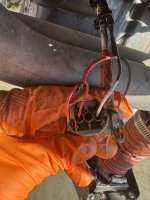
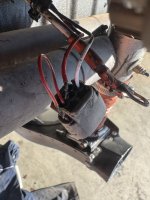
Got the cowling off and discovered the two red wires had come out of the plug. So thankfully it’s an easy fix. Any idea what type of plug and pins used in this is and where to get them? The Hartzell pigtail part is 11-1010 but that’s over $100 and I’m sure I can find the connector and pins somewhere to redo it.
 

Attachments

  • IMG_7939.jpeg
    IMG_7939.jpeg
    1.6 MB · Views: 72
  • IMG_7934.jpeg
    IMG_7934.jpeg
    1.4 MB · Views: 66
Got the cowling off and discovered the two red wires had come out of the plug. So thankfully it’s an easy fix. Any idea what type of plug and pins used in this is and where to get them? The Hartzell pigtail part is 11-1010 but that’s over $100 and I’m sure I can find the connector and pins somewhere to redo it.
Sumitomo TS 3 Way Alternator Plug Production Kit, (Toyota # 90980-11349)

https://www.bmotorsports.com/shop/product_info.php/products_id/1704
 
Hello all,

Recently noticed my internally regulated plan power alternator on my 8 was putting out higher than normal Voltages on startup. It then tripped the alt field breaker (not the alternator breaker). Is this a sign of a failing/failed regulator?

Of note I do not have and alternator field switch, should I? I believe it’s recommended to start and shut down with the alternator off, but how critical is this?

Thanks!

Please check, double check and then triple check each and every ground.

Trust me…I had a voltage over regulate situation along with starter not cranking. After 16 days of 5 experienced pilots/owners troubleshooting, 3 starters, 5 batteries & 5 different jump cables later…it turned out to be a ground issue.

In addition, you can remove the alternator and take it to a local auto shop to test if the regulator has failed.
 
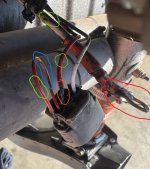
@WingnutWick; Brian gave good advice for replacing the connector, but, there are some mechanical issues here as well. Thanks to your great photo, here's what I see: there's some charring on the jumper wire (blue circle), so these parts definitely got hot. The connector housing looks a bit burnt too. Also some of the insulation got thin from rubbing against stuff (green circles). Orange circle shows some broken strands. Red circle shows a pretty bad B+ terminal, which won't lay flat, leading to high resistance in a high-amperage connection (also not good).

I'd replace all of this wiring back to the firewall or wherever it's still in good shape. And how did those wires get pulled out of the connector? Remember these engines shake like wet dogs on startup/shutdown, so adequate-length service loops need to be there to accommodate that movement. The connector that Brian linked to requires a special crimper, like this one: https://www.bmotorsports.com/shop/product_info.php/cPath/111_112_170/products_id/362. And the big B+ terminal also needs a special crimper.

Another potential issue is the heat distress which will affect the bearing and bore in the alternator casting (that's the SRE, slip ring end, or rear of the alt). We know that the bearing bore tends to expand and get loose with heat which allows the bearing race to spin in the casting and tear that up. Plus the voltage regulator might be compromised by the heat as well.

Best thing is to disassemble the alternator and inspect the SRE bearing and bore and regulator.

1769633186869.jpeg
 
@WingnutWick; Brian gave good advice for replacing the connector, but, there are some mechanical issues here as well. Thanks to your great photo, here's what I see: there's some charring on the jumper wire (blue circle), so these parts definitely got hot. The connector housing looks a bit burnt too. Also some of the insulation got thin from rubbing against stuff (green circles). Orange circle shows some broken strands. Red circle shows a pretty bad B+ terminal, which won't lay flat, leading to high resistance in a high-amperage connection (also not good).

I'd replace all of this wiring back to the firewall or wherever it's still in good shape. And how did those wires get pulled out of the connector? Remember these engines shake like wet dogs on startup/shutdown, so adequate-length service loops need to be there to accommodate that movement. The connector that Brian linked to requires a special crimper, like this one: https://www.bmotorsports.com/shop/product_info.php/cPath/111_112_170/products_id/362. And the big B+ terminal also needs a special crimper.

Another potential issue is the heat distress which will affect the bearing and bore in the alternator casting (that's the SRE, slip ring end, or rear of the alt). We know that the bearing bore tends to expand and get loose with heat which allows the bearing race to spin in the casting and tear that up. Plus the voltage regulator might be compromised by the heat as well.

Best thing is to disassemble the alternator and inspect the SRE bearing and bore and regulator.

View attachment 108454

Excellent observation and points by @hgerhardt ; While we're fixing things - and this applies to ALL y'all (Texas term for "EVERYBODY") - please put a heatshield on that exhaust cross over pipe -- the Alternator is getting quite the sunburn without one (I know it's Infrared, not UV-A/B/C -- but it's close to 1000°F at that location); We're not trying to make toast...

One of these - or equivalent https://store.vansaircraft.com/clamp-on-exhaust-heat-shield-ea-lv-1-heat-shield.html, maybe make it a little longer.
 
Aircraft Spruced did sell a replacement regulator for the Plane Power alternator at a fair price. Not sure it is still available with the new Hartzell ownership .
 
Back
Top