Van's Air Force

The definitive Van's Aircraft support community! Buying, building or flying an RV? Join our exclusive family of mentors and enthusiasts!

Aircraft Logbooks 101?

rv12is

Well Known Member
Patron
As I'm nearing the finish of my project, one item I have questions about are the logbooks. I've never owned an airplane before, and haven't ever paid too much attention to the logbooks associated with rentals. So, I have zero experience on best practices in regards to aircraft logs.

I've done some Google searching, but haven't managed to find much that's been helpful. As someone new to logbooks, I'll need to know not only the basics, but also what are considered best practices. Can anyone point me to some good resources?
 
And as a corollary, are there specific items that should be recorded in the logbooks before the build is complete (besides the obvious like ELT battery, etc)?
 
I'm going to glom onto this post to ask: what is the correct way to handle running out of space in an airframe logbook? Lots of space left in inspections section, but out of space in maintenance section.
 
I'm going to glom onto this post to ask: what is the correct way to handle running out of space in an airframe logbook? Lots of space left in inspections section, but out of space in maintenance section.
I just line through the title and add in my description if it can be done cleanly and communicates well. There are no FAR’s that I am aware of that dictate how a log book gets organized, just what information needs to be there….
 
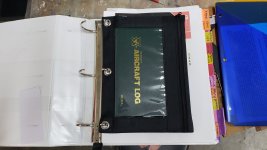
Here's my solution for what it's worth.
Log fits in a pouch inside the 3-ring. The 3-ring has all the manufacturer manuals. Same for the Engine log and Prop log. Except the Hartzel Prop manual is smaller. I've considered reprinting it 8.5x11.
I prefer to keep maintenance in spreadsheets so it's easy to print sheets for the 3-ring. The logbooks will be restricted to more abbreviated entries.
 

Attachments

  • 20240917_162626.jpg
    20240917_162626.jpg
    1.2 MB · Views: 33
Here's my solution for what it's worth.
Log fits in a pouch inside the 3-ring. The 3-ring has all the manufacturer manuals. Same for the Engine log and Prop log. Except the Hartzel Prop manual is smaller. I've considered reprinting it 8.5x11.
I prefer to keep maintenance in spreadsheets so it's easy to print sheets for the 3-ring. The logbooks will be restricted to more abbreviated entries.
I do this as well. My checklist is structured with common maintenance items noted as well as lines for notes for each page by section; ie Tail, Emepnnage, Fuselage, etc…..
 
The standard logbook is ancient in layout, but used by the vast majority. As an AP/IA, I see a bunch of them. I often completely disregard the lines and blocks, merely writing all the pertinent data. Many repair stations use adhesive printed labels that are just stuck over the page. You can make your own informal logbook (large page ones,8.5X11, are really nice) or whatever you choose. The regs don't mandate anything, just suggest. More than pertinent details can become excess babble, but detail goes a long way in resale/ new ownership.
 
I strongly suggest separate Airframe, Engine and Propeller log books. If you ever decide to do an engine or prop change, you will need them to sell the engine or prop.
Keep the entries clear and concise. If you are doing your own condition inspections there is specific wording for those entries. I find it helpful to include make/model/serial number for components; it is helpful if there is an SB or AD on a component.
I log SB compliance in the log book but I also maintain a separate spreadsheet with all relevant SB.
 
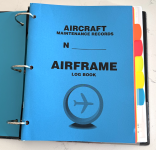
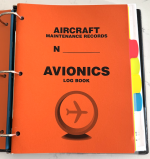
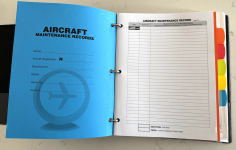
We've owned our 182 for 31 years. I've always used the pouches that fit in a 3 ring binder, as pictured above. Always until two years ago. I picked up a "single engine logbook kit" from Aircraft Spruce. It has 4 separate 8.5 x 11" books that fit in a 3 ring binder. Airframe, Engine, Propeller, Avionics. I still paste self adhesive logbook entries but the format of these books is far superior to the traditional small format logbooks, in my opinion. BTW, I did not wait until my old logbooks were full. I just made a notation in each that I was moving to a new book.

When my 14 is done, I will use the same thing.
 
We've owned our 182 for 31 years. I've always used the pouches that fit in a 3 ring binder, as pictured above. Always until two years ago. I picked up a "single engine logbook kit" from Aircraft Spruce. It has 4 separate 8.5 x 11" books that fit in a 3 ring binder. Airframe, Engine, Propeller, Avionics. I still paste self adhesive logbook entries but the format of these books is far superior to the traditional small format logbooks, in my opinion. BTW, I did not wait until my old logbooks were full. I just made a notation in each that I was moving to a new book.

When my 14 is done, I will use the same thing.
I think these are probably the same ones that I got.
https://www.aircraftspruce.com/catalog/pspages/logbook13-18063.php

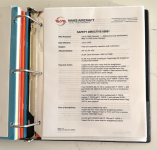
I've put them in a 3 ring binder, along with the Production Acceptance Procedures and all completed service bulletins, safety directives and notifications.
Screenshot 2024-12-02 at 4.31.06 PM.pngScreenshot 2024-12-02 at 4.31.14 PM.pngScreenshot 2024-12-02 at 4.31.33 PM.pngScreenshot 2024-12-02 at 4.32.06 PM.png

Now I need to figure out what I should put in them.
 
I’m just format the page on excel and print out more pages when the log needs more paper. I have one log book that documents everything including oil change, compression, etc. I have the Ly coming log book but I can’t find a reason to log anything in it
 
I use Adlog for my Dakota and bought the binder and logs for the vans and zenith, it’s got more then logs, dividers for ad, sb, etc
 
IMHO, I would look at it more from the eye of a potential buyer in the future. Log books can make or break a sale. It only takes a few minutes extra to do it right.

What I believe is important.
* Log books should look professional and have complete entries. Ex. don't just say completed CI per the manual. Call out details like, inspected oil filter; no anomalies and compressions 78/80, 77,80,....
* If you add / replace hardware note the model and the serial numbers, which helps with SBs, ADs,... reviews in the future. Call out why you did it. If I saw someone that replaced a prop with no other annotations, I assumed it was due to a prop strike.
* Record when you replace or inspect a time based item. The assumption is you never did it, if I can't find it.
* If you have a printer at home, buy some shipping labels and print your entries out from a computer.

I use a common format. The header includes Tail Number, Date and Relevant Times for the log (TT, TSMO, TTAF,...). The body is basically what I did, what did I find, important details (ex. model, SN) and reference used. The close is the return to service and my information.

I think it is worth looking at a few log books and I believe you will quickly see what a quality entry looks like. Local A&Ps should be able to share some examples or you can browse any of the major sales sites. Log books are normally uploaded and you can browse those. Compare what a 60 year old 172 log book looks like vs a Cirrus or Diamond which normally gets service done at a national service center.
 
IMHO, I would look at it more from the eye of a potential buyer in the future. Log books can make or break a sale. It only takes a few minutes extra to do it right.

What I believe is important.
* Log books should look professional and have complete entries. Ex. don't just say completed CI per the manual. Call out details like, inspected oil filter; no anomalies and compressions 78/80, 77,80,....
* If you add / replace hardware note the model and the serial numbers, which helps with SBs, ADs,... reviews in the future. Call out why you did it. If I saw someone that replaced a prop with no other annotations, I assumed it was due to a prop strike.
* Record when you replace or inspect a time based item. The assumption is you never did it, if I can't find it.
* If you have a printer at home, buy some shipping labels and print your entries out from a computer.

I use a common format. The header includes Tail Number, Date and Relevant Times for the log (TT, TSMO, TTAF,...). The body is basically what I did, what did I find, important details (ex. model, SN) and reference used. The close is the return to service and my information.

I think it is worth looking at a few log books and I believe you will quickly see what a quality entry looks like. Local A&Ps should be able to share some examples or you can browse any of the major sales sites. Log books are normally uploaded and you can browse those. Compare what a 60 year old 172 log book looks like vs a Cirrus or Diamond which normally gets service done at a national service center.
Thank you! This is the type of information I was looking for. I hadn't thought about it from the perspective of a potential buyer yet.

I also agree that the best thing for me to do would be to look at a few log books. I've already examined a few from online sales, and feel like I'm starting to get a better understanding of what's expected.
 
I made my own version of the Adlog system on 8.5 X 11 pages in a large 3-ring binder. I can print as many pages as I want for each section to be filled out as time goes on. I have tabbed sections for Aircraft, Engine, Propeller, SB’s, Weight and Balance, Equipment list, and a Documents section where I keep misc things like current PAPR report. Everything for my airplane is in one convenient binder. I have a separate 3-ring binder where I keep stuff like wiring diagrams, equipment pages for specific equipment, etc.
 
Back
Top