


Van's Air Force

The definitive Van's Aircraft support community! Buying, building or flying an RV? Join our exclusive family of mentors and enthusiasts!

Accidentally used acetone on canopy. Am I doomed?

bertschb

Where's my engine????
Sponsor
So today I was scuffing the leading edge of my canopy getting ready to do the fiberglass work. After finishing the scuffing, I removed the 3M electrical tape because I was paranoid about it interacting chemically with the canopy and won't be doing the fiberglass work for another day or two. After removing the tape, I noticed a tiny bit of tape residue caused by sanding over the tape. Sooooo, I decided to clean it off and grabbed my go-to cleaner - acetone. About 3 seconds after I wiped it onto a small section of the canopy (shown below) I realized my mistake and quickly grabbed my isopropyl alcohol and wiped the same area with that and then grabbed a paper towel, put some water on it and wiped it down with that. The whole ordeal took less than 30 seconds.

So my question is - am I doomed to cracks and crazing in this area? If so, how long does it take for them to show up? This area has been sanded on the inside and outside (per the plans). Should I replace the canopy now before I bond it to the canopy frame assembly? This airplane build is going to give me a heart attack before I'm done....
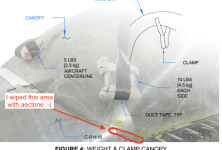
Screenshot 2025-04-20 at 7.02.02 PM.png
 
Last edited:
So today I was scuffing the leading edge of my canopy getting ready to do the fiberglass work. After finishing the scuffing, I removed the 3M electrical tape because I was paranoid about it interacting chemically with the canopy and won't be doing the fiberglass work for another day or two. After removing the tape, I noticed a tiny bit of tape residue caused by sanding over the tape. Sooooo, I decided to clean it off and grabbed my go-to cleaner - acetone. About 3 seconds after I wiped it onto a small section of the canopy (shown below) I realized my mistake and quickly grabbed my isopropyl alcohol and wiped the same area with that and then grabbed a paper towel, put some water on it and wiped it down with that. The whole ordeal took less than 30 seconds.

So my question is - am I doomed to cracks and crazing in this area? If so, how long does it take for them to show up? This area has been sanded on the inside and outside (per the plans). Should I replace the canopy now before I bond it to the canopy frame assembly? This airplane build is going to give me a heart attack before I'm done....

View attachment 85743
As a point of reference. On my original 4 I had some overspray of paint on the canopy. I used an old piece of canopy scrap and tested removing paint with no issues. I removed the overspray paint with acetone. I owned the airplane 15 years with no problems. I know acetone does not get along with screwdriver handles but it was not an issue on the canopy in my case anyway.
 
So today I was scuffing the leading edge of my canopy getting ready to do the fiberglass work. After finishing the scuffing, I removed the 3M electrical tape because I was paranoid about it interacting chemically with the canopy and won't be doing the fiberglass work for another day or two. After removing the tape, I noticed a tiny bit of tape residue caused by sanding over the tape. Sooooo, I decided to clean it off and grabbed my go-to cleaner - acetone. About 3 seconds after I wiped it onto a small section of the canopy (shown below) I realized my mistake and quickly grabbed my isopropyl alcohol and wiped the same area with that and then grabbed a paper towel, put some water on it and wiped it down with that. The whole ordeal took less than 30 seconds.

So my question is - am I doomed to cracks and crazing in this area? If so, how long does it take for them to show up? This area has been sanded on the inside and outside (per the plans). Should I replace the canopy now before I bond it to the canopy frame assembly? This airplane build is going to give me a heart attack before I'm done....
I think you removed the residue and cleaned it up. I would not replace canopy. The damage is done, if any or may be nil... If it is a high stress area crazing may occur. Stress is a key in crazing, with environment factors, regardless of acetone. Since you sanded this area down, you have removed microcracks. I would use very fine sandpaper in the 300-500 range to polish it. This is under your fiberglass fairing I think. You are good as far as cloudiness. Your rag was not sopping wet with acetone and left standing for a long time. You quickly cleaned it off.

Google says: acetone will damage plexiglass (acrylic). Acetone is harmful to plexiglass. It is a solvent and will make it cloudy and possibly cause mocrofractures. It can also soften he acrylic and even dissolve it. Exposed to acetone for extended periods is worse case. Your plexi was not exposed too long. What was on evaporated quickly, then you cleaned it.
 
Is that area not covered by fibreglass? It will need to be scuffed up real well. I really doubt you caused any damage.
I also painted that area inside that can be scene when I painted the rest of the canopy.
 
Last edited:
Thanks for the feedback guys. To answer a couple questions: -Yes, this area will be covered by fiberglass - at least the majority of it will. I probably got acetone on an additional 1" aft of the scuffed area. I can't use fine sandpaper on the outside of the canopy in this area as the plans call for using 80 grit sandpaper on both the canopy and skin to rough it up so the fiberglass will adhere to it. I do plan to use black pigment in the fiberglass on the initial strip that gets laid down. Scot (Vans video) used gray but I want it to be black.

My main concern is not knowing how long it might take for problems to manifest themselves. I also don't know what the cracks people refer to look like. I've seen tiny cracks around drilled holes but do huge cracks open up eventually? If I end up with tiny cracks or a "glazed" (foggy) area under the fiberglass, no big deal. If a 12" crack opens up a year from now, that would be bad.
 
So today I was scuffing the leading edge of my canopy getting ready to do the fiberglass work. After finishing the scuffing, I removed the 3M electrical tape because I was paranoid about it interacting chemically with the canopy and won't be doing the fiberglass work for another day or two. After removing the tape, I noticed a tiny bit of tape residue caused by sanding over the tape. Sooooo, I decided to clean it off and grabbed my go-to cleaner - acetone. About 3 seconds after I wiped it onto a small section of the canopy (shown below) I realized my mistake and quickly grabbed my isopropyl alcohol and wiped the same area with that and then grabbed a paper towel, put some water on it and wiped it down with that. The whole ordeal took less than 30 seconds.

So my question is - am I doomed to cracks and crazing in this area? If so, how long does it take for them to show up? This area has been sanded on the inside and outside (per the plans). Should I replace the canopy now before I bond it to the canopy frame assembly? This airplane build is going to give me a heart attack before I'm done....

View attachment 85743
I use goof off or goo gone for stuff like this on the glass and then go behind it with a damp cloth with dawn.
 
Thanks for the feedback guys. To answer a couple questions: -Yes, this area will be covered by fiberglass - at least the majority of it will. I probably got acetone on an additional 1" aft of the scuffed area. I can't use fine sandpaper on the outside of the canopy in this area as the plans call for using 80 grit sandpaper on both the canopy and skin to rough it up so the fiberglass will adhere to it. I do plan to use black pigment in the fiberglass on the initial strip that gets laid down. Scot (Vans video) used gray but I want it to be black.

My main concern is not knowing how long it might take for problems to manifest themselves. I also don't know what the cracks people refer to look like. I've seen tiny cracks around drilled holes but do huge cracks open up eventually? If I end up with tiny cracks or a "glazed" (foggy) area under the fiberglass, no big deal. If a 12" crack opens up a year from now, that would be bad.
Build on. You are concerned about something that may never happen and you can't do anything about it now.
 
For future reference, leave the Acetone, MEK, Xylene, in the can...at the hardware store...

I can't predict the future, otherwise I'd be posting on the Gulfstream G5 forums about silicone :) But, the canopy is fine - there's no residual acetone, you've cleaned the area and you're going to cover it with an epoxy resin.

Also, invest in a Micromesh Plastic polishing kit.
 
Thanks for the feedback guys. To answer a couple questions: -Yes, this area will be covered by fiberglass - at least the majority of it will. I probably got acetone on an additional 1" aft of the scuffed area. I can't use fine sandpaper on the outside of the canopy in this area as the plans call for using 80 grit sandpaper on both the canopy and skin to rough it up so the fiberglass will adhere to it. I do plan to use black pigment in the fiberglass on the initial strip that gets laid down. Scot (Vans video) used gray but I want it to be black.

My main concern is not knowing how long it might take for problems to manifest themselves. I also don't know what the cracks people refer to look like. I've seen tiny cracks around drilled holes but do huge cracks open up eventually? If I end up with tiny cracks or a "glazed" (foggy) area under the fiberglass, no big deal. If a 12" crack opens up a year from now, that would be bad.
Cracking happens after solvent contact because the solvent removes plasticizers in the acrylic. Since you wiped off right away, the acetone & isopropanol would not have penetrated very far, so any resulting cracks are likely to be shallow and small. Most importantly, they are not likely to propagate into the canopy that did not have solvent contact, unless it is stressed.
 
Back
Top