Van's Air Force

The definitive Van's Aircraft support community! Buying, building or flying an RV? Join our exclusive family of mentors and enthusiasts!

912IS Electrical Indications on the Garmin G3X Touch

mhailey

Member
Patron
Could someone explain what I am seeing on the G3X Touch EIS like I am a 6th grader. I was flying a 2 hour leg yesterday, and happened to open the EIS display. There was no alert either white or yellow. I noticed right away the Battery Amps in the negative. I normally fly with all lights on. I will upload some images I took. Is this a normal indication or as I suspect the B Generator is not working? As a side note the Gen came up normally after engine start and 2500 RPMs

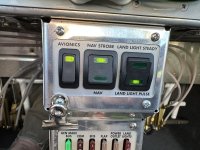
Initail Indication.JPGInital light setup.JPG
 
While I cannot explain it to you I can tell you that I often see, while in cruise stage of flight, BATT AMPS fluctuate between "0" and "-1" I, too, fly with NAV STROBE and LAND LIGHT PULSE since the Rotax generates more than enough power to do so. Why not be seen by other pilots?
 
If you're sure this is a nuisance indication, then you might check out the "Zero Deadband" setting on the appropriate current calibration page in configuration mode.
 
Thanks for the inputs.

Amadeus it's good to hear this is not unusual. Do you think it would it be safe to say this ALT AMPS gauge is telling me how much work is being done by the B 30amp Alternator? I'll upload an image from when I turned the Landing Light off. Notice the BATT AMPS changed -1 turned to 0 , and ALT AMPS changed from 10 to 8AMPS, possibly indicating less work being performed.
If you are wondering why I am interested in this subject I am considering a heated Pitot install at the next CI. I already have a GPS175 installed, so just wondering on electrical load.

Matt I will look at the calibration page. I wonder if it's not set at a default of .5, thus making it show -1. I'll investigate changing the deadband to 1.


Turn off lights switching.JPGEIS after turning off lights.JPG
 
Matt Burch's suggestion of adjusting the "Zero Deadband" is worth a try. Since the Alt Amps is just at 10, it's far from near capacity. I've had a similar -1 Batt Amps show up, but only during cold (e.g. 10 F or colder) temps, which I attribute to cold air blowing on the very small reference shunt of the AV-60000 circuit board. That would lower its resistance and produce a spurious reference voltage drop across the shunt, which is the basis for calculating the amperage going to or from the battery. Since I only see that at very cold temps, and your OAT is 53 F, that reason doesn't seem to apply to your situation.
 
When the load is stable (you havent turned on/off the landing lights recently), the alternator is outputting a specific voltage.. 13.9v.. and everything on the bus is energized to about 13.9v.. including the battery. At some point, the battery is "full" and can't accept any more charge.. so you see 0 A.

When you turn on a big load, like the landing lights, this causes the voltage on the main bus to drop a little bit. The drop is due to the wire gauges used, the traces on the back of the Power Module, etc. Really fat wires - very little resistance in the wire, very little voltage drop. Really thin wires - a lot of resistance, lots of voltage drop.. Wire heats up due to the resistance, and in extreme cases, the wire's insulation can melt or catch fire. This is why conductor size is chosen based on the amperage that may go thru it.

On the RV-12iS, the wire from the fusebox to the Power Module is 5' and 10AWG. 13.9v over 10 gauge wire (copper), 5 feet long at 10A will drop -0.12v to 13.78v. Consider now that the landing lights (and everything else) are being powered by all sources on the bus -- the alternator at 13.78v and the battery at 13.9v. The battery will discharge until its also at 13.78v. So you will see the battery discharging until it gets back down to equilibrium with the other power sources on the bus.

As a practical matter, you really only care about battery discharge as a way to make sure the alternator hasnt crapped out.. so as long as its not discharging at -5 A or more.. then its likely working OK. I have theorized that swapping out the fusebox <-> Power Module wire to 8 gauge will help slightly..but its never been worth my time/expense to try it out.

 
Back
Top