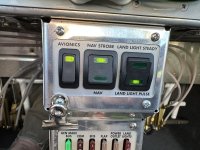
When the load is stable (you havent turned on/off the landing lights recently), the alternator is outputting a specific voltage.. 13.9v.. and everything on the bus is energized to about 13.9v.. including the battery. At some point, the battery is "full" and can't accept any more charge.. so you see 0 A.
When you turn on a big load, like the landing lights, this causes the voltage on the main bus to drop a little bit. The drop is due to the wire gauges used, the traces on the back of the Power Module, etc. Really fat wires - very little resistance in the wire, very little voltage drop. Really thin wires - a lot of resistance, lots of voltage drop.. Wire heats up due to the resistance, and in extreme cases, the wire's insulation can melt or catch fire. This is why conductor size is chosen based on the amperage that may go thru it.
On the RV-12iS, the wire from the fusebox to the Power Module is 5' and 10AWG. 13.9v over 10 gauge wire (copper), 5 feet long at 10A will drop -0.12v to 13.78v. Consider now that the landing lights (and everything else) are being powered by all sources on the bus -- the alternator at 13.78v and the battery at 13.9v. The battery will discharge until its also at 13.78v. So you will see the battery discharging until it gets back down to equilibrium with the other power sources on the bus.
As a practical matter, you really only care about battery discharge as a way to make sure the alternator hasnt crapped out.. so as long as its not discharging at -5 A or more.. then its likely working OK. I have theorized that swapping out the fusebox <-> Power Module wire to 8 gauge will help slightly..but its never been worth my time/expense to try it out.