


Van's Air Force

The definitive Van's Aircraft support community! Buying, building or flying an RV? Join our exclusive family of mentors and enthusiasts!

6A Leg Reinforcement

DanH

Legacy Member
Benefactor
Advertiser
Mentor
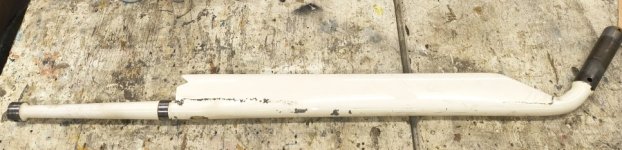
This is a nose leg from a 6A, off the airplane for a SB 07-11-08 fork upgrade. The original builder glassed on what appears to be a hardwood stiffener.
ScreenHunter_2821 Jun. 08 20.57.jpg

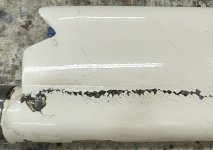
From the color, it appears to be polyester resin and glass, which makes sense given the vintage. It wasn't strong enough to stand up long term, so the glass fiber appears broken.
ScreenHunter_2820 Jun. 08 20.57.jpg

It's hard to know what the builder had in mind, cosmetics or reinforcement, but it seems to me the application requires treating it as a reinforcement, or it will just crack again, as above.

The trick box here is the difficulty of knowing the applied load at the joint, in order to know how many plies of what material needs to be in the new layup. Best approach is probably empirical. Anyone have application experience with a nose leg stiffener like this?
 
I understand that the nose gear leg is supposed to be able to flex fore and aft. The plans show how to make a wooden damper strip bonded onto the MAIN gear legs, but not for the nose gear leg.

p.s. if the fiberglass is cracked then it is possible that moisture has got in and caused corrosion on the gear leg underneath, this has happened before on some main gear legs here.
 
Last edited:
Sorry, but have no experience to offer .. however, interested to know what you learn here. I have found the nose gear leg to move a lot while taxing. I have had observers tell me it is wobbling around and the see nose wheel pant going up and down. I have no shimmy or other objectionable issues, but feel that a damper would be a good thing, but would need to be strong enough to resist some of the movement versus the classic cyclical or frequency dampening to add much value. My fear was that there is a lot more flexing happening than what is seen on the mains and therefore dampers would need to be more strongly attached.
 
This is a nose leg from a 6A, off the airplane for a SB 07-11-08 fork upgrade. The original builder glassed on what appears to be a hardwood stiffener.

View attachment 89747

From the color, it appears to be polyester resin and glass, which makes sense given the vintage. It wasn't strong enough to stand up long term, so the glass fiber appears broken.

View attachment 89748

It's hard to know what the builder had in mind, cosmetics or reinforcement, but it seems to me the application requires treating it as a reinforcement, or it will just crack again, as above.

The trick box here is the difficulty of knowing the applied load at the joint, in order to know how many plies of what material needs to be in the new layup. Best approach is probably empirical. Anyone have application experience with a nose leg stiffener like this?
Dan,
Builders usually attach these in an attempt to cure excess shimmy of the leg. Most often, the real problem is that the socket for that leg [part of the engine mount] is machine fit prior to the welding being done. The welding distorts the socket. Vans instructions tell the builder to simply sand/grind away on the ID of the socket to achieve a fit. The builder overdoes this and creates a loose fit, causing the excess motion in the joint. Proper way to do that is to use an adjustable reamer set to the proper ID of the socket. This allows the leg to fit, without creating excess clearance.
Bonding a dampener to the steel leg will usually cause corrosion of the leg at the contact points. Best to carefully remove that dampener. Check the fit of the leg in the socket. There should only be .001" - .002" clearance. Better to install an AntiSplat Aero Nose Job 2 dampener if needed. Do anything possible to reduce the weight on the nose gear.
 
Some comparison with the Anti-Splat is inevitable. At the structural level, the AS device stiffens against the fork being pushed rearward, while the hardwood stiffener resists that and vertical bending....one way vs two way.

Here the socket fit is fine. I'll be stripping the old glass and inspecting the leg for corrosion. Looking for input regarding similar applications.
 
On main gear legs at least, I remember that some folks were using hardwood stiffeners held to the leg with fiberglass strapping tape.

Ed
 
Hi Dan,
This looks like the builder built a faring on the leg. If this RV6 kit is pre 99, it used a U-603 leg (SB 98-10-1).
After 99, Van's went to a U-603-2 leg that was tapered in a different location.
Instead of altering this leg, (if it is a U-603) just purchase the -2. The new one will be of the shorter version and comply with SB 07-11-09.
You will need to send in the old leg to match drill..... And then top it off with a fiberglass faring.
 
Last edited:
This looks like a bad idea. This gear leg is stiffened in the direction it is supposed to flex during landing and taxi loads. The stiffening causes much higher bending loads at the root than would occur if the leg were allowed to flex as designed, during dynamic loading.

The stiffeners on the main gear (if used) are primarily not in the axis of up/down flexibility, but do increase the stiffness in the for/aft direction, which tends to be the shimmy mode of the mains. Some component of the stiffeners do affect the up/down stiffness since they gear are swept back.
 
Owner has elected to leave it as is for now. On to the next task...
 
Back
Top
