Van's Air Force

The definitive Van's Aircraft support community! Buying, building or flying an RV? Join our exclusive family of mentors and enthusiasts!

#3 braided stainless lines for brakes.

Blain

Well Known Member
Patron
As usual I can’t leave “good enough” alone. Want to use stainless Teflon lines in place of the nylon in the kit. I just finished a Beringer setup on another ship that used #3 but with banjo fittings. That won’t work with the 1/8” FIP thread in the master cylinders. So, question is, are there fitting available in #3 to MIP 90 degree? Prefer not to use 2 fittings to get there. Searched several different ways with no luck.
 
As usual I can’t leave “good enough” alone. Want to use stainless Teflon lines in place of the nylon in the kit. I just finished a Beringer setup on another ship that used #3 but with banjo fittings. That won’t work with the 1/8” FIP thread in the master cylinders. So, question is, are there fitting available in #3 to MIP 90 degree? Prefer not to use 2 fittings to get there. Searched several different ways with no luck.
TS Flightlines can make whatever you need. On my 9 I used #3 Teflon/Stainless line from the firewall to the brakes and they put a #4 fitting on the #3 line. Caliper has a #4 AN fitting. Line was flexible enough to just circle around the gear leg like the aluminum line used to.

Don Broussard
RV9 Rebuild in Progress (In Paint)
57 Pacer.
 
I switch my lines from the Nylos I built it with to the braided lines after leaks and failures became regular issues with Nylos. Tom at Flightlines made me the #2 lines , which are smaller diameter, easier to run and just as effective. Tiny calipers don't need much flow.
 
XRP Fittings has them and you can make your own right at home. They have all SS fittings. I used AN3 steel fittings on the brakes and master.
 
As usual I can’t leave “good enough” alone. Want to use stainless Teflon lines in place of the nylon in the kit. I just finished a Beringer setup on another ship that used #3 but with banjo fittings. That won’t work with the 1/8” FIP thread in the master cylinders. So, question is, are there fitting available in #3 to MIP 90 degree? Prefer not to use 2 fittings to get there. Searched several different ways with no luck.
Blain---use AN822-3D (90*s) and -3 hose ends. We do this on the RV14s and others. We have jump sized hose ends to go from -3 hose to -4 as well..
Tom
 
I don't like the nylon brake lines. Currently I'm replacing them on a rv4 for a friend. Was leaking where the line enters the caliper
It’s a common area that many folks simply don’t seem to understand how to do correctly.
Done right, no worries….. and it isn’t that hard to do. There are thousands flying with thousands of hours and no issues, yet, folks think they leak all the time. They don’t. I’m a broken record….
Do it right the first time and never look back. Or, call Tom. His product is pre-done and tested for you. Easy Peazy.
…but hey, I’m the guy who took out perfectly good flexible main fuel lines and replaced with hard lines just as a “right of passage”, so what do I know?
 
It’s a common area that many folks simply don’t seem to understand how to do correctly.
Done right, no worries….. and it isn’t that hard to do. There are thousands flying with thousands of hours and no issues, yet, folks think they leak all the time. They don’t. I’m a broken record….
Do it right the first time and never look back. Or, call Tom. His product is pre-done and tested for you. Easy Peazy.
…but hey, I’m the guy who took out perfectly good flexible main fuel lines and replaced with hard lines just as a “right of passage”, so what do I know?
I have high regards for Tom at TS however I prefer to "build" and not just "order". What I was asking was for a single fitting that captured the tubing with, probably an olive compression with 1/8" MIP on a 90. All in one fitting without doing a 90 adapter and flare to hose-1 less joint to leak.
 
This might be helpful for you. The link to the diagram has the part numbers for fittings - from an Australian supplier but it will give you an idea what I used.

Making up the hose ends was easily the least fun part of this build. Get the proper aluminium jaws for your vice.

I tested every hose to as high as my compressor would go.

 
It’s a common area that many folks simply don’t seem to understand how to do correctly.
Done right, no worries….. and it isn’t that hard to do. There are thousands flying with thousands of hours and no issues, yet, folks think they leak all the time. They don’t. I’m a broken record….
Do it right the first time and never look back. Or, call Tom. His product is pre-done and tested for you. Easy Peazy.
…but hey, I’m the guy who took out perfectly good flexible main fuel lines and replaced with hard lines just as a “right of passage”, so what do I know?
Probably mishandling when removing the caliper to change brake linings caused the leak
 
I tested every hose to as high as my compressor would go.
Tom might chime in but thats probably less than 10% of what they should be tested to. It’s been a long time, but all the hoses I built were tested to something like 1500psi.
 
I have high regards for Tom at TS however I prefer to "build" and not just "order". What I was asking was for a single fitting that captured the tubing with, probably an olive compression with 1/8" MIP on a 90. All in one fitting without doing a 90 adapter and flare to hose-1 less joint to leak.
Blain----a 1 piece Male 1/8 NPT /90* to teflon is most probably something you wont find. See----NPT threads are tapered, so your final torqued orientation may not be in alignment with where you want the hose to route. And if you did, then once you assembled the hose end on the hose, you'd have to spin the fitting around and around to get it tight---imagine doing that with long hoses. Sorry, but I'll stick with the AN adapters and flared hose ends. Thats a proven reliable solution.
 
I should have added, I didn’t build the second set. I called Tom. I sent my rubber hoses to him and he built me Teflon. Won’t need to do it again. Thx Tom!
 
Tom might chime in but thats probably less than 10% of what they should be tested to. It’s been a long time, but all the hoses I built were tested to something like 1500psi.
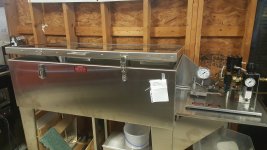
A compressor 'might' go to 150 psi if you really crank the regulator. We have Proof testing test benches that can go to 7500 psi. We normally test everything at 2000 psi for -2 through -8. -10 through -16 is 1500-1000 depending on size. Thats because we use a different hose. So if you are testing your brake hoses or retract hydraulics (;)) at 150 psi, thats not really doing a proof test, since max brake pressure might get to 450, and retract hydraulics to 1200-1500 psi, dependent on the system.
Just because inquiring minds might want to know, when we are doing development on new hose ends to hose, espeically in the -3 to -8 range, we run them to 7500. Why? LOL, I'm alittle crazy; Im the son of a US Marine Explosive Ordnance Disposal Officer, so blowing things up are kinda fun; and we need to know the yield points. (Sometimes just for giggles, I'll undercrimp a hose end and run the pressures up, just to hear the fitting blow off). Dont worry, stainless proof test cabinet with shatter proof glass ( I hope). In our production shop, they PT EVERY hose they build, and data tag them, with a paper trail, to assure our customers of a quality assembly. Tom

 

Attachments

  • Hydrostatic pressure tester.jpg
    Hydrostatic pressure tester.jpg
    422.1 KB · Views: 22
A compressor 'might' go to 150 psi if you really crank the regulator. We have Proof testing test benches that can go to 7500 psi. We normally test everything at 2000 psi for -2 through -8. -10 through -16 is 1500-1000 depending on size. Thats because we use a different hose. So if you are testing your brake hoses or retract hydraulics (;)) at 150 psi, thats not really doing a proof test, since max brake pressure might get to 450, and retract hydraulics to 1200-1500 psi, dependent on the system.
Just because inquiring minds might want to know, when we are doing development on new hose ends to hose, espeically in the -3 to -8 range, we run them to 7500. Why? LOL, I'm alittle crazy; Im the son of a US Marine Explosive Ordnance Disposal Officer, so blowing things up are kinda fun; and we need to know the yield points. (Sometimes just for giggles, I'll undercrimp a hose end and run the pressures up, just to hear the fitting blow off). Dont worry, stainless proof test cabinet with shatter proof glass ( I hope). In our production shop, they PT EVERY hose they build, and data tag them, with a paper trail, to assure our customers of a quality assembly. Tom

Like Tannerite for us less-professional folks....?
 
Tom might chime in but thats probably less than 10% of what they should be tested to. It’s been a long time, but all the hoses I built were tested to something like 1500psi.
I know, but it was the best i could do in my shed.

My plan is to add some brake fluid once i get the brakes on, and crank as hard as can on the pedels (and look for leaks). I can then replace / repair as need be. Hopefully they are fine.
 
6:20 in the above video....:eek:

How much pressure can it make....
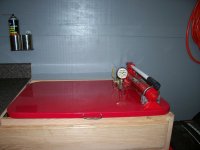
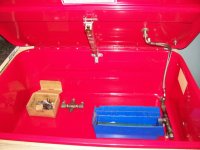
On a similar note, way back in the early days, I made a pressure tester from a cleaning tank and a hydraulic ram pump. 2 different gauges, 1 was to 6000 psi, the other was to 10,000, the max pressure of the pump. Worked fine as a portable tester. Since teflon was impervious to fluids, I used ISO46 hydraulic fluid, for the orings in the pump. YEP, had to flush the hose really good afterwards. I have to say the test cabinets and systems we have now are ALOT better. But for those that want to make your own assemblies, this is an easy way to test them. YES---contain them in some sort of cabinet----just in case!
Tom
 

Attachments

  • 101_1662.JPG
    101_1662.JPG
    174.4 KB · Views: 18
  • 101_1663.JPG
    101_1663.JPG
    169.2 KB · Views: 18
Blain----a 1 piece Male 1/8 NPT /90* to teflon is most probably something you wont find. See----NPT threads are tapered, so your final torqued orientation may not be in alignment with where you want the hose to route. And if you did, then once you assembled the hose end on the hose, you'd have to spin the fitting around and around to get it tight---imagine doing that with long hoses. Sorry, but I'll stick with the AN adapters and flared hose ends. Thats a proven reliable solution.
You make a good point, Tom. Thinking about it further I realized even the banjo fittings has 2 joints. Gotta' quit trying to reinvent the wheel!
 
You make a good point, Tom. Thinking about it further I realized even the banjo fittings has 2 joints. Gotta' quit trying to reinvent the wheel!
Blain, the industrial guys have a NPT Swivel hose end, not unlike alot that you see from the race car guys. Basically a stem, and oring setup, with a crimped back threaded male NPT. Works awesome---for about a year. The constant pressure buildup and reduction, makes the orings begin to leak, which defeats the purpose. Symetrics has them---used in high pressure systems. The stem is on roller or needle bearings, with teflon seals. Awesome product, but take your American Express Card with you. 🤣
 
Back
Top